Project Manager — Projects guide
Know where every project stands, and be able to prove it.
Owns scope, schedule, staffing and money on every project — the board, the sprint, the plan, the hours and the report somebody else reads. The only thing closed to this role is the company's own settings and the tenant-wide audit trail.
What you will be able to do
- See every project, its health and what is slipping, on one screen
- Run a sprint or a stage-gated plan without changing tools
- Read burndown, cycle time, earned value and a completion forecast computed from the tasks themselves
- Approve the team's hours, so project cost means something
- Hand somebody a status report you did not have to write
What this role can and cannot do
| Can | Cannot |
|---|---|
|
|
18 steps, each one carried out in the product on .
Check what your sign-in can do #
Where Your name, top right » Profile
- Open your company's address in the browser — it looks like yourcompany.tarleaks.com.
- Type the e-mail address your administrator set up for you, then your password.
- You land on the app launcher: a grid of the apps your company uses.
- Click your name, top right.
- Choose Profile.
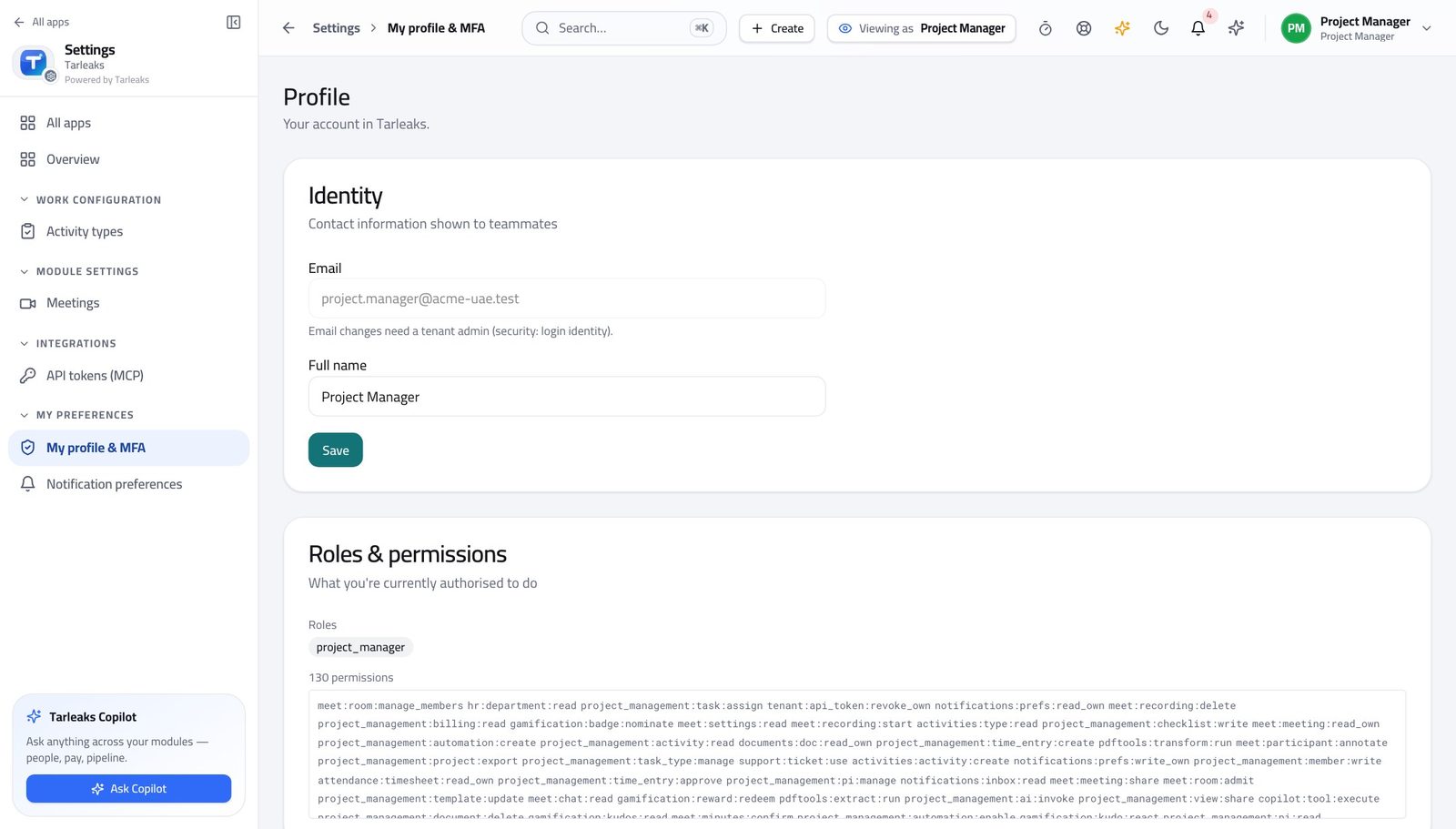
You should see It lists the project-manager role. Projects, sprints, dependencies, staffing, hours and the money on a project are yours. The company's settings and the audit trail are not.
Watch out If the project-manager role is not listed, nothing below will match what you see. Ask your administrator before you start planning.
Worth knowing If the role here is not what you expected, stop and ask your administrator before you start planning anything.
See every project on one screen #
Where Projects » All projects
- From the launcher, click the Projects tile.
- Read state, health, progress and due date on each card.
- Type part of a name in the search box to narrow the list.
- Use the status filter for Active, Planning, On hold, Completed or Cancelled.
- Copy the web address to send somebody the exact list you are looking at.
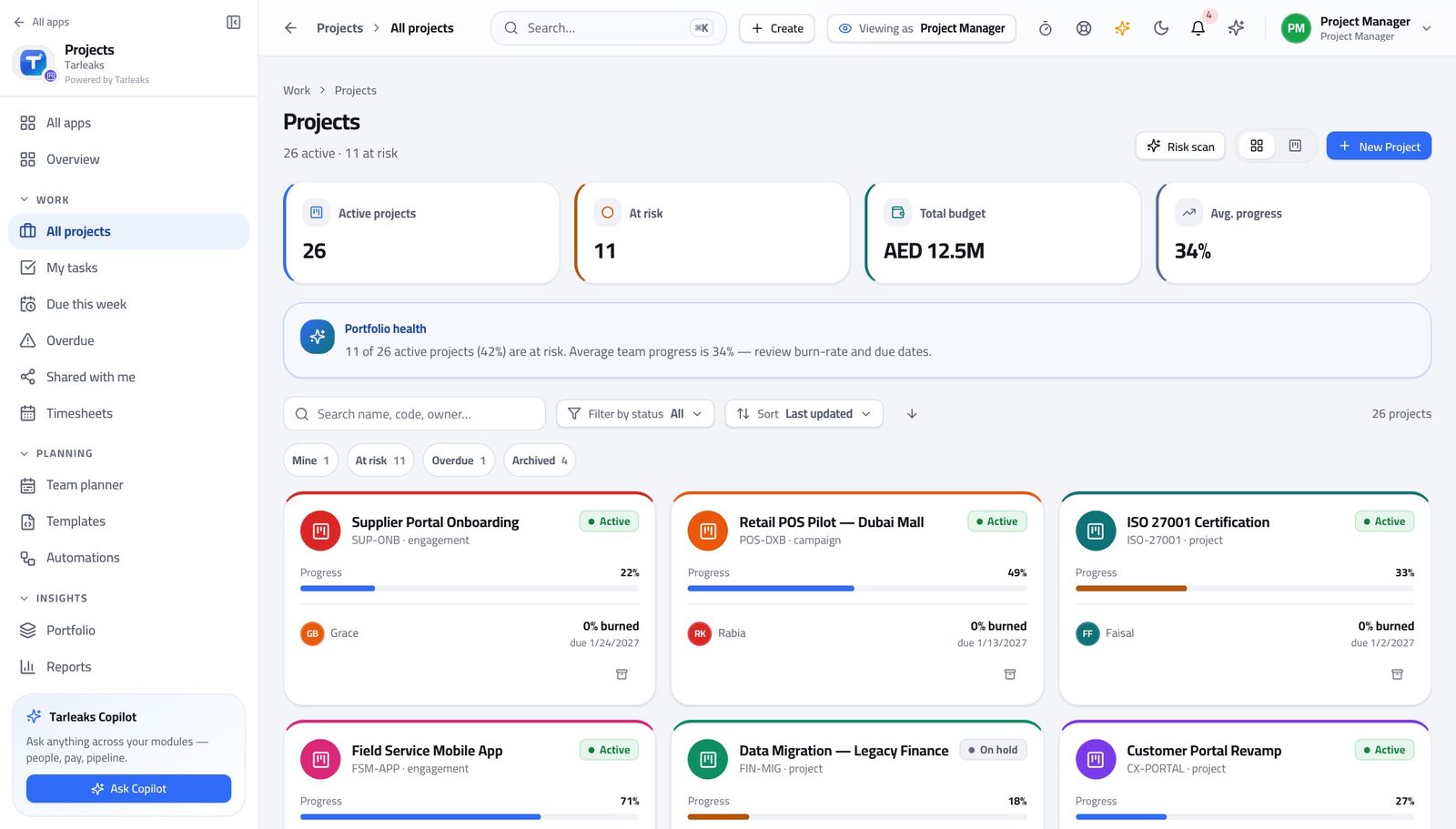
You should see One list, with the four things that decide what you open first: how far along it is, whether it is on track, when it is due, and who owns it.
Watch out A project sitting at the same progress for three weeks usually has work that was never broken into items, not a team that stopped.
Worth knowing Sorting defaults to what moved most recently rather than alphabetically — the project that changed today is almost always the one you wanted.
Start a project from a way of working #
Where Projects » All projects » New project
- Click New project.
- Choose the way of working — each one says what it is for.
- Start from a template, or choose a blank project.
- Press Continue, then name it and choose the work-item types.
- Read the You'll get panel, then Create project.
| Field | What to put in it |
|---|---|
| Name | What people will call it in conversation — not a code. |
| Way of working | Simple, Kanban, Scrum, Waterfall or SAFe. This decides which tabs the project has. |
| Work item types | The ladder the project uses: epic, feature, story, task — or your own words. |
| Template | Optional. A blueprint that creates the stages and the first tasks for you. |
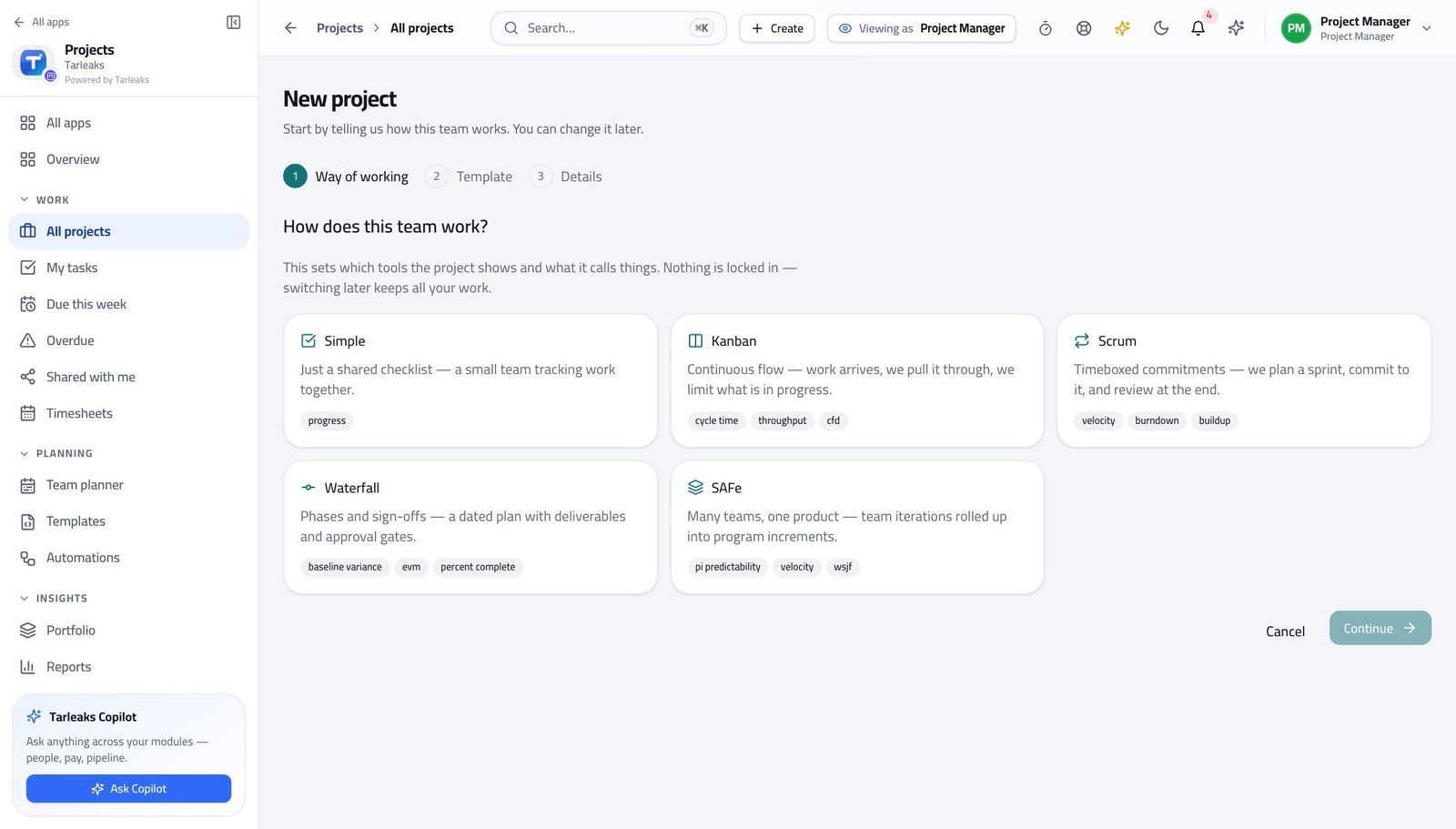
You should see The method is not decoration: it decides which tabs the project has. Scrum gives you sprints and a backlog; Waterfall gives you a timeline, baselines, approvals and a budget.
Watch out Choosing Scrum for a project with no sprints gives you an empty backlog and a burndown of nothing. Pick the method the team actually works to.
Worth knowing Pick Simple if you are not sure. Changing the method later is one setting, and nothing you have already created is lost.
Work a project on its board #
Where Projects » a project » Board
- Open a project from the list.
- The board opens on its stages.
- Drag a card to the next column, or open it and change it there.
- Use Group by to arrange the same cards by assignee, priority or epic.
- Add stage adds a column; Add task adds a card to one.
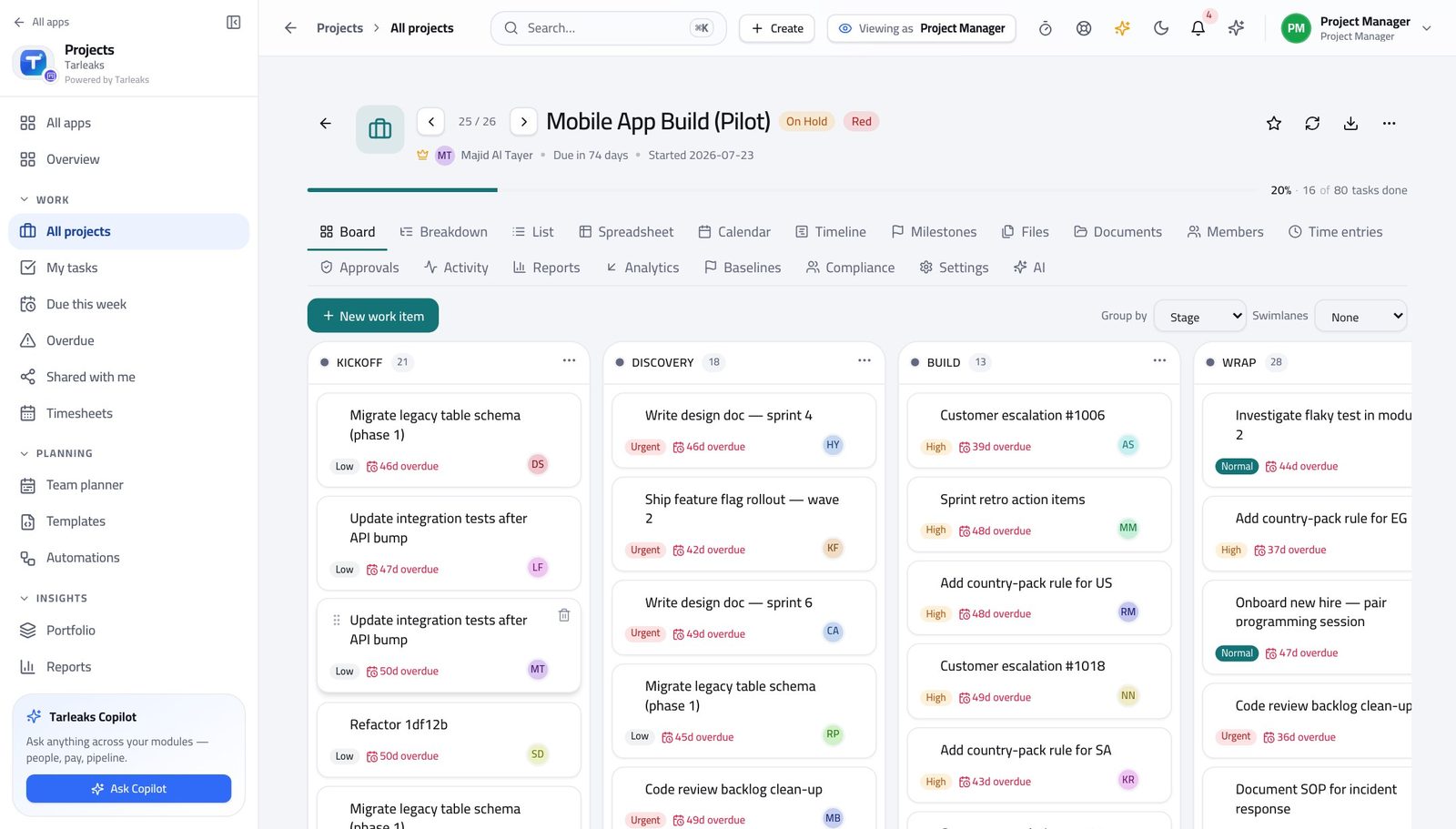
You should see The board is the plan. Moving a card IS the status update, which is why there is nothing to write up afterwards.
Watch out If a column is full and the next is empty, that is a bottleneck rather than a busy team — and it is the one thing the board tells you that a report will not.
Worth knowing A column filling up while the next one stays empty is a bottleneck, not a busy team. That is the single most useful thing on this screen.
Read the whole portfolio at once #
Where Projects » Portfolio
- Open Portfolio.
- Read projects in view, total budget, open and overdue work.
- Pick a programme to chart its roadmap.
- Turn on Include standalone projects to see the ones outside any programme.
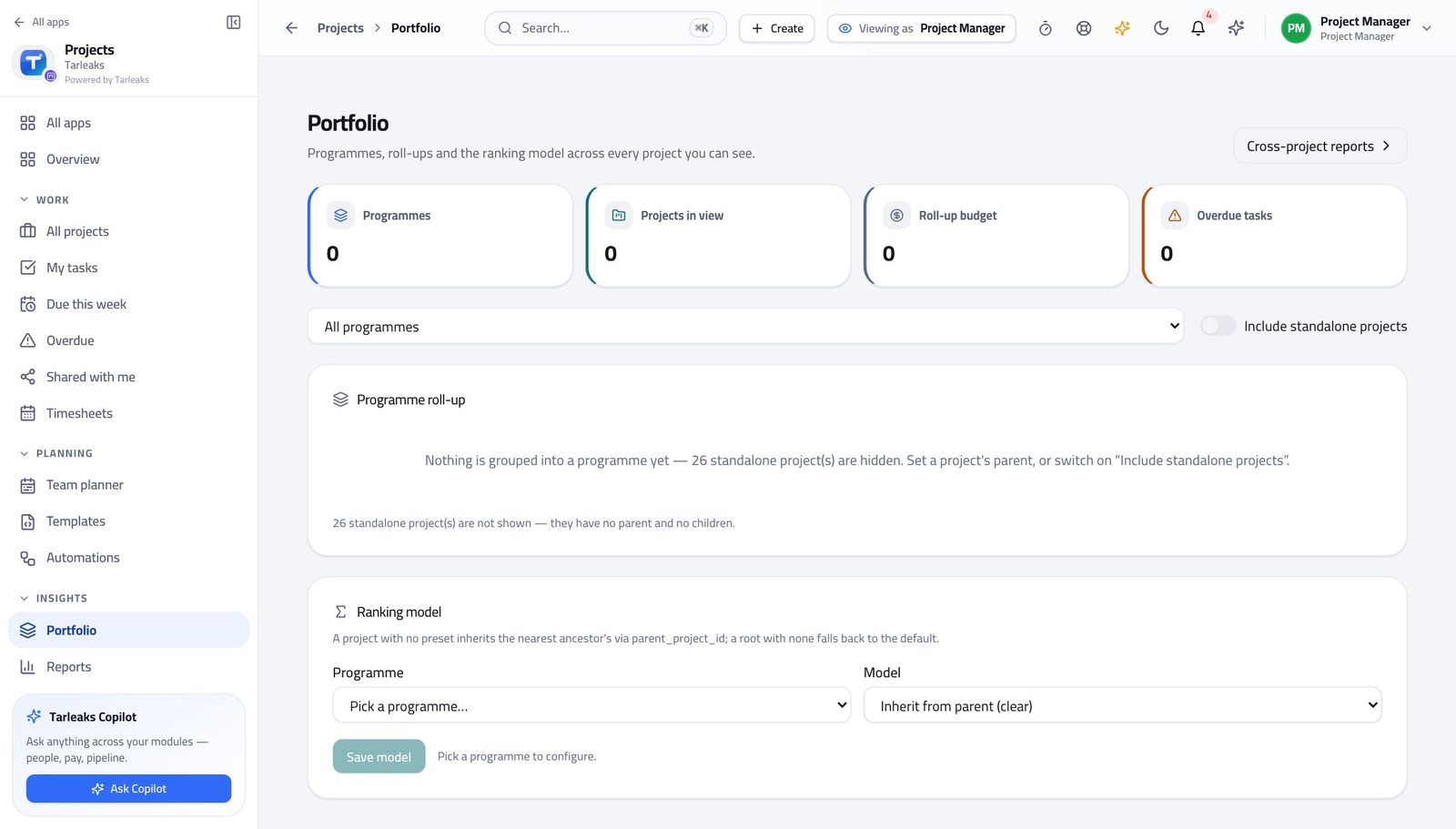
You should see You can answer 'how are we doing' without opening six projects and adding them up yourself.
Watch out A green programme made of amber projects is arithmetic, not comfort. Open the ones that are amber.
Get the numbers without building them #
Where Projects » Reports
- Open Reports.
- Choose the period: last 7, 30 or 90 days, or a custom range.
- Scope it to one project, or leave it across all of them.
- Read delivery trend, status distribution and throughput by week.
- Use Customize to hide the sections you never read.
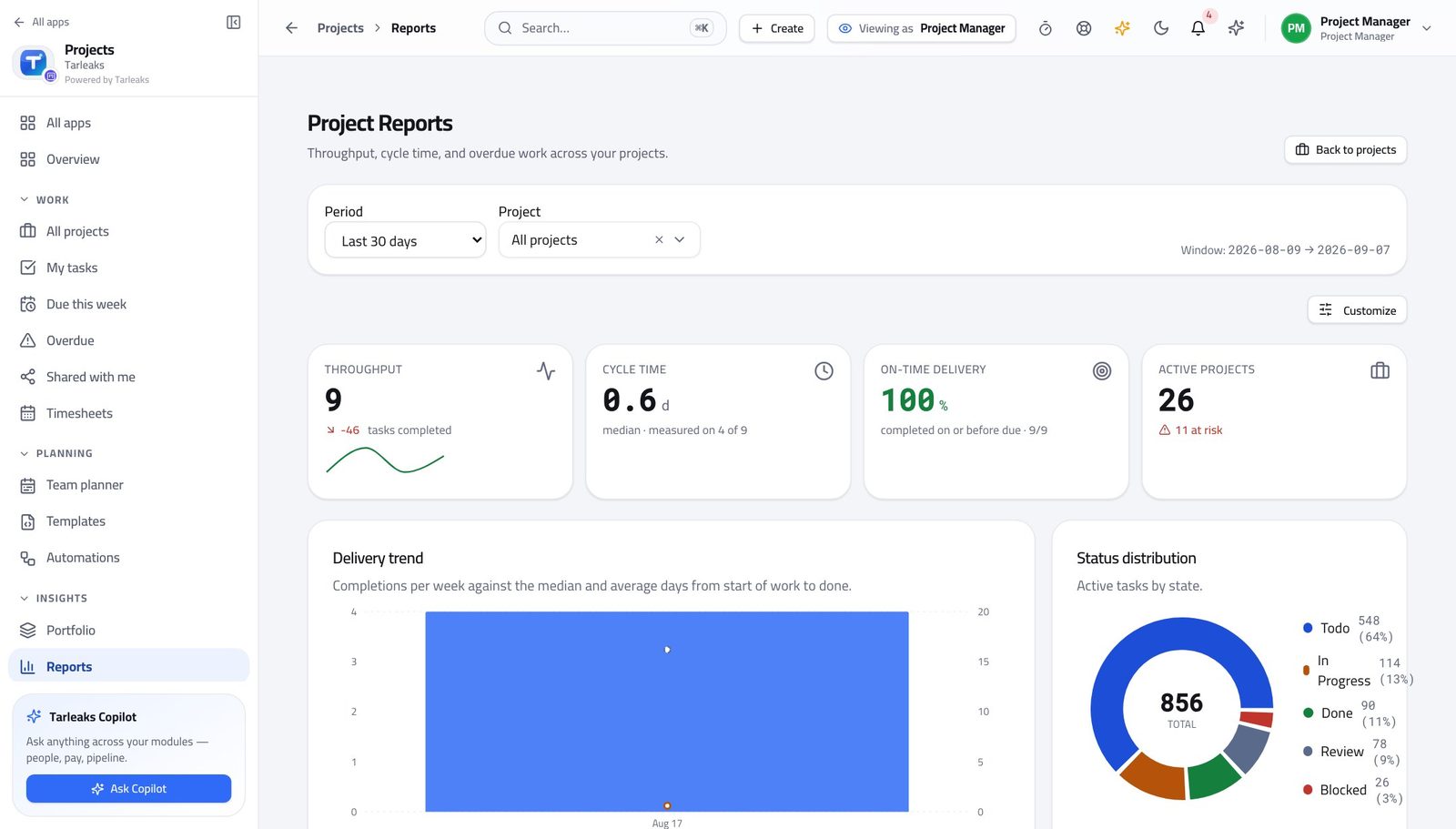
You should see Every figure is computed from the tasks, so the report cannot disagree with the board your team is looking at.
Watch out A throughput spike is usually a batch of items closed at once rather than work finished at once. Check the dates before you celebrate.
Worth knowing Cycle time answers 'how long does work take once we start it', which is a far better planning number than how many tasks are open.
Approve the team's hours #
Where Projects » a project » Time entries
- Open the project, then its Time entries tab.
- Read the date, the task, the hours, billable and the rate.
- Press Approve on a submitted row, or Reject and say why.
| Field | What to put in it |
|---|---|
| Hours | What was actually worked, against one task, on one day. |
| Task | Which piece of work the hours belong to — this is what makes project cost real. |
| Billable | Whether the customer sees these hours. Getting this wrong is an invoice conversation later. |
| Rate | What the hour is charged at. Blank means the project's default. |
| Description | Only when something needs explaining; the task carries the rest. |
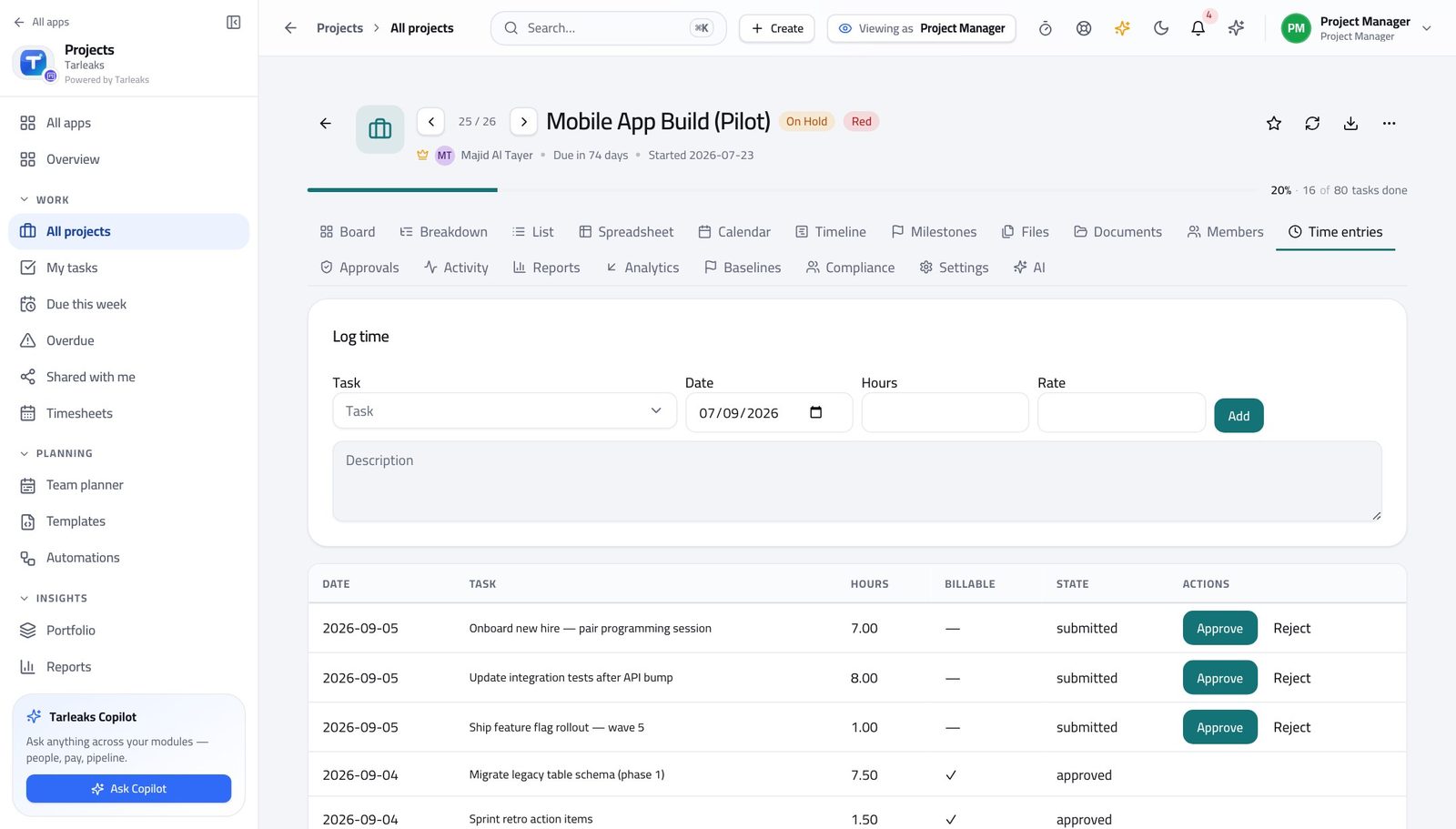
You should see Approved hours are what project cost, utilisation and any invoice are built from. Hours nobody approved are counted nowhere.
Watch out Approving hours you have not read is how a project's cost stops meaning anything — and it is your name on the approval.
Worth knowing Hours are approved on the project, not on the Timesheets page — Timesheets is where a person logs their own week.
See what lands this week #
Where Projects » Due this week
- Open Due this week.
- Press Everyone to widen it past your own work.
- Click a title to open the item without leaving the list.
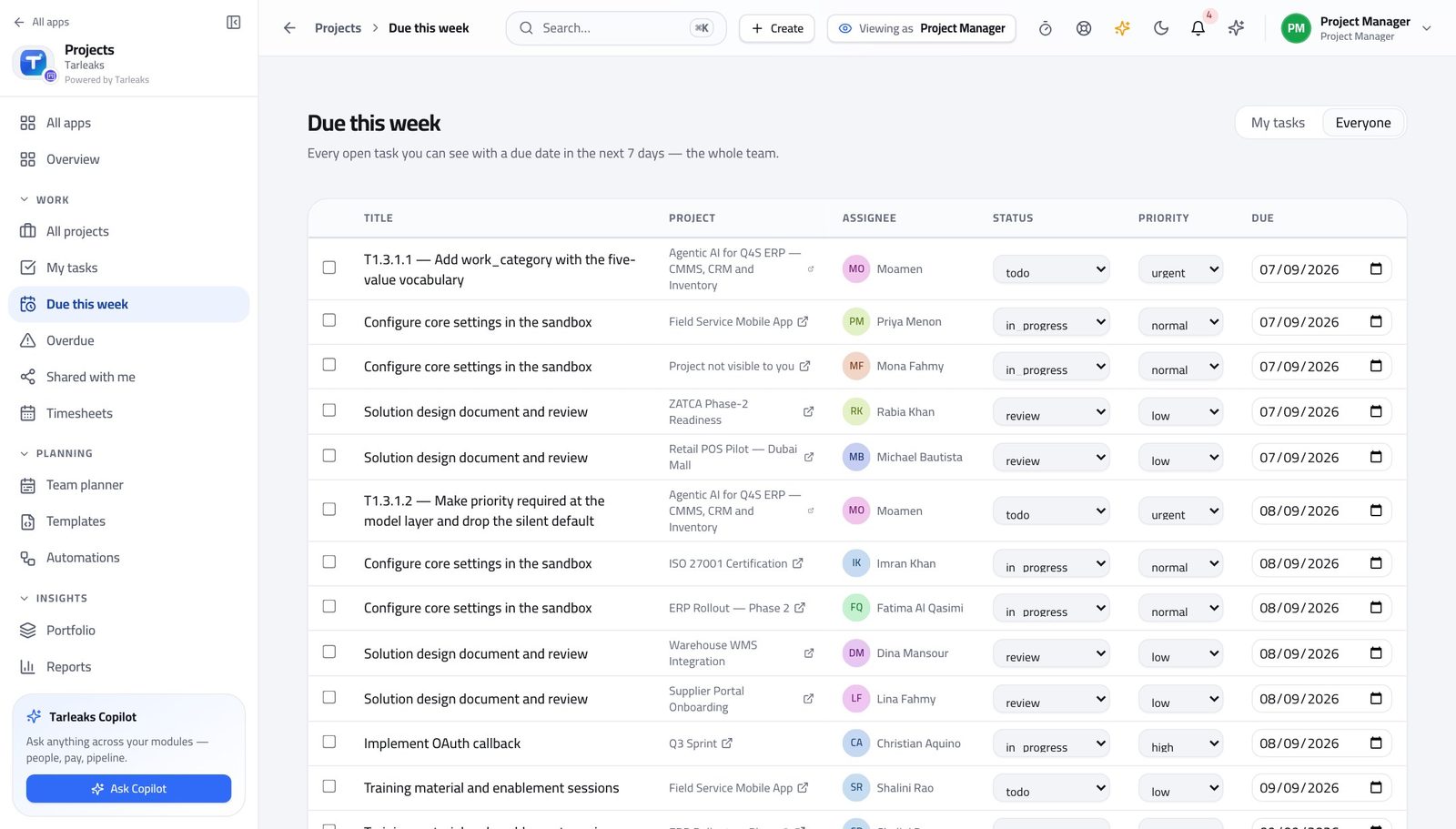
You should see The week ahead across every project you can see, without opening each one to look for it.
Work down what is already late #
Where Projects » Overdue
- Open Overdue.
- Press Everyone.
- Sort by days overdue and work from the top.
- Open a title, and either move it or change the date deliberately.
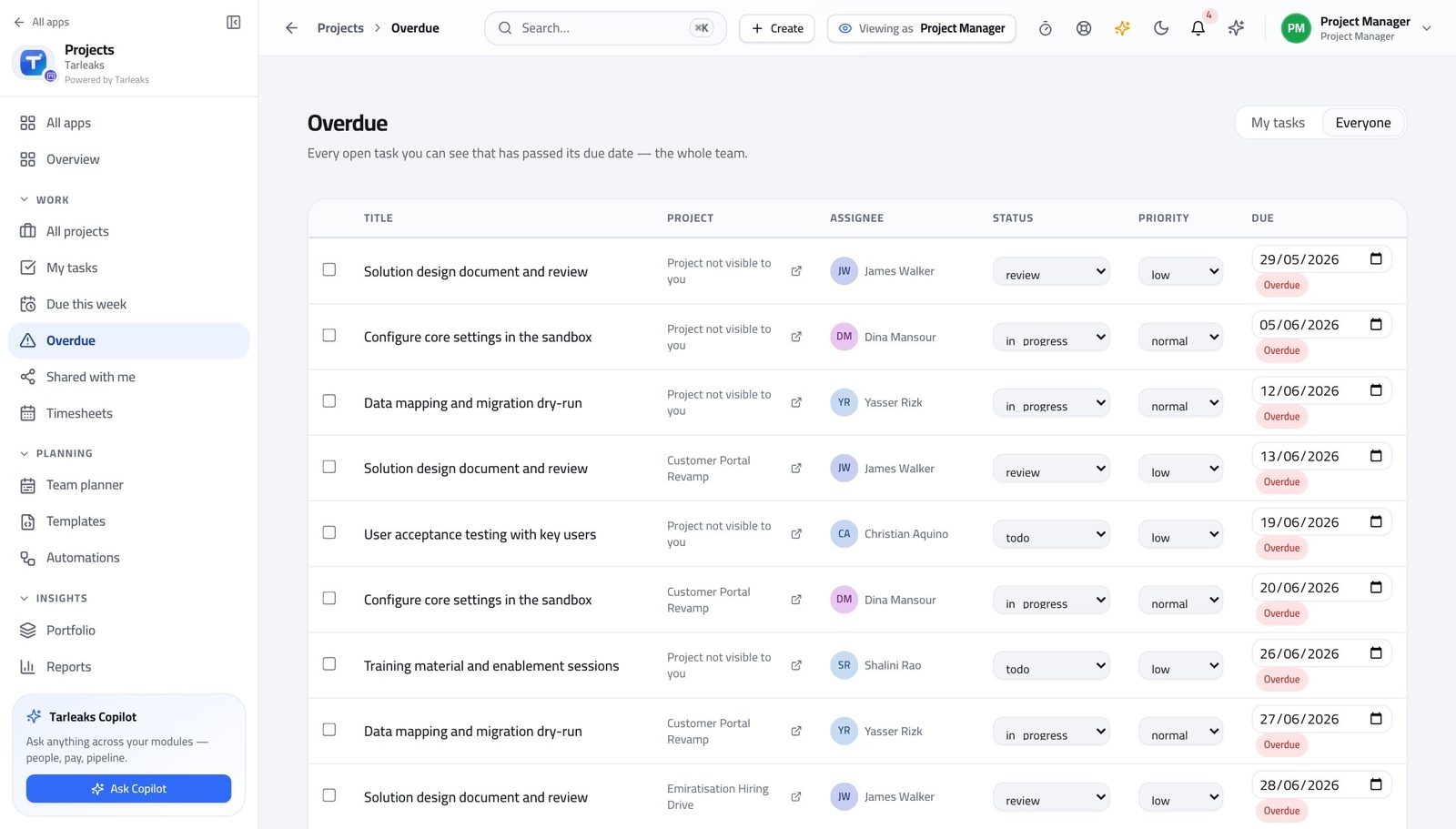
You should see Late work stops being a feeling and becomes a list you can finish.
Watch out Quietly moving a due date is not progress. If the date moves, somebody who was relying on it should hear it from you first.
Worth knowing If the same task is late every week, it is not late — it was never sized. Break it up rather than chasing it again.
Plan, start and close a sprint #
Where Projects » a Scrum project » Sprints
- Open a Scrum project.
- Go to the Sprints tab.
- Add sprint, then set the name and the dates.
- Press Start when it begins.
- Press Close when it ends and choose what happens to unfinished work: roll it over, or send it back to the backlog.
| Field | What to put in it |
|---|---|
| Sprint name | What the team calls it out loud. |
| Start date | The day the sprint actually begins. |
| End date | On or after the start date; the module refuses otherwise. |
| Capacity | How many points the team believes it can finish. Optional, and worth setting once you have two sprints of history. |
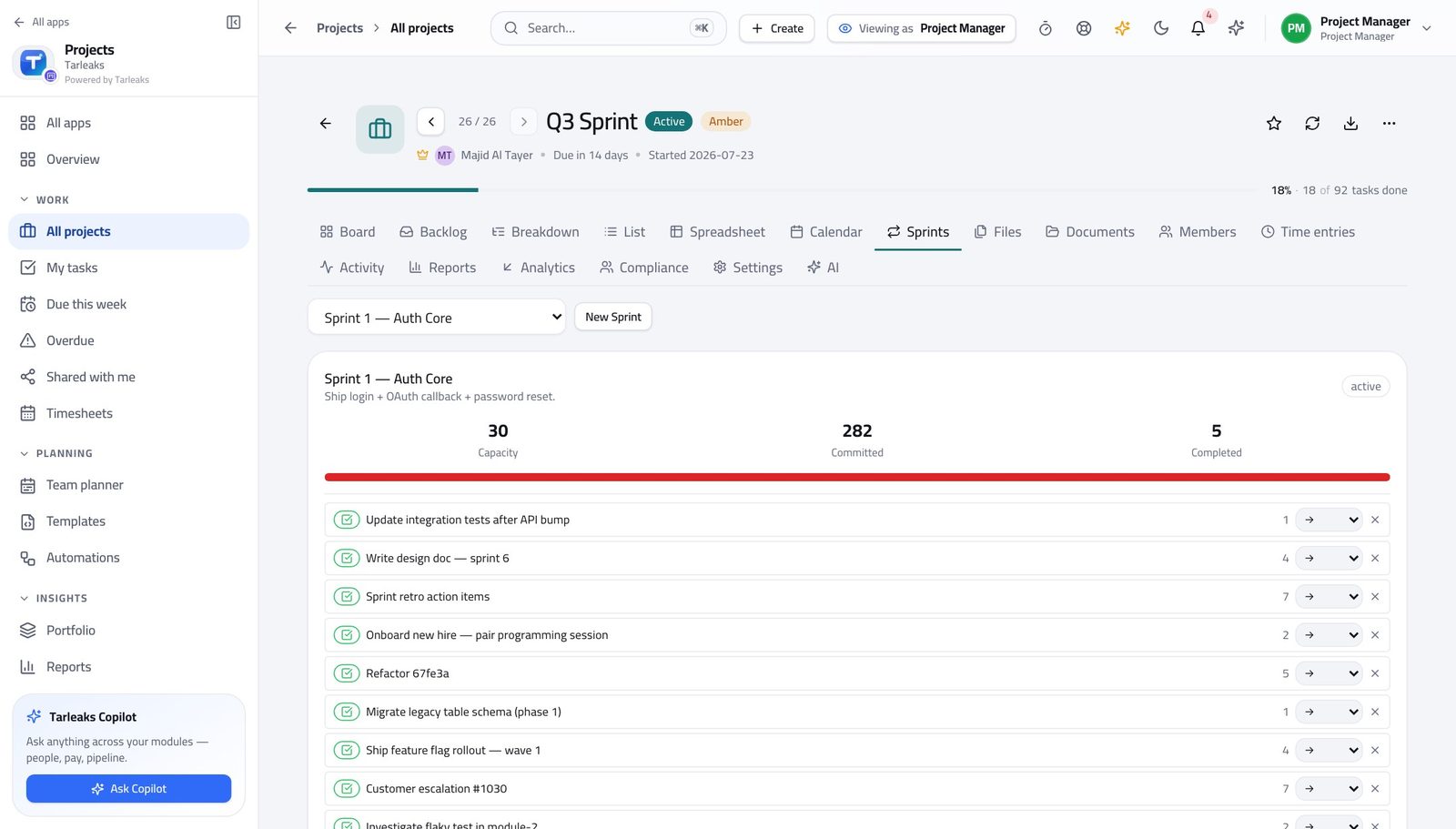
You should see A sprint has a start, an end and a commitment. What did not finish is rolled over deliberately rather than quietly carried.
Watch out Closing a sprint without deciding what happens to unfinished work is how a backlog quietly fills with things nobody chose to keep.
Worth knowing Only projects whose way of working is Scrum or SAFe have this tab. On a Simple project there is nothing to hide — sprints are simply not part of that method.
Give work items their real names #
Where Projects » a project » Settings » Work item types
- Open a project's Settings tab.
- Find the work-item types.
- Read the label, the colour and the level of each.
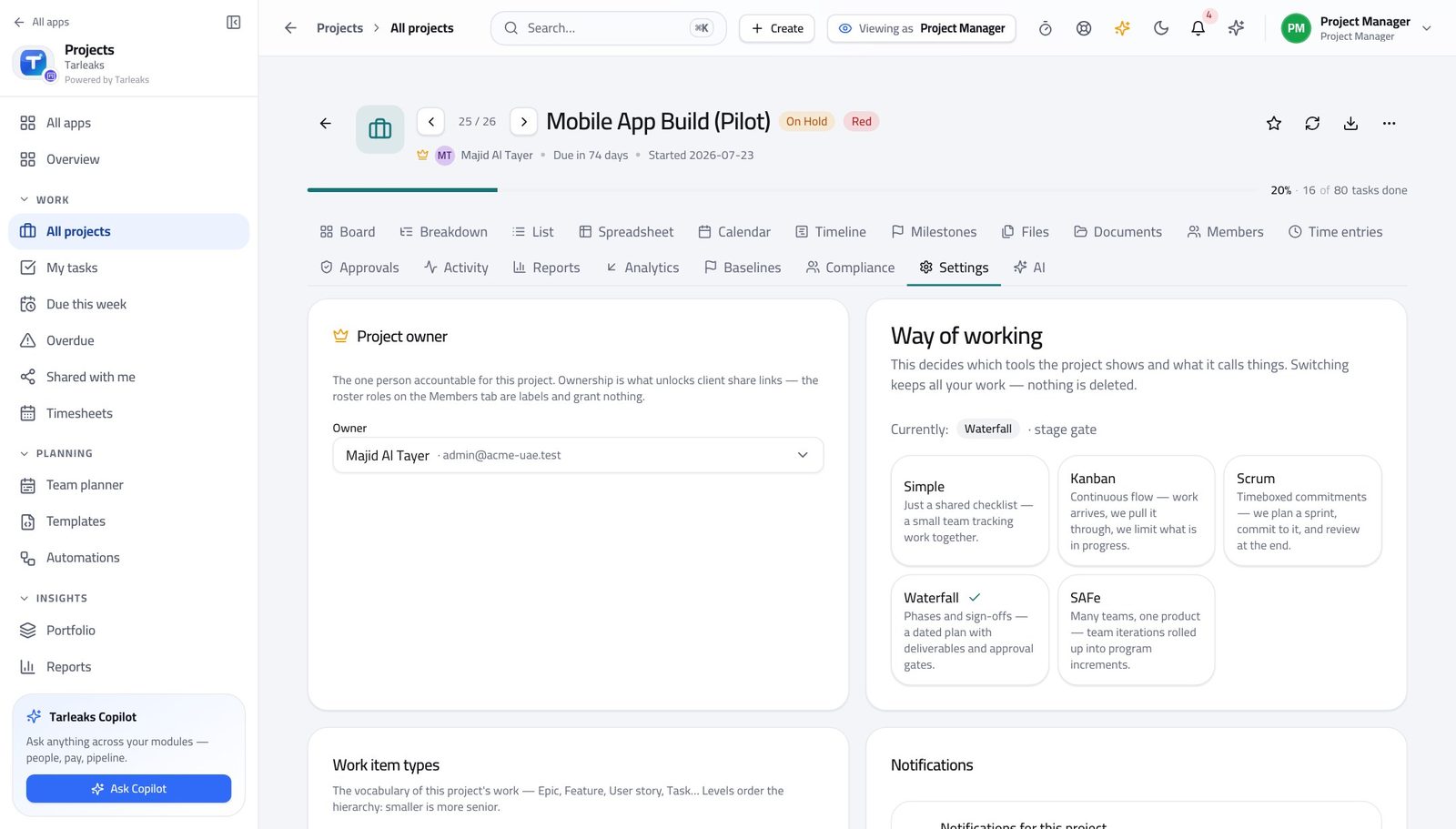
You should see The ladder is real, not a label. That is why a progress roll-up over an epic means something, and why a report can group by epic at all.
Watch out A work item carries two status-shaped things: the state the board moves it through, and the plain word the list shows. They are kept in step for you, but the board's state is the one the rules and the reports act on — so change it on the board, not by editing text.
Worth knowing Two columns on a work item look similar and are not: one is the state the board moves it through, the other is the plain word the list shows. The board's state is the one the rules act on.
See the plan, and what the plan depends on #
Where Projects » a project » Timeline
- Open the project's Timeline tab.
- Drag a bar's edge to change dates.
- Drag from one bar to another to link a dependency.
- Click a link to remove it.
- Use Zoom to move between days and months.
- Capture baseline freezes today's plan.
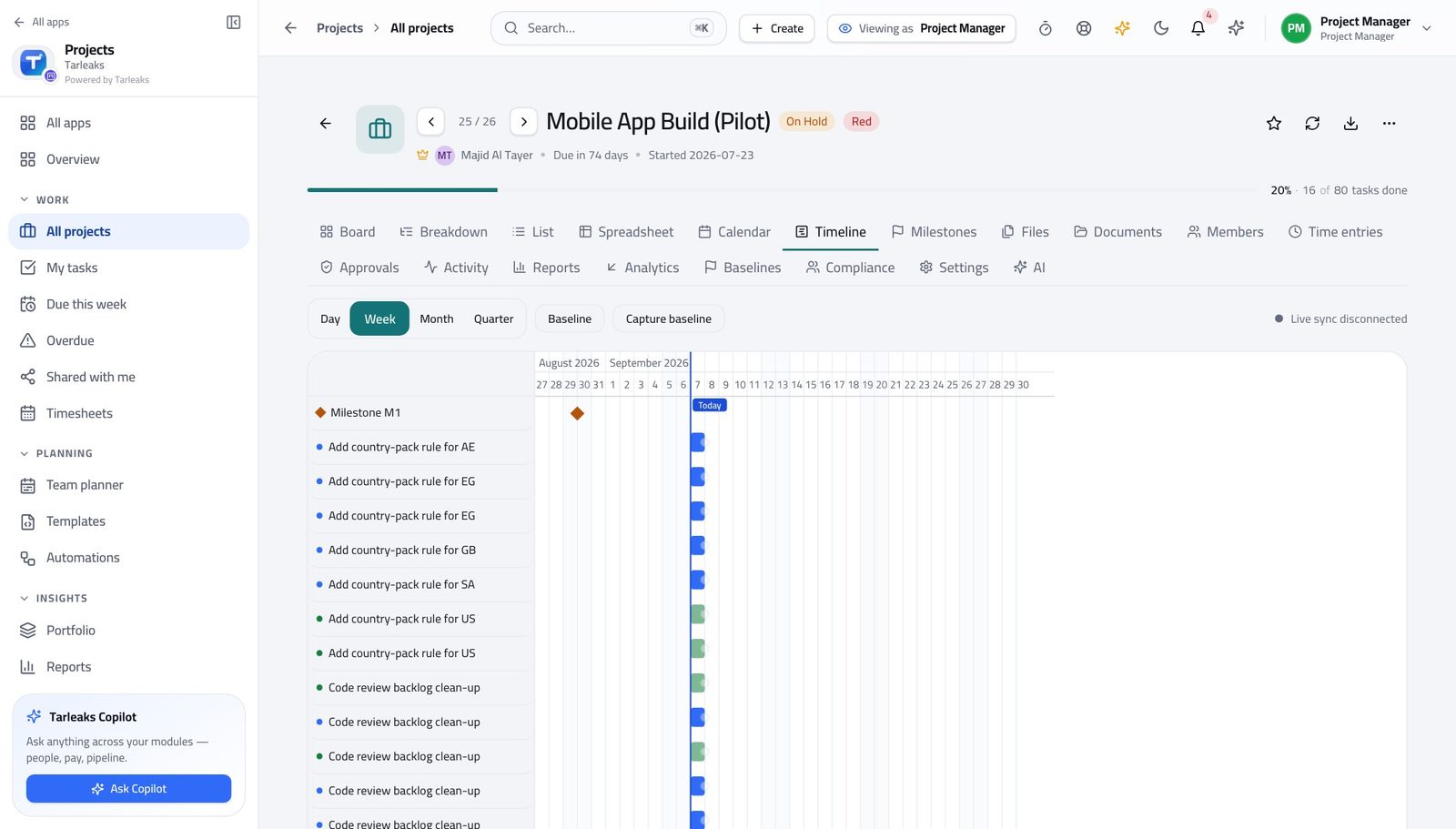
You should see Slack and the critical path are worked out from the links you drew, so a slipped task shows you what it takes with it.
Watch out Only Waterfall and SAFe projects have this tab. On Scrum, the sprint is the plan and the timeline would be a second, competing one.
Worth knowing Capture baseline on this screen freezes today's plan. Do it when the plan is agreed, not when it starts going wrong.
Compare today's plan against the plan you agreed #
Where Projects » a project » Baselines
- Open the Baselines tab.
- Pick a baseline and compare it against today.
- Read what moved, item by item.
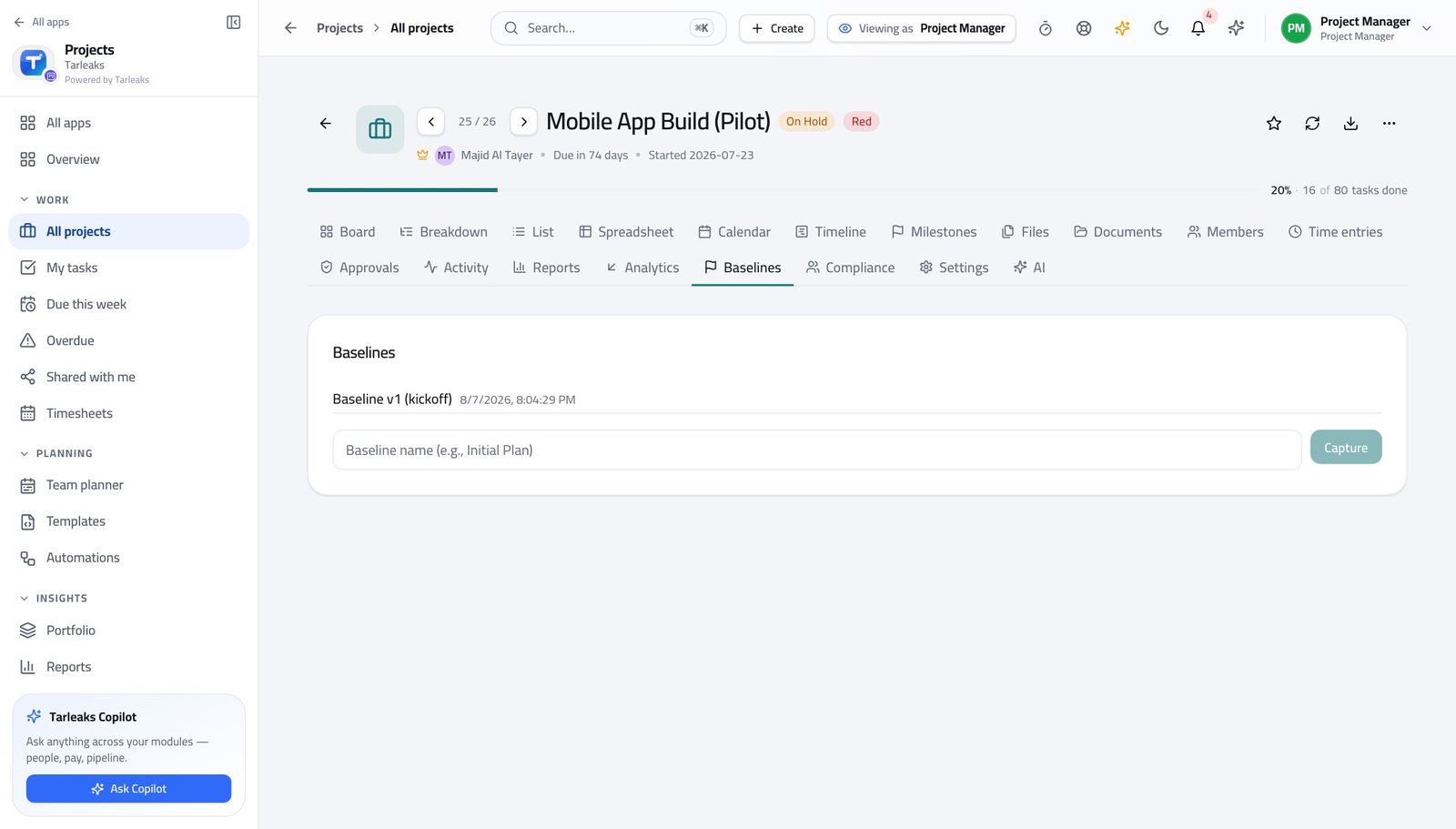
You should see A baseline is the difference between 'we are three weeks late' and 'we are three weeks later than the plan everyone signed'.
Watch out Capture the baseline when the plan is agreed. Capturing it after things slip records the slip as the plan.
Check whether progress matches the spend #
Where Projects » a project » Analytics
- Open the project's Analytics tab.
- Read what the plan said should be done by now, what actually is, and what it cost.
- Read the schedule and cost indexes beside them.
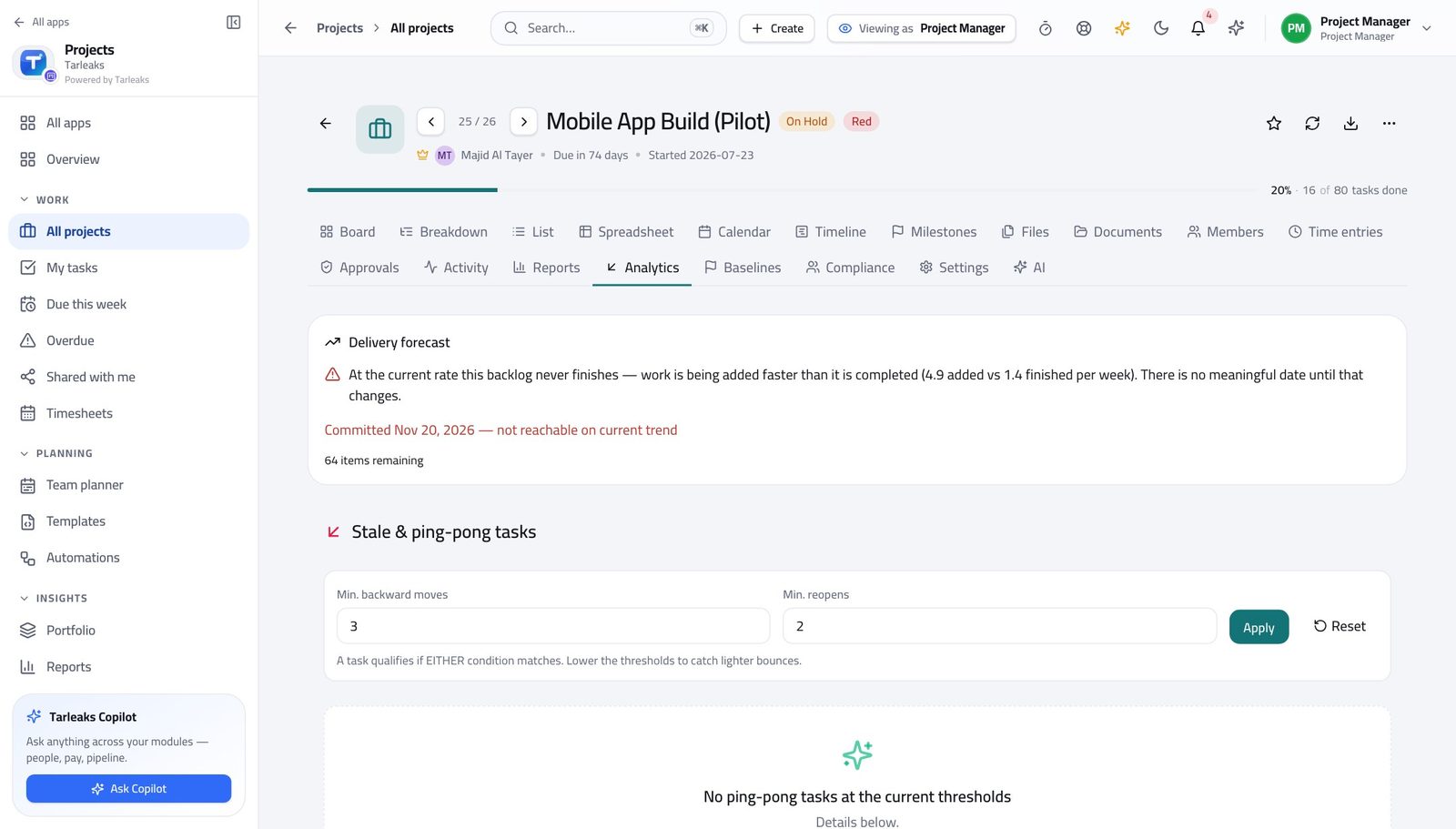
You should see Below one, the project is behind or over. It is arithmetic on the plan and the tasks, not an opinion collected in a meeting.
Watch out These need a budget and dated work to say anything. On a project with neither they are honest about it rather than inventing a number.
Worth knowing Earned value needs a budget and dated work. On a project with neither, the figures are honest about having nothing to say.
Give a date range instead of a promise #
Where Projects » a project » Analytics
- Stay on Analytics.
- Read the completion forecast and its confidence levels.
- Compare the earliest date with the safest one.
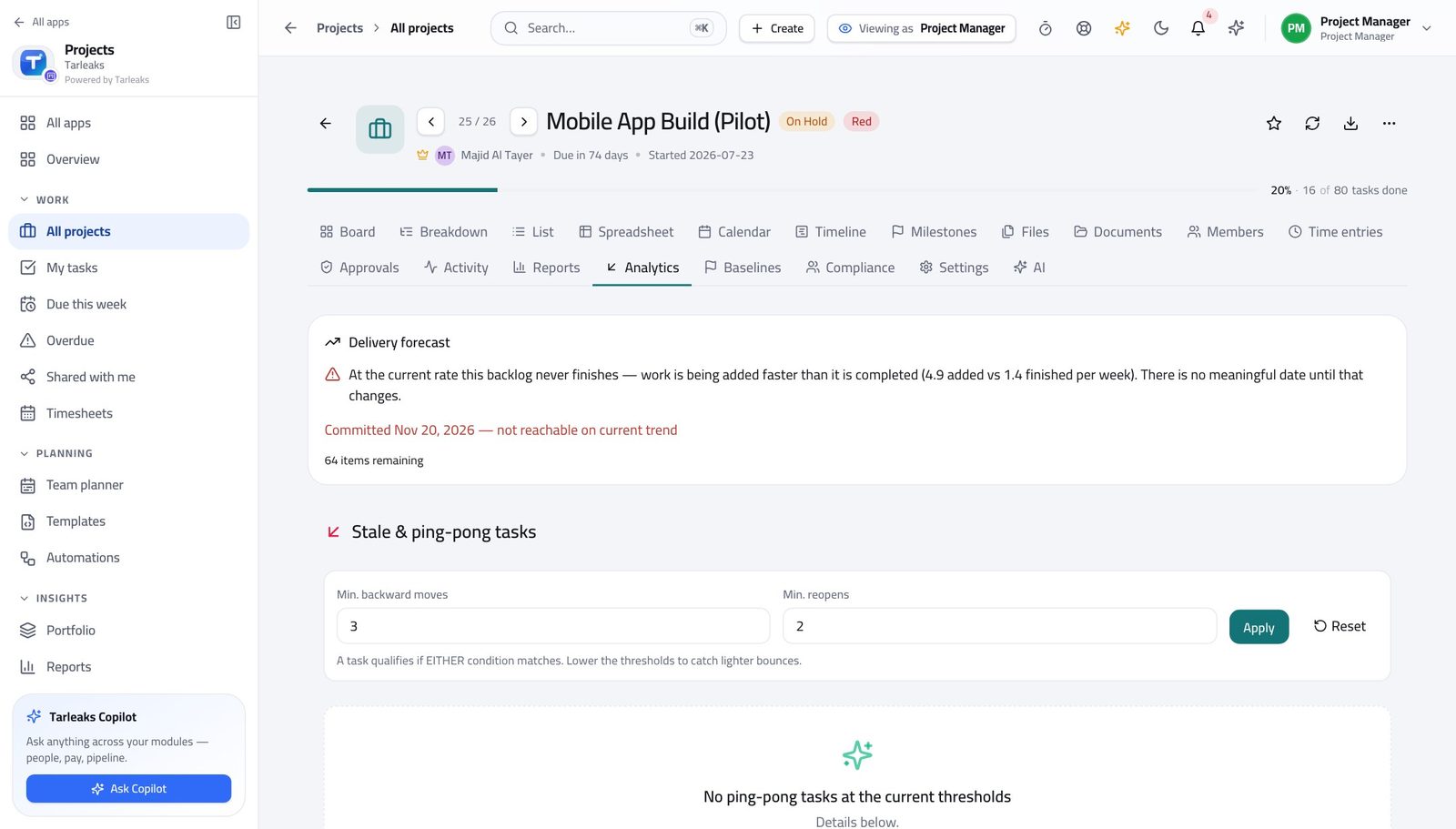
You should see A range you can defend beats a single date you cannot. This is the number to take into a steering meeting.
Watch out A forecast years out is not a broken chart — it is a project closing almost nothing per week. Fix the flow, then look again.
Worth knowing A forecast years away is not a broken forecast — it is a project closing almost nothing per week. Fix the flow, not the chart.
See who is over, before they tell you #
Where Projects » Team planner
- Open Team planner.
- People are rows, days are columns.
- Drag a task to another person to reassign it, or to another day to reschedule it.
- Then open Reports and read utilisation.
| Field | What to put in it |
|---|---|
| Basis | What the week is measured against — working days times hours per day, minus approved leave. |
| Task title | What the new task is called when you add one from here. |
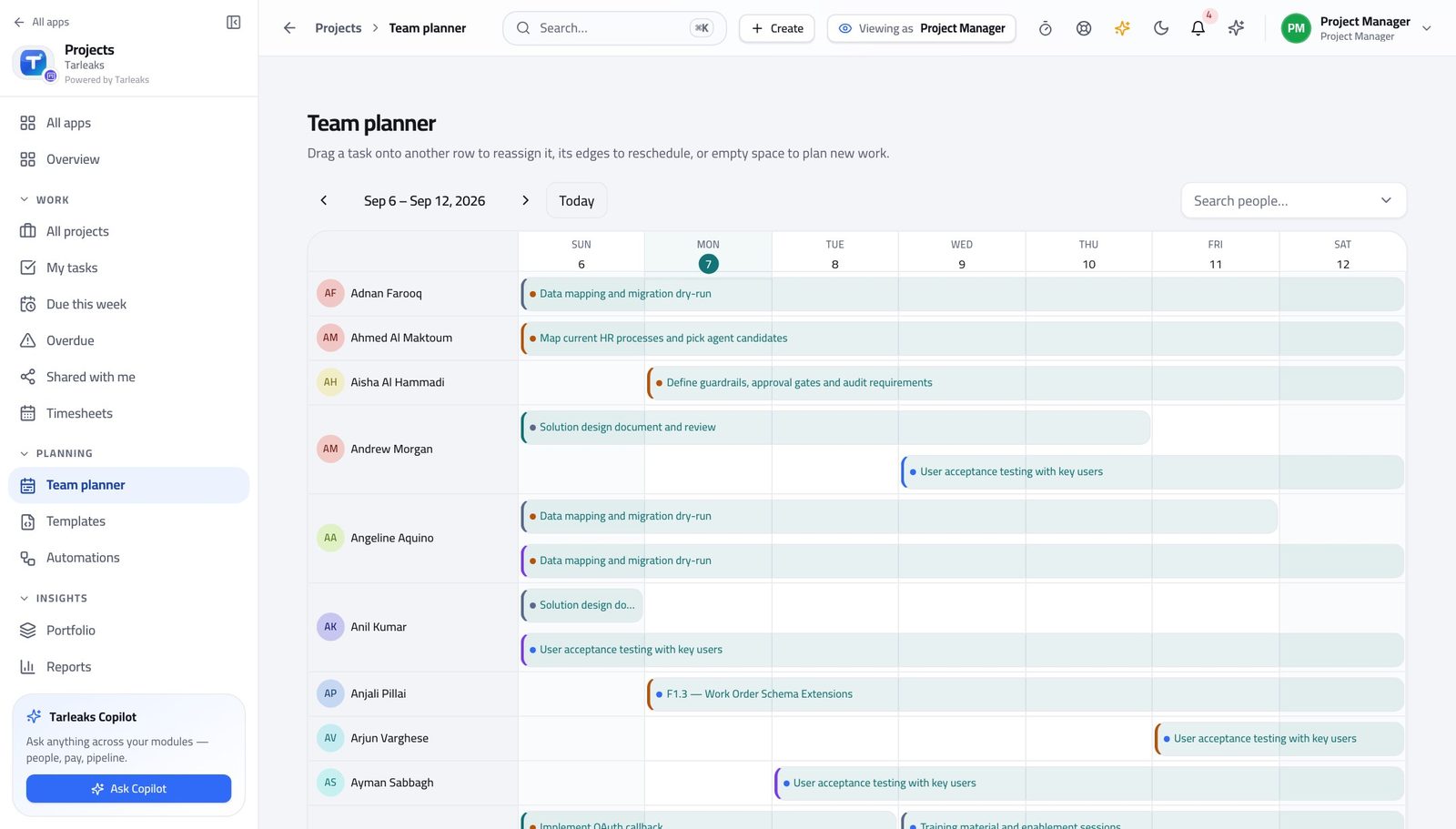
You should see Load becomes a number per person and per period, so 'everyone is busy' turns into something you can act on.
Watch out Dragging a task changes its dates. If somebody was relying on the old one, tell them rather than letting the board tell them.
Worth knowing The planner reschedules by dragging, which also moves the task's dates. If a date matters to somebody else, say so before you drag.
Read what is waiting on a decision #
Where Projects » a project » Approvals
- Open the project's Approvals tab.
- Read what is waiting: a milestone, a budget, a baseline or a contract.
- Approve or Reject, and put the reason in the notes.
| Field | What to put in it |
|---|---|
| Notes | Why you decided what you decided. This is the field an auditor reads, and the one you will want in six months. |
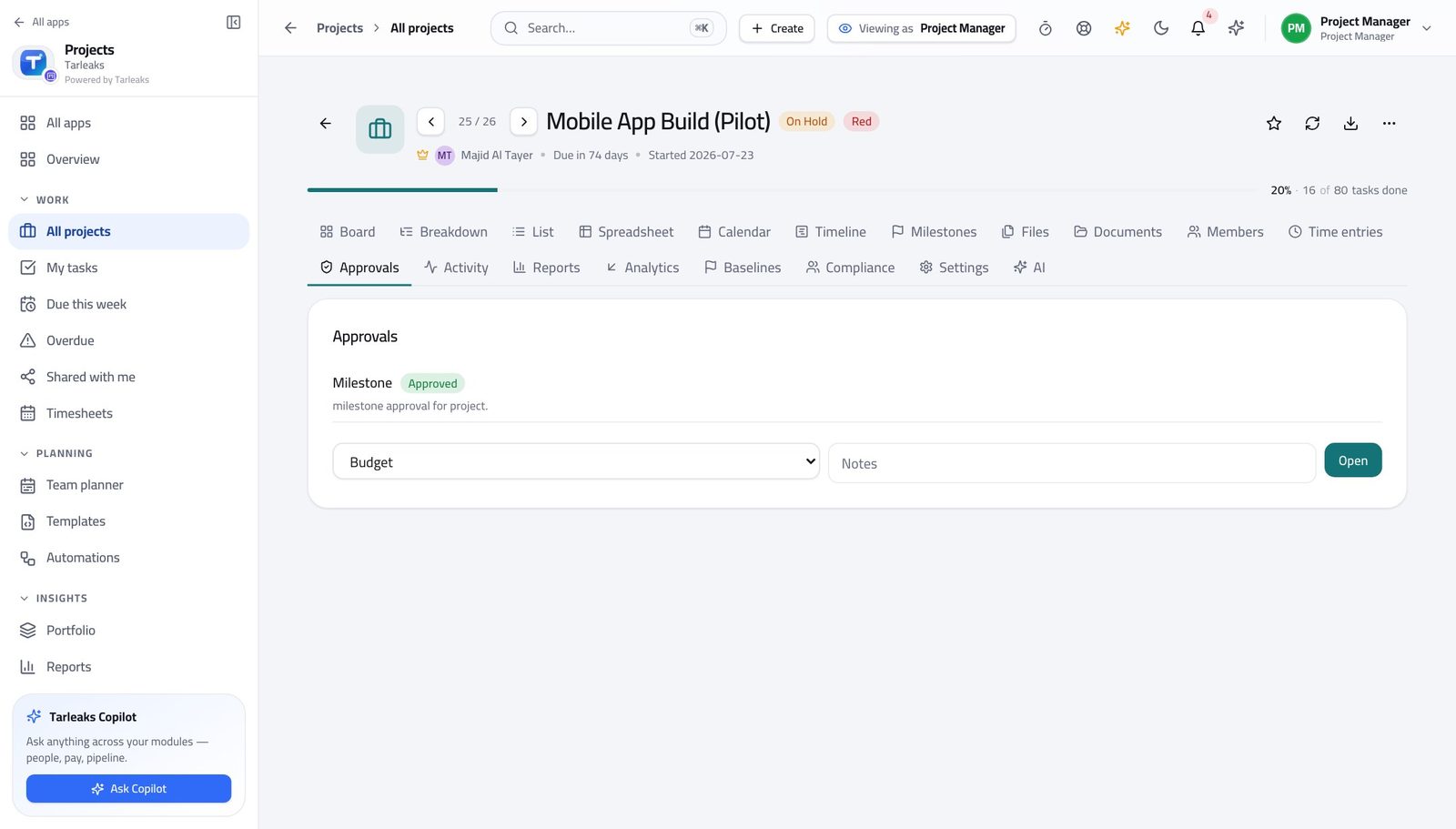
You should see A gate somebody has to pass is a record with a date and a name on it, not an e-mail somebody has to find later.
Watch out Rejecting without a note leaves the person guessing, and leaves you with no record of the reason.
The company-wide audit trail is not yours #
Where Settings » Audit log
- Ask for Settings, then the Audit log.
- Read the message.
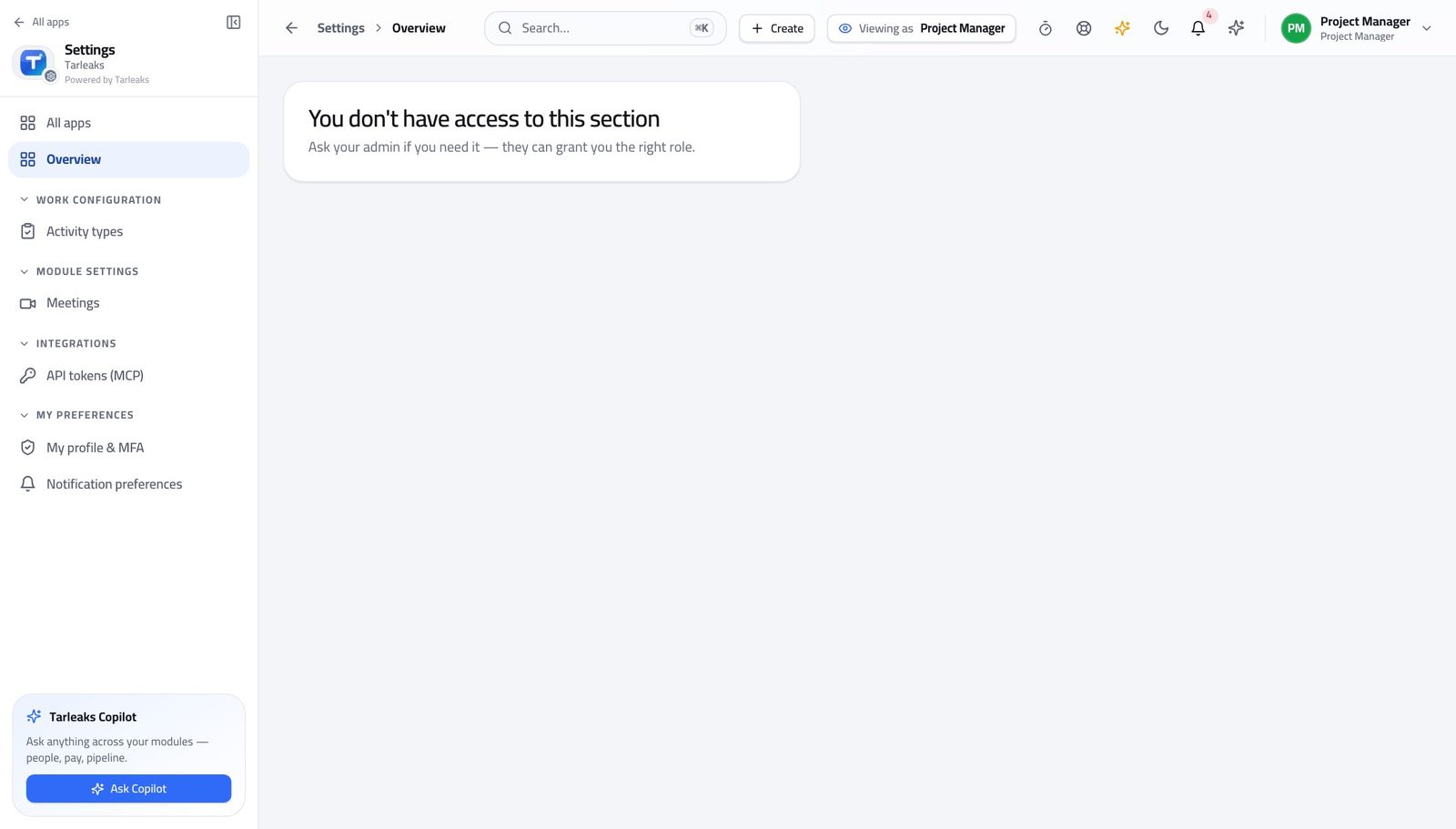
You should see Who-changed-what across the whole company belongs to your administrator. That boundary is what keeps a delivery role a delivery role — and it is the same boundary that makes your own approvals worth something.
Watch out This is not a bug to route around. The project's own Activity tab gives you everything that happened on YOUR project — it is the company-wide trail that is somebody else's.
Worth knowing You still see everything that happened on a project: its Activity tab is the project's own history, and it is open to you.
Use cases — the work, step by step
Each one is a sequence somebody actually performs, with the screen behind every step. Every screen here was opened in the product as this role before it was published.
weeklyRun the week: board, blockers, hours #
Four screens replace the status meeting — and they are the same data the team is working in, so nothing has to be assembled.
Open the project's board and look for a column that is filling up while the next one stays empty. That is the bottleneck, and it is the one thing a report will not tell you.
Projects » a project » Board — verified: the page says “Board”; no “Project not found” anywhere on the page Check what lands in the next seven days across every project you can see — press Everyone to widen it past your own work.
Projects » Due this week — verified: the page says “Due this week”; no “Nothing due this week” anywhere on the page Work down what is already late, oldest first. If a task is late every week it was never sized; break it up rather than chasing it again.
Projects » Overdue — verified: the page says “Overdue”; no “Nothing overdue” anywhere on the page Approve the team's submitted hours on the project, or reject them with a reason. These hours become the project's cost, and your name is on the approval.
Projects » a project » Time entries — verified: the page says “Hours”; the page says “Billable”
monthlyAnswer 'how are we doing' in two minutes #
Every figure is computed from the tasks, so the answer you give matches the board somebody else can open while you are still talking.
Open the portfolio and read progress, budget and health across projects rather than one at a time.
Projects » Portfolio — verified: the page says “Portfolio”; no “No projects are visible to you here” anywhere on the page Open Reports for the project that looks worst: delivery trend, status distribution, throughput by week.
Projects » Reports — verified: the page says “Throughput”; the page says “Cycle time” Check whether the progress matches the spend — the earned value figures say which of the two problems you have.
Projects » a project » Analytics — verified: the page says “Analytics” Generate the status report from the project itself, read the highlights, risks and asks it assembled, then share it. You are editing a draft, not writing a document.
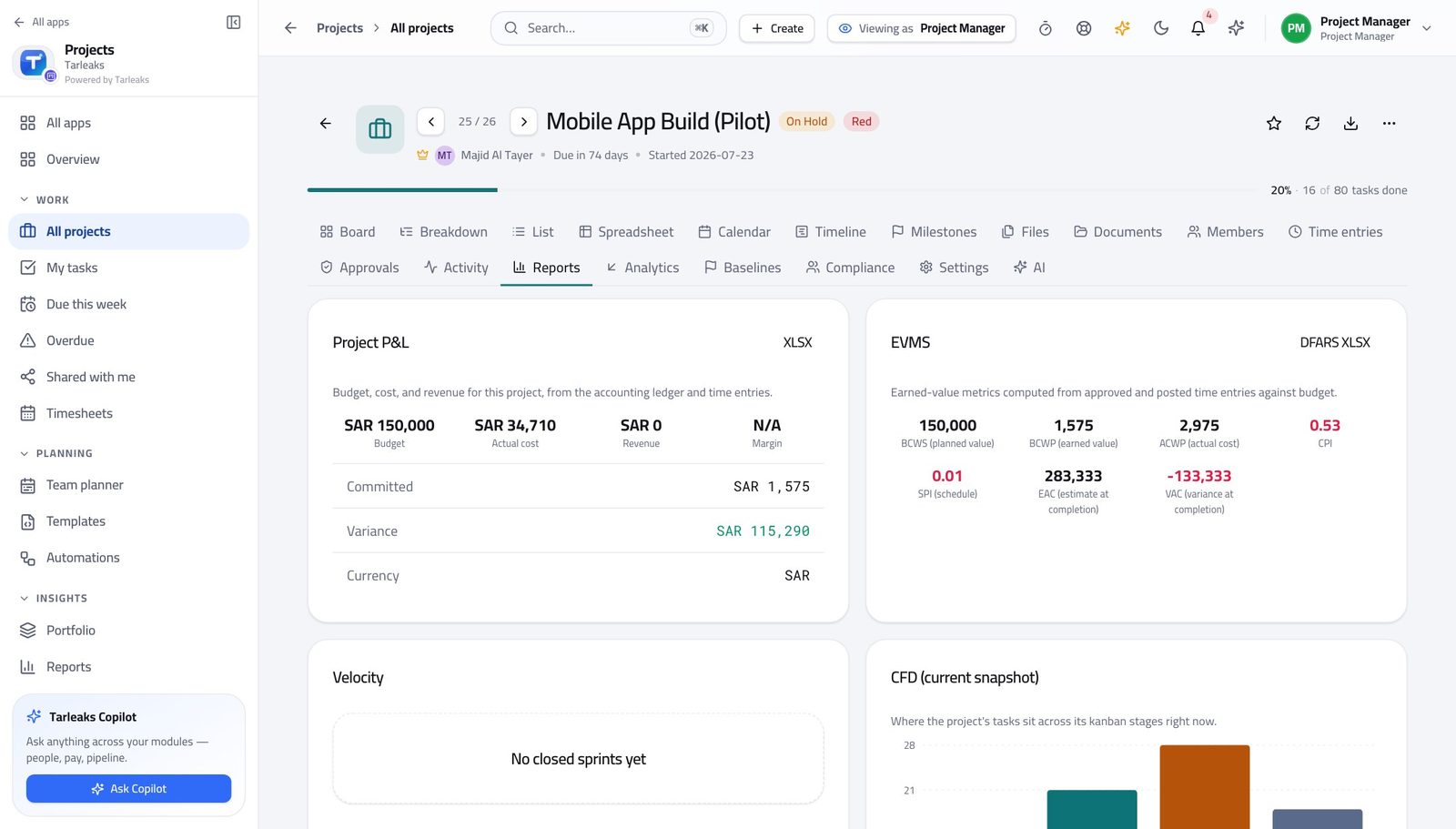
Projects » a project » Reports — verified: the page says “Status reports”; the page says “Generate report”
weeklyRun a sprint from planning to close #
A sprint is a commitment with a start and an end. What did not finish should be rolled over deliberately, not carried quietly into the next one.
Open the Scrum project's Sprints tab and add the next sprint with its dates. The end date must be on or after the start date; the module refuses otherwise.
Projects » a Scrum project » Sprints — verified: the page says “Sprints”; no “Project not found” anywhere on the page Check the work items have the right type before you commit them — a story that is really an epic will never finish inside one sprint.
Projects » a project » Settings » Work item types — verified: the page says “Work item types” Mid-sprint, read the board rather than asking for an update. Cards that have not moved in three days are the conversation.
Projects » a project » Board — verified: the page says “Board”; no “Project not found” anywhere on the page At the end, read throughput and cycle time for the period. Velocity that swings wildly is usually inconsistent sizing rather than an inconsistent team.
Projects » Reports — verified: the page says “Throughput”; the page says “Cycle time”
urgentA project is slipping and somebody wants a date #
You can answer with evidence in about five minutes: what the plan said, what actually happened, what it is costing, and the range you can honestly commit to.
Start on the timeline. The critical path is the chain with no slack in it — everything else can move a little, that chain cannot.
Projects » a project » Timeline — verified: the page says “Timeline”; no “No tasks yet to render” anywhere on the page Compare today's plan against the baseline you captured when the plan was agreed. 'Three weeks late' and 'three weeks later than what everyone signed' are different sentences.
Projects » a project » Baselines — verified: the page says “Baseline” Read the earned-value figures. Behind on schedule and over on cost are two different problems with two different answers.
Projects » a project » Analytics — verified: the page says “Analytics” Give the forecast as a range with its confidence levels, not as a single date. The width of the range is the risk, and it is the honest part of the answer.
Projects » a project » Analytics — verified: the page says “Analytics” Then look at who is over capacity. A slipping project with an overloaded team is a staffing decision, not a planning one.
Projects » Team planner — verified: the page says “Team planner”
The plan, the board and the report are the same data. That is why the report is never out of date and never needs assembling — and why moving a card is the whole status update. What you cannot do is change the company's settings or read the tenant-wide audit trail; those belong to your administrator.