Partners role guides — what each role can do, step by step
How a partner's owner, finance and sales people use the partner portal — the link, deals, clients, commission, statements and payouts — and how the platform's partner team approves partners, pays them and keeps the legal documents current. 45 steps across 4 roles, every one of them carried out in the product before it was published here.
Last updated
Nothing matches that. Try a shorter word, or pick All roles to search every guide.
Go deeper
Partner owner
Run the whole partnership from one portal: the link, the clients, the money and the people.
Runs the partnership for the partner's company: shares the link, registers deals, follows every client and every amount, keeps the team, the bank details and the agreement in order.
What you will be able to do
- Copy your referral link and share it
- Follow every client credited to you, hosted or self-hosted, with what it earned you
- Register a deal before the company signs up, so it is credited to you
- Read every commission line, statement, payout and document
- Invite a finance and a sales colleague, each with only what they need
- Keep the company's tax details, the bank account and two-step sign-in in order
What this role can and cannot do
| Can | Cannot |
|---|---|
|
|
14 steps, each one carried out in the product on .
Your dashboard #
Where Partner portal » Dashboard
- Open partner.tarleaks.com and sign in with your e-mail address and password.
- Type the 6-digit code from your authenticator app.
- The Dashboard opens. Open it again any time from Dashboard at the top of the menu.
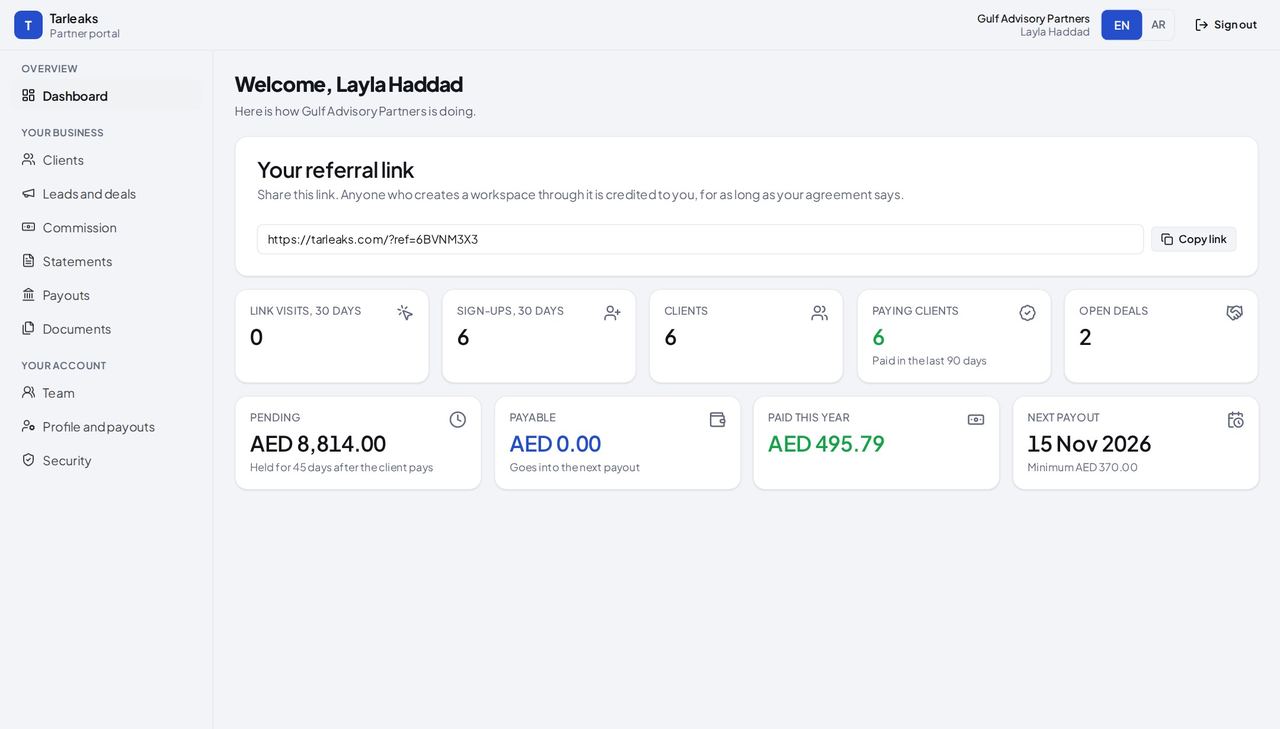
You should see The page greets you by name and says how Gulf Advisory Partners is doing: your referral link, link visits and sign-ups in the last 30 days, clients, paying clients and open deals, then Pending, Payable, Paid this year and Next payout.
Watch out Pending is commission still held after the client paid; only Payable goes into the next payout.
Worth knowing Every tile opens the list behind it: press Pending to see the lines still held.
Copy your referral link #
Where Partner portal » Dashboard » Your referral link
- On the Dashboard, press Copy link beside Your referral link.
- Paste it wherever you share it.
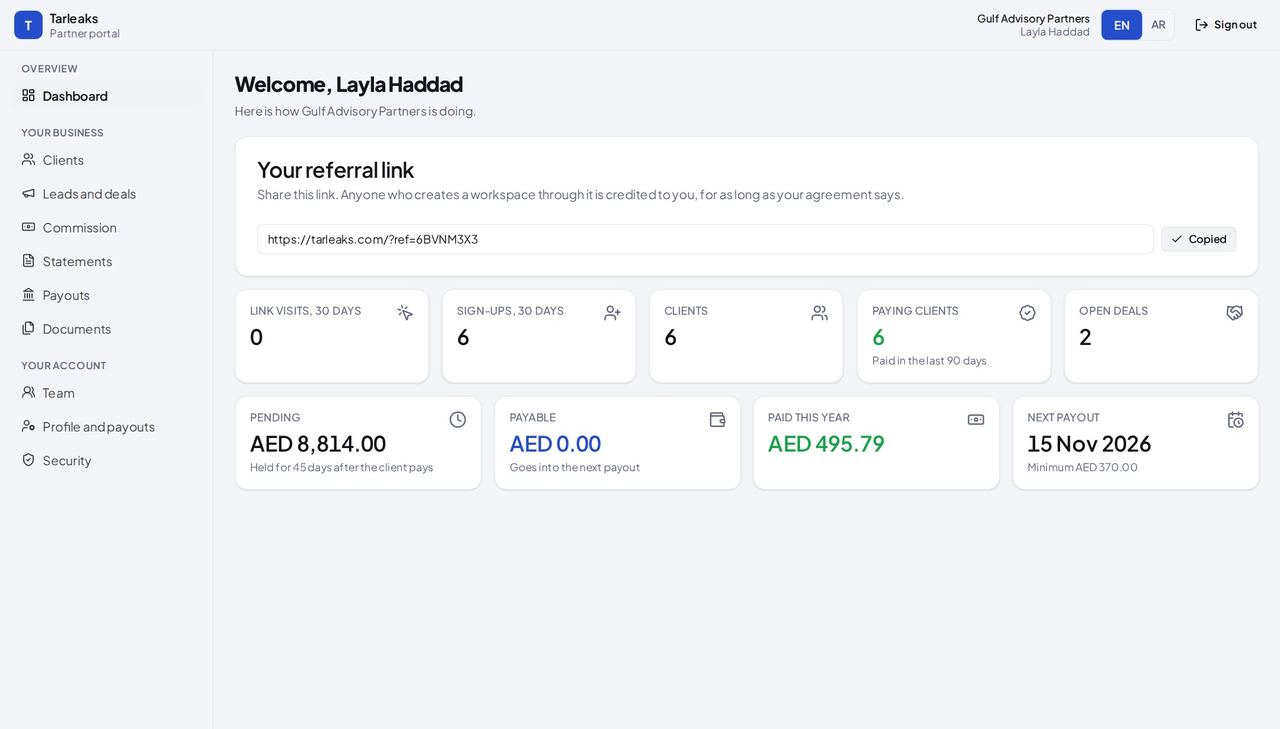
You should see The button says Copied for a moment. A company that creates its workspace through the link is credited to you, for as long as your agreement says.
Watch out Share this exact link. A company that signs up without it, and without a deal you registered, is not credited to you.
Your clients #
Where Partner portal » Clients
- Open Clients in the menu, under Your business.
- Type in the search box to find a client by name or country.
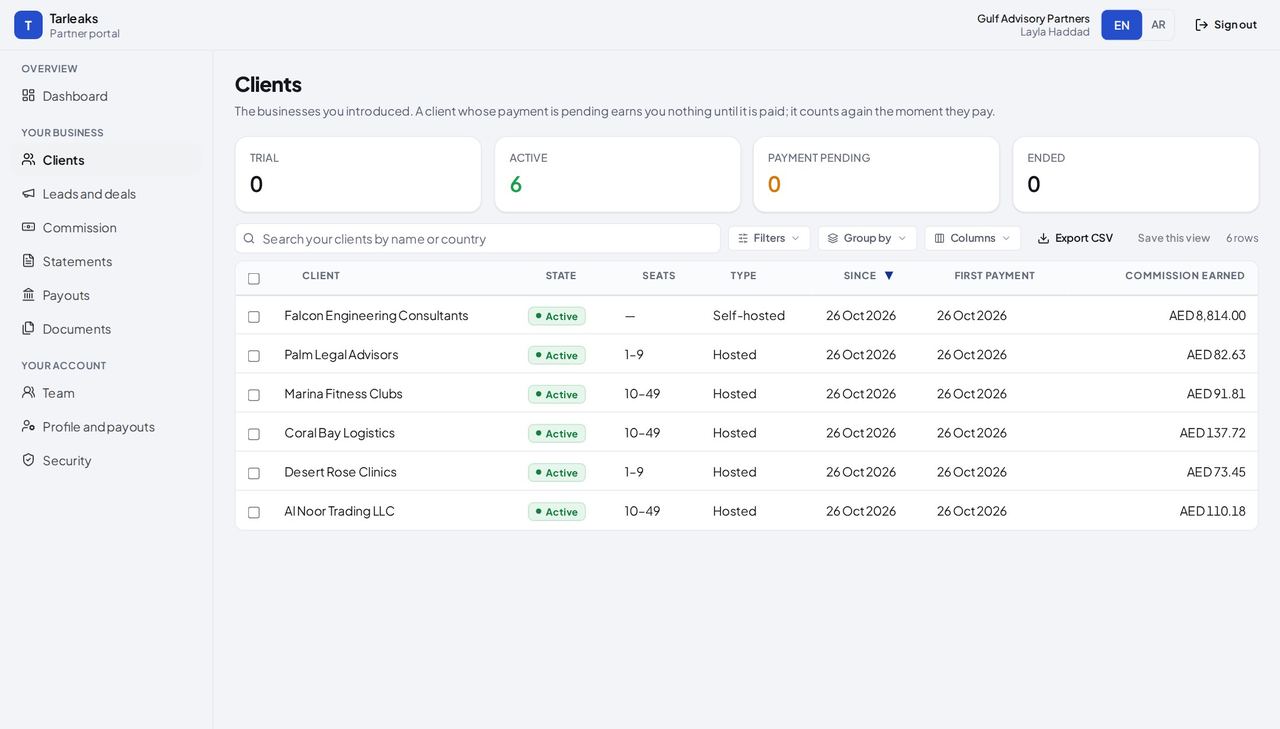
You should see Each company credited to you, by name: its state, its size in seats, Hosted or Self-hosted, since when, its first payment and the commission it has earned you.
Watch out A client whose payment is pending earns you nothing until it pays; it counts again the moment it does.
Leads and deals #
Where Partner portal » Leads and deals
- Open Leads and deals in the menu.
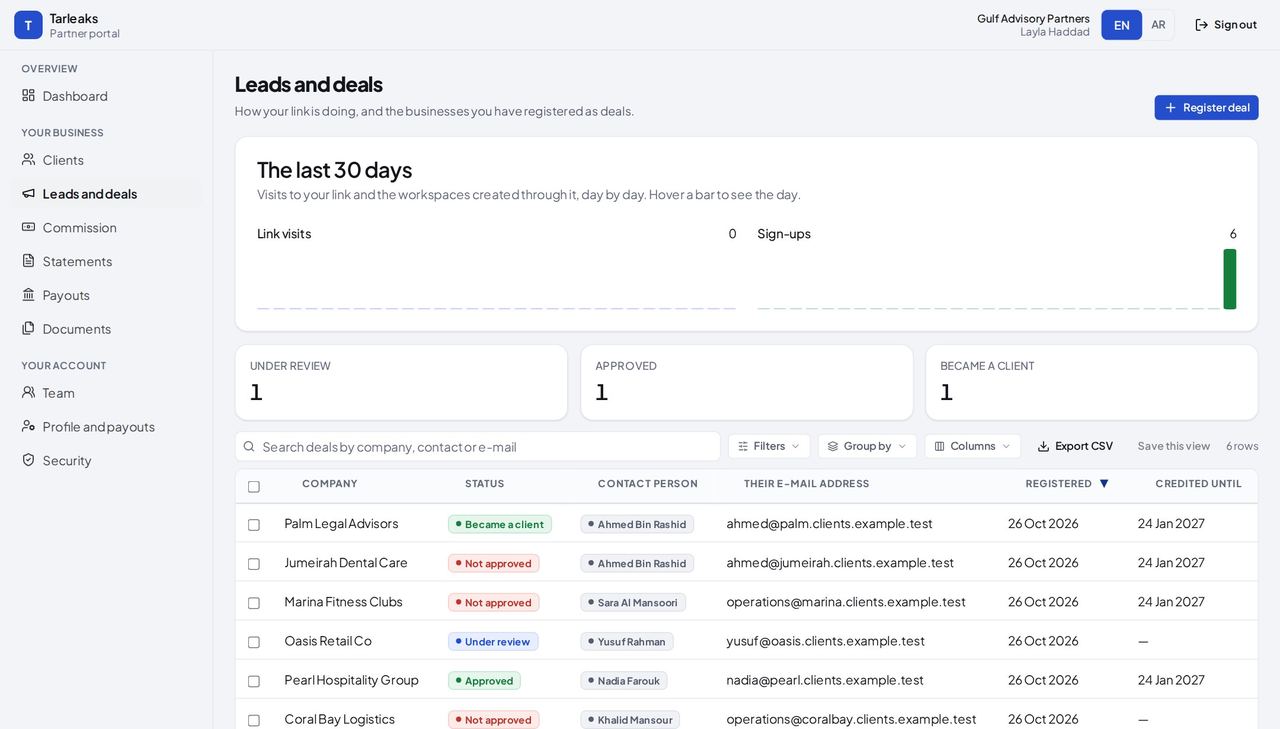
You should see Link visits and sign-ups day by day, then each registered deal with its status, its contact, when it was registered and until when it is credited to you.
Watch out Under review means the partner team has not decided yet; Became a client means the company signed up and is credited to you.
Register a deal #
Where Partner portal » Leads and deals » Register deal
- Open Leads and deals.
- Press Register deal at the top right.
- Fill in the form.
- Press Register deal at the bottom of the window.
| Field | What to put in it |
|---|---|
| Company | The business you are talking to. Required. |
| Contact person | The person you deal with there. |
| Their e-mail address | Their work address at the company's own domain. Required: it is how their sign-up is matched to your deal. |
| Country | Where the company is. |
| Expected number of users | About how many people will use it. |
| Anything we should know | A sentence for the partner team, for example where you met. |
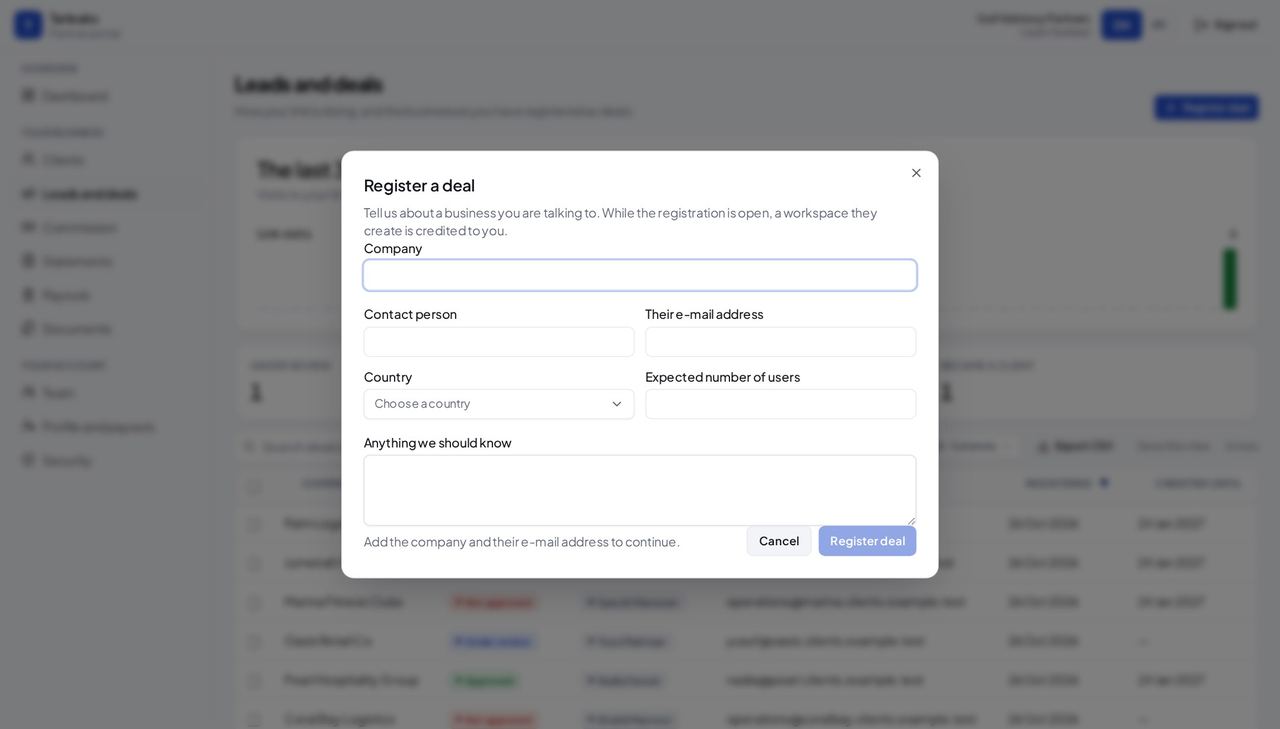
You should see The deal appears in the list as Under review, and the partner team's decision shows there. Once the partner team approves it, a workspace that company creates is credited to you.
Watch out If another partner already registered the same company, the partner team decides; you see the decision in the deal's status.
Worth knowing Register before the company signs up: a deal registered afterwards cannot credit a workspace that already exists.
Commission, line by line #
Where Partner portal » Commission
- Open Commission in the menu.
- Press a chip (Pending, Payable, In a payout, Paid) to narrow the list.
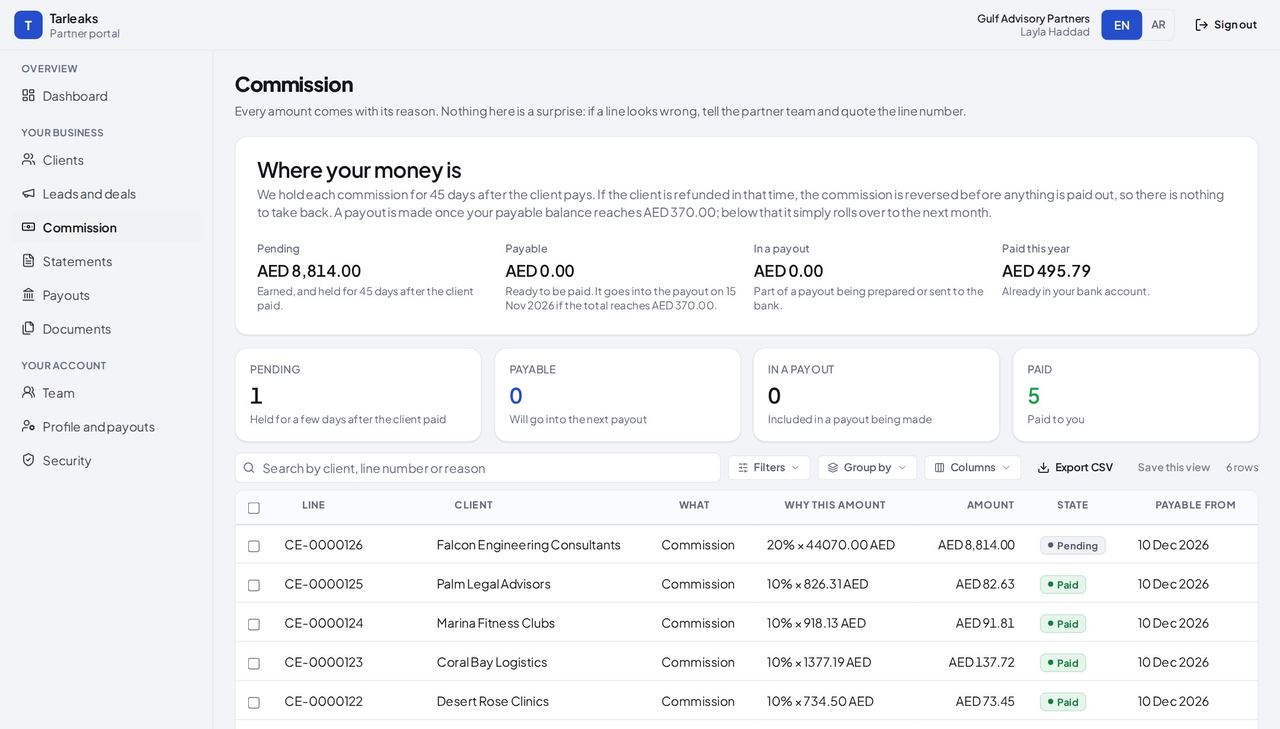
You should see Every line has its client, its reason (Why this amount), its amount, its state and the day it can be paid. A line still in its holding period is Pending.
Watch out If a line looks wrong, tell the partner team and quote its line number.
Statements #
Where Partner portal » Statements
- Open Statements in the menu.
- Press PDF or Printable page on a row.
- For another closed month, choose it under Month and press Get this statement.
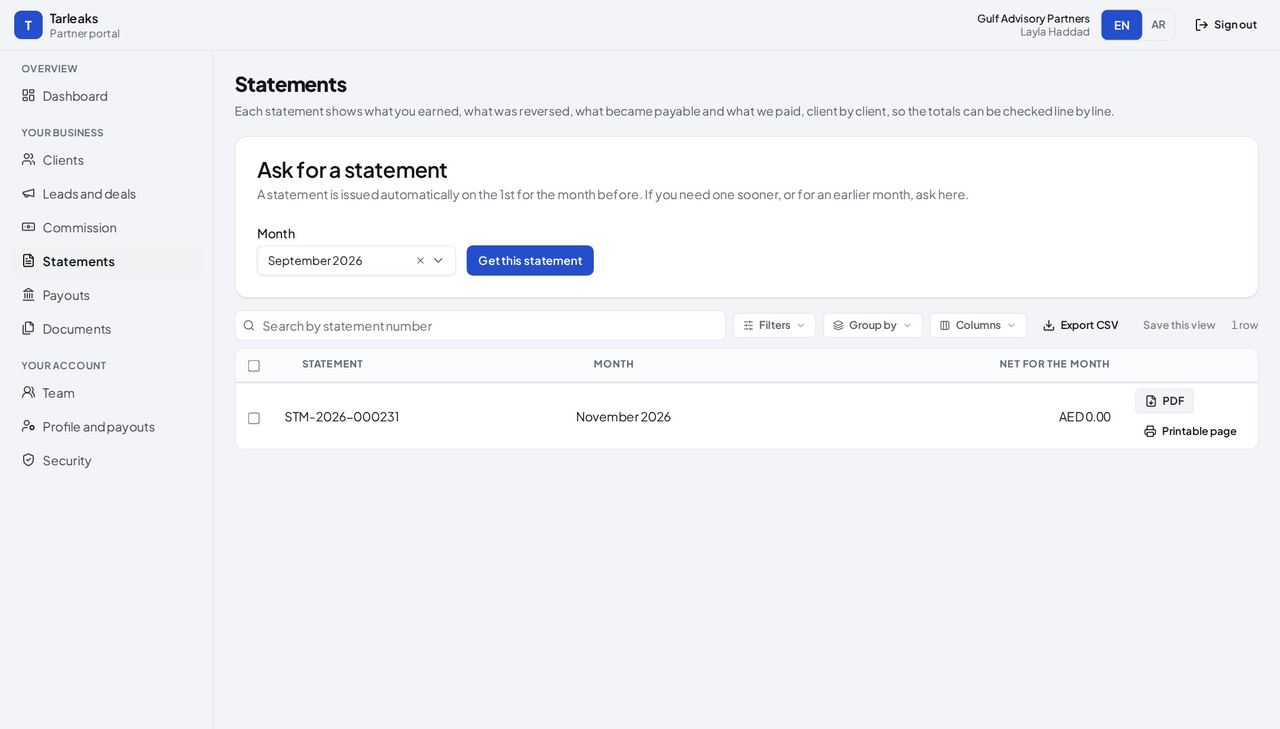
You should see One statement for each closed month with activity: what you earned, what was reversed, what became payable and what was paid, client by client.
Watch out The current month is not final, so it is not in the Month list.
Worth knowing A statement is issued by itself on the 1st for the month before.
Payouts #
Where Partner portal » Payouts
- Open Payouts in the menu.
- On a paid payout, press PDF beside Tax invoice or Payment advice.
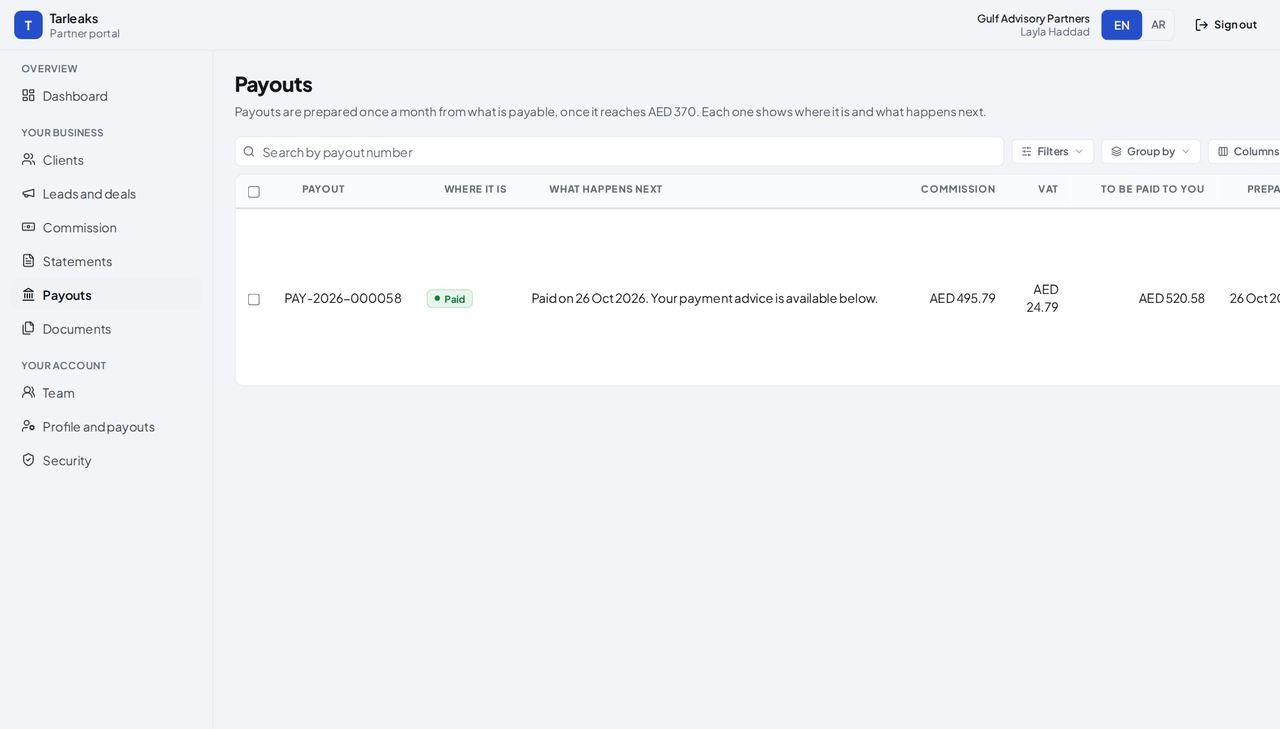
You should see Each payout with its commission, its VAT and what is paid to you. A paid one says Paid, with its Tax invoice and Payment advice ready to download.
Watch out Ask about this payout appears only during the review period, and each payout can be questioned once.
Documents #
Where Partner portal » Documents
- Open Documents in the menu.
- Press PDF or Printable page on a row.
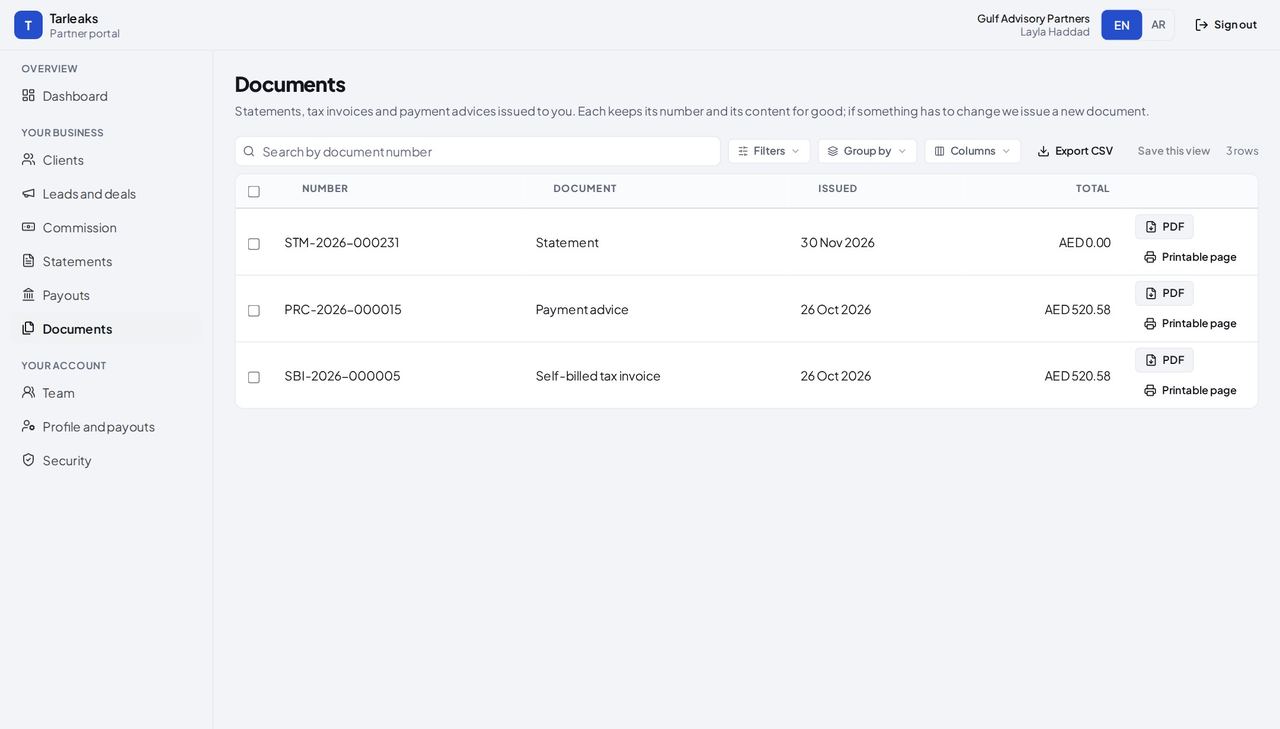
You should see Every document issued to you: statements, self-billed tax invoices, payment advices and credit notes, each with its number, date and total.
Watch out A correction is a new document (a credit note), never an edit of an old one.
Worth knowing A document never changes after it is issued; a correction is a new document.
Your team #
Where Partner portal » Team
- Open Team in the menu, under Your account.
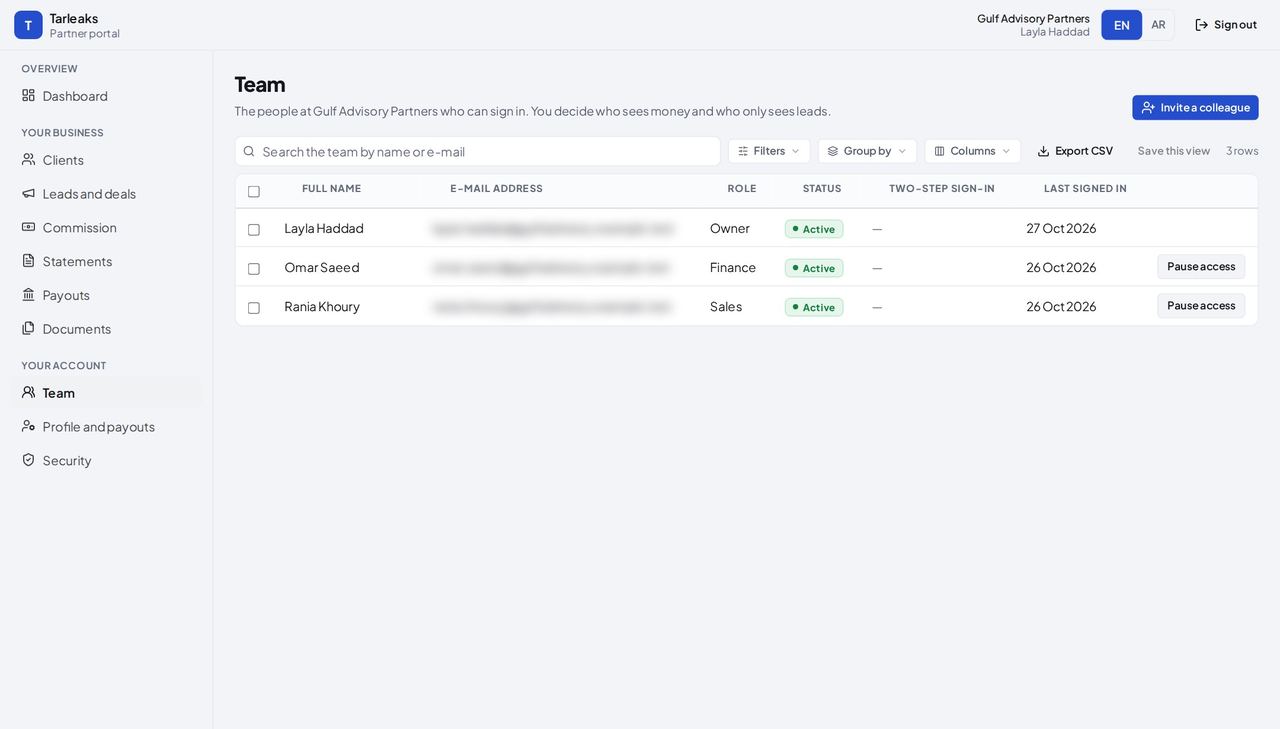
You should see Everyone who can sign in for your company, with their role (Owner, Finance or Sales), their status, whether two-step sign-in is on and when they last signed in.
Watch out You cannot pause your own access. A paused colleague is signed out at once; nothing they did is deleted.
Invite a colleague #
Where Partner portal » Team » Invite a colleague
- Open Team.
- Press Invite a colleague.
- Fill in the three fields.
- Press Send invitation.
| Field | What to put in it |
|---|---|
| Full name | Their name as it should appear in the portal. |
| E-mail address | Their work address. The invitation goes there. |
| Role | Finance (commission, payouts, documents and the bank details) or Sales (leads, deals and clients, no money). |
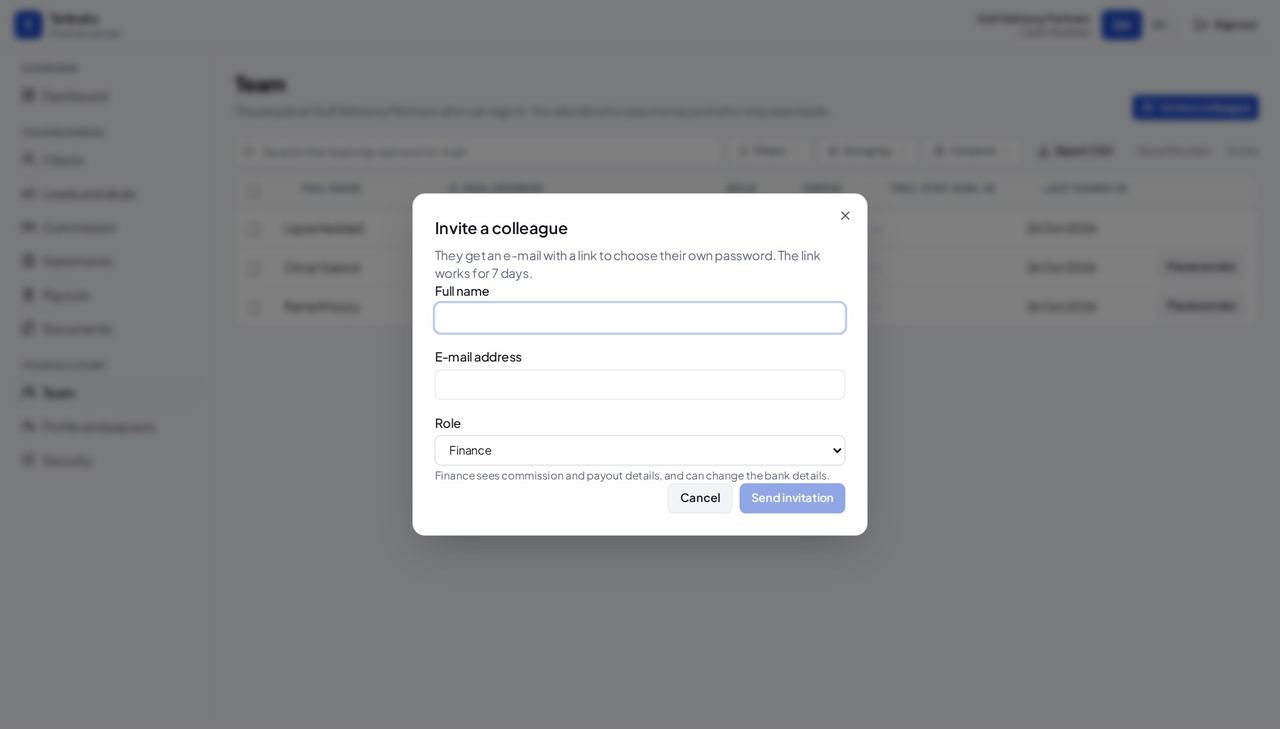
You should see They get an e-mail with a link to choose their own password; the link works for 7 days. They appear in the list as Invited until they do.
Watch out The link in the invitation works for 7 days. If it runs out, invite them again.
Worth knowing Finance sees the money and keeps the bank details. Sales brings clients and sees no amount.
Profile and payouts #
Where Partner portal » Profile and payouts
- Open Profile and payouts in the menu.
- Scroll down to Payout details.
| Field | What to put in it |
|---|---|
| Display name | How your company appears to your clients. |
| Phone / Website / Country | How we reach you. |
| Tax registration number (TRN) | A UAE TRN has 15 digits. |
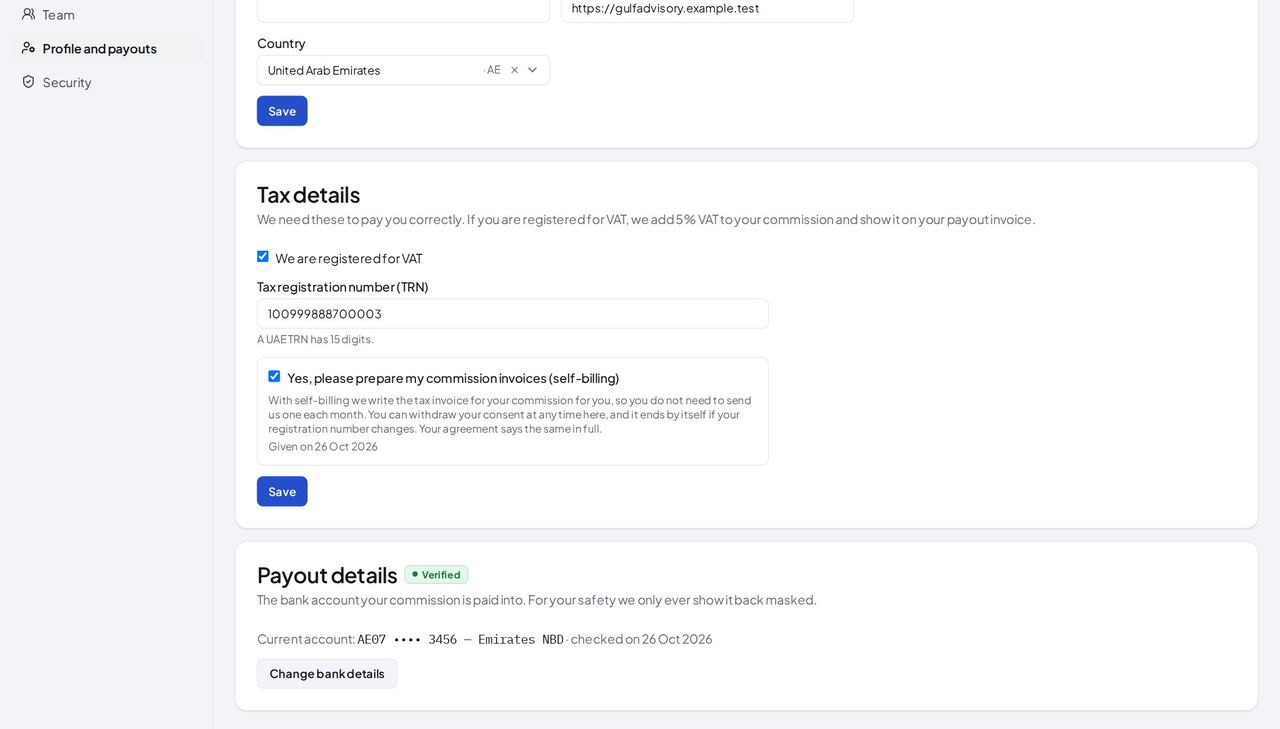
You should see The account is shown masked, with Verified once the partner team has checked it. With self-billing on, we write the tax invoice for your commission for you.
Watch out Your legal name and e-mail change only through the partner team. The full account number is never shown back, to anyone.
Security #
Where Partner portal » Security
- Open Security in the menu.
| Field | What to put in it |
|---|---|
| Current password | The one you sign in with today. |
| New password | At least the length the hint says; a short sentence is easy to remember. |
| Repeat the password | The same again. |
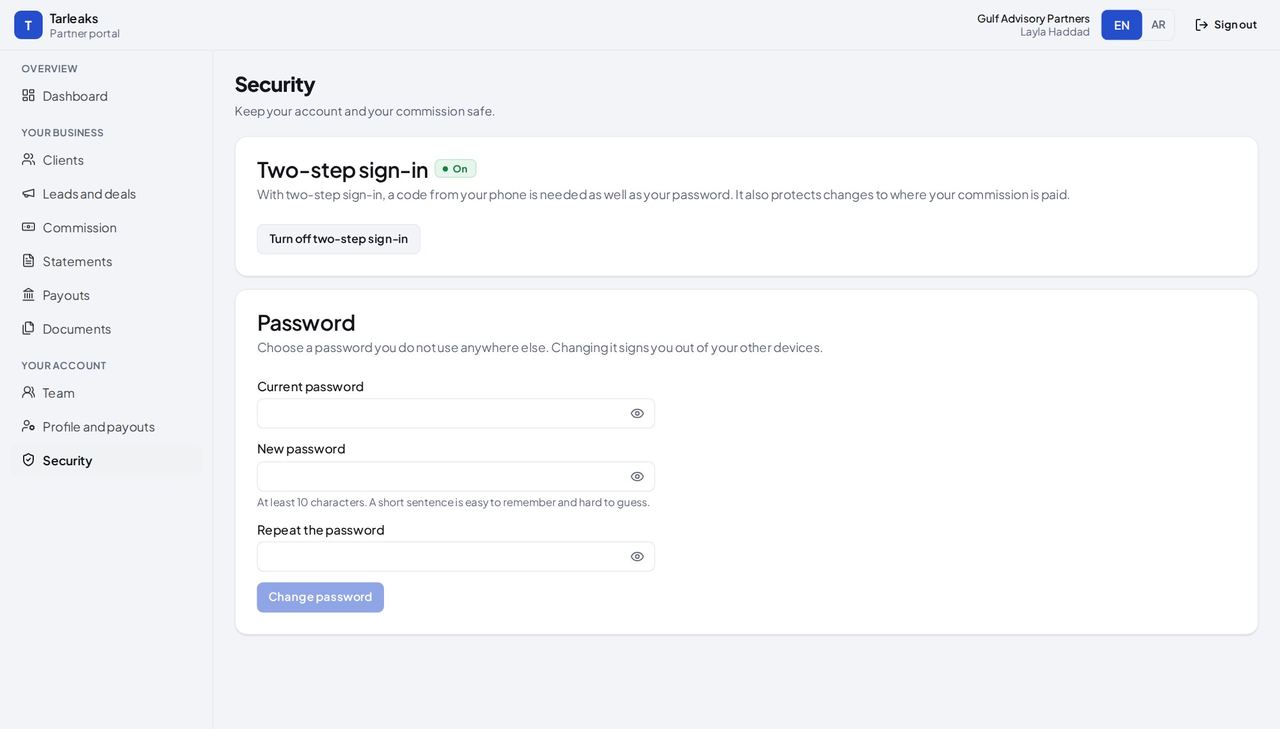
You should see Two-step sign-in is On: a code from your phone is needed as well as your password, and it also protects changes to where your commission is paid.
Watch out Changing the password signs you out of your other devices. Keep two-step sign-in on: it also protects changes to the bank account.
The agreement #
Where Partner portal » Partner agreement (by its address)
- Type partner.tarleaks.com/admin/partner/agreement in the address bar.
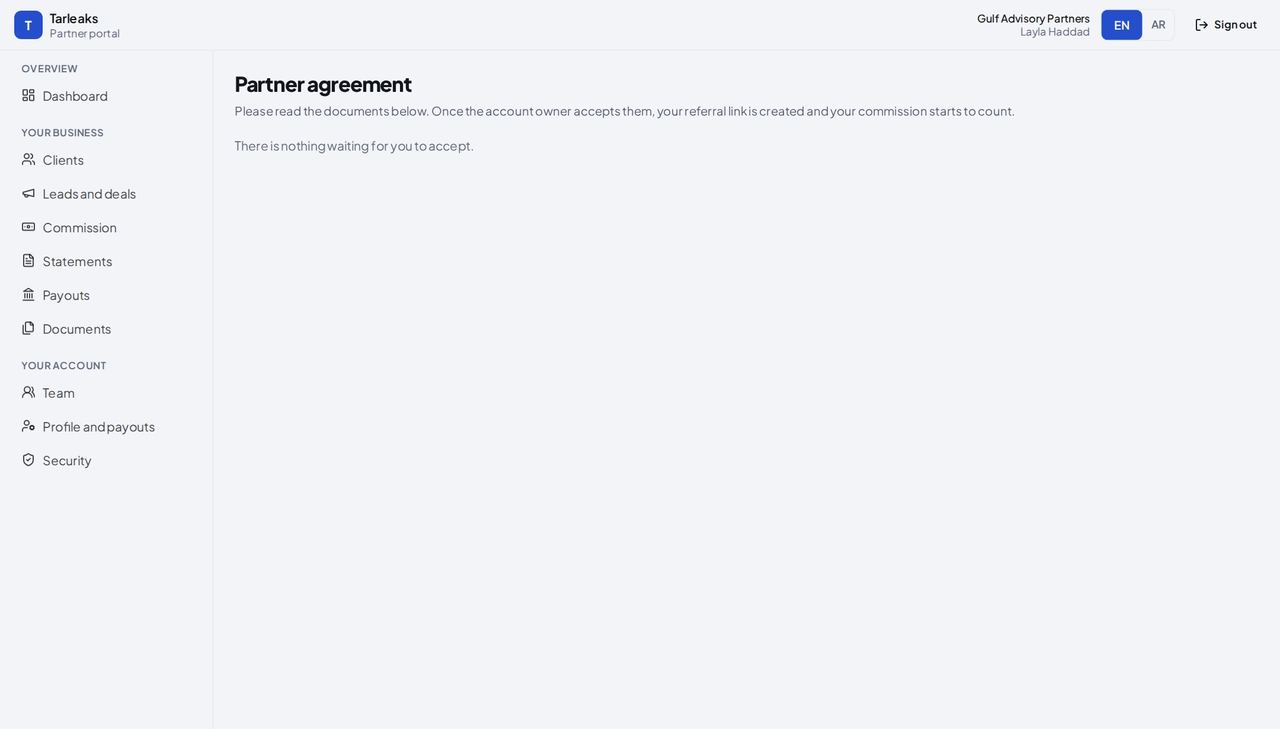
You should see The Partner agreement page shows only documents still waiting for you to accept; with everything accepted it says There is nothing waiting for you to accept. When a new version is published it opens over every page until you accept it or sign out.
Watch out There is no menu entry for the agreement. When a new version is published, a window opens over every page: read What changed, tick the box, type your full name and accept, or sign out and come back later.
Worth knowing Only the owner can accept for the company. A colleague is asked to wait for you.
Use cases — the work, step by step
Each one is a sequence somebody actually performs, with the screen behind every step. Every screen here was opened in the product as this role before it was published.
every new clientBring in a client and get credited for it #
A client is credited to you either because it signed up through your link, or because you registered the deal and the partner team approved it before it signed up. Registering first is the safer way: an approved deal holds the company for 90 days, even if it signs up from another device.
Register the deal as soon as the company is interested: its name, the contact and the contact's work address.
Partner portal » Leads and deals » Register deal — verified: the control is offered; the page says “Register a deal” Send your link with the demo invitation, so the sign-up carries it too.
Partner portal » Dashboard » Your referral link — verified: the page says “Your referral link”; the page says “Copied” Follow the deal on Leads and deals: Under review, then Approved, then Became a client when the company signs up.
Partner portal » Leads and deals — verified: the page says “The last 30 days”; the page says “Pearl Hospitality Group”; the page says “Oasis Retail Co”; the page says “Credited until”; 6 row(s) listed The company appears on Clients, credited to you.
Partner portal » Clients — verified: the page says “Al Noor Trading LLC”; the page says “Desert Rose Clinics”; the page says “Coral Bay Logistics”; the page says “Falcon Engineering Consultants”; the page says “Self-hosted”; the control is offered; 6 row(s) listed
every monthFrom a client's payment to money in your bank #
Commission is earned when the client pays, held for 45 days in case the client is refunded, then paid out on the 15th once your payable balance reaches the minimum.
Read the new line on Commission: the amount, the reason and the day it can be paid.
Partner portal » Commission — verified: the control is offered; the control is offered; the page says “Where your money is”; the page says “Why this amount”; the page says “Payable from”; 6 row(s) listed On the 15th the payout is prepared; read it on Payouts with its VAT.
Partner portal » Payouts — verified: the page says “Where it is”; the page says “To be paid to you”; the page says “Paid on”; the page says “Payment advice”; the page says “Tax invoice”; 1 row(s) listed When it is paid, the self-billed invoice and the payment advice are on Documents.
Partner portal » Documents — verified: the page says “Self-billed tax invoice”; the page says “Payment advice”; the page says “Printable page”; 3 row(s) listed At the month's end, the statement shows everything that moved.
Partner portal » Statements — verified: the control is offered; the page says “Ask for a statement”; the page says “Get this statement”
when someone joinsGive a colleague the access their job needs #
Finance needs the money and the bank details but not your clients; sales needs the link and the deals but no amounts. Each role sees exactly that.
Open Team and press Invite; choose Finance or Sales.
Partner portal » Team » Invite a colleague — verified: the control is offered; the control is offered; the control is offered; the page says “They get an e-mail with a link to choose their own password”; the page says “Finance sees commission and payout details” Check who can sign in, and their roles.
Partner portal » Team — verified: the page says “Owner”; the page says “Finance”; the page says “Sales”; the page says “Two-step sign-in”; the page says “Last signed in”; 3 row(s) listed
Every amount on the portal comes with its reason. If a line looks wrong, tell the partner team and quote its line number: nothing is changed behind your back.
Partner finance
See what your company has earned, why, and when it is paid, and keep the bank account right.
Looks after the partner's money: what has been earned and why, the monthly statements, the payouts and their documents, and the bank account they are paid to.
What you will be able to do
- Read each commission line and why it is that amount
- Know why a line is Pending, and when it becomes Payable
- Follow each payout with its VAT, and download its tax invoice and payment advice
- Get the monthly statement as a PDF
- Check the bank account payouts go to, shown masked
What this role can and cannot do
| Can | Cannot |
|---|---|
|
|
6 steps, each one carried out in the product on .
What finance sees #
Where Partner portal » Dashboard
- Open partner.tarleaks.com and sign in with your e-mail address and password.
- The Dashboard opens.
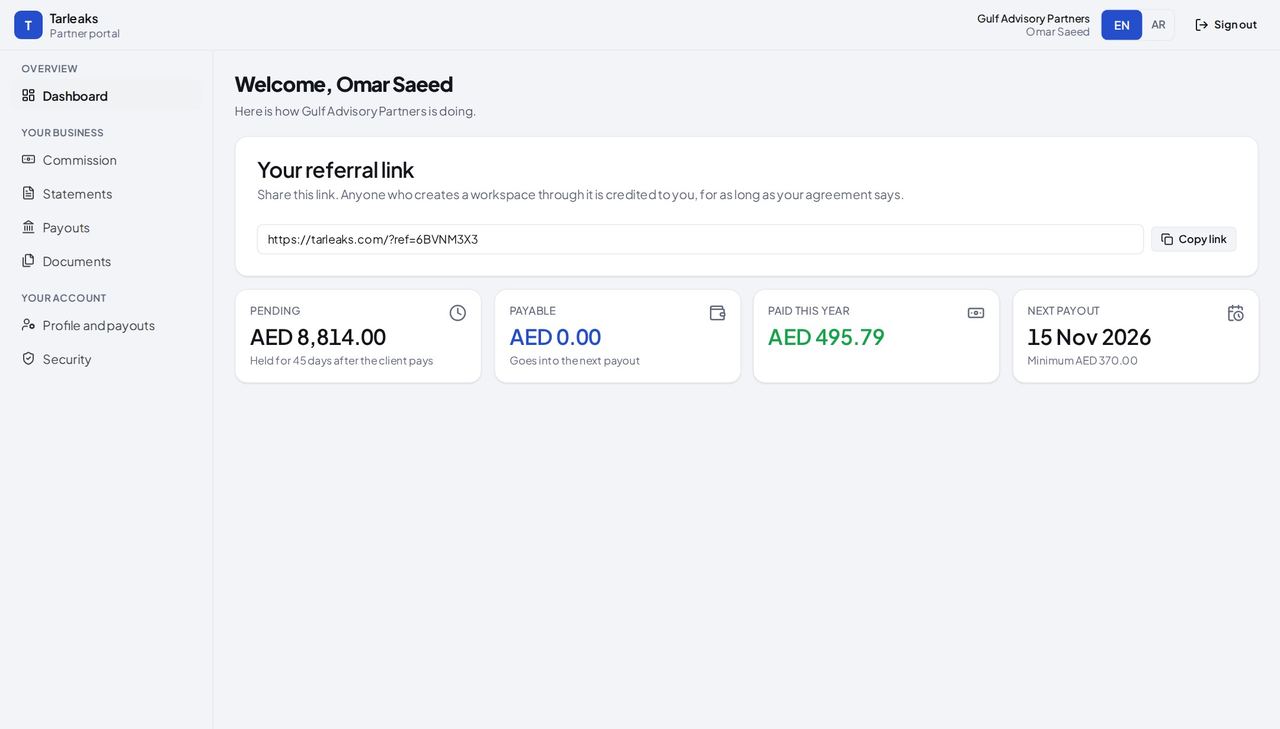
You should see The referral link and the money: Pending, Payable, Paid this year and Next payout. Clients, Leads and deals and Team are not in your menu.
Watch out Clients, deals and the team are the owner's and sales' pages. Opening their address says This is not available right now.
Commission and why #
Where Partner portal » Commission
- Open Commission.
- Press the Pending chip.
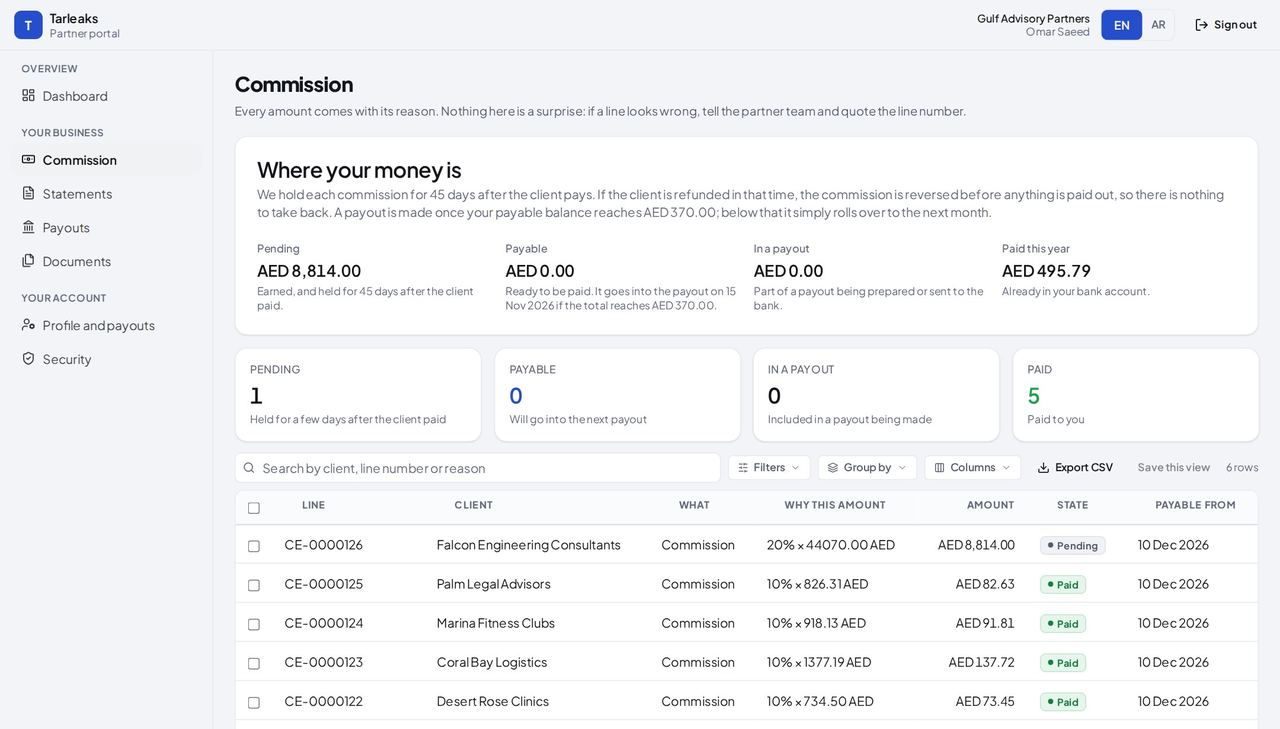
You should see Every amount has its reason. A line in its holding period is Pending and shows the day it becomes payable; Where your money is explains why it waits.
Watch out A line is held after the client pays so that a refund in that time reverses it before anything is paid out.
Payouts #
Where Partner portal » Payouts
- Open Payouts.
- Press PDF beside Tax invoice and Payment advice on the paid payout.
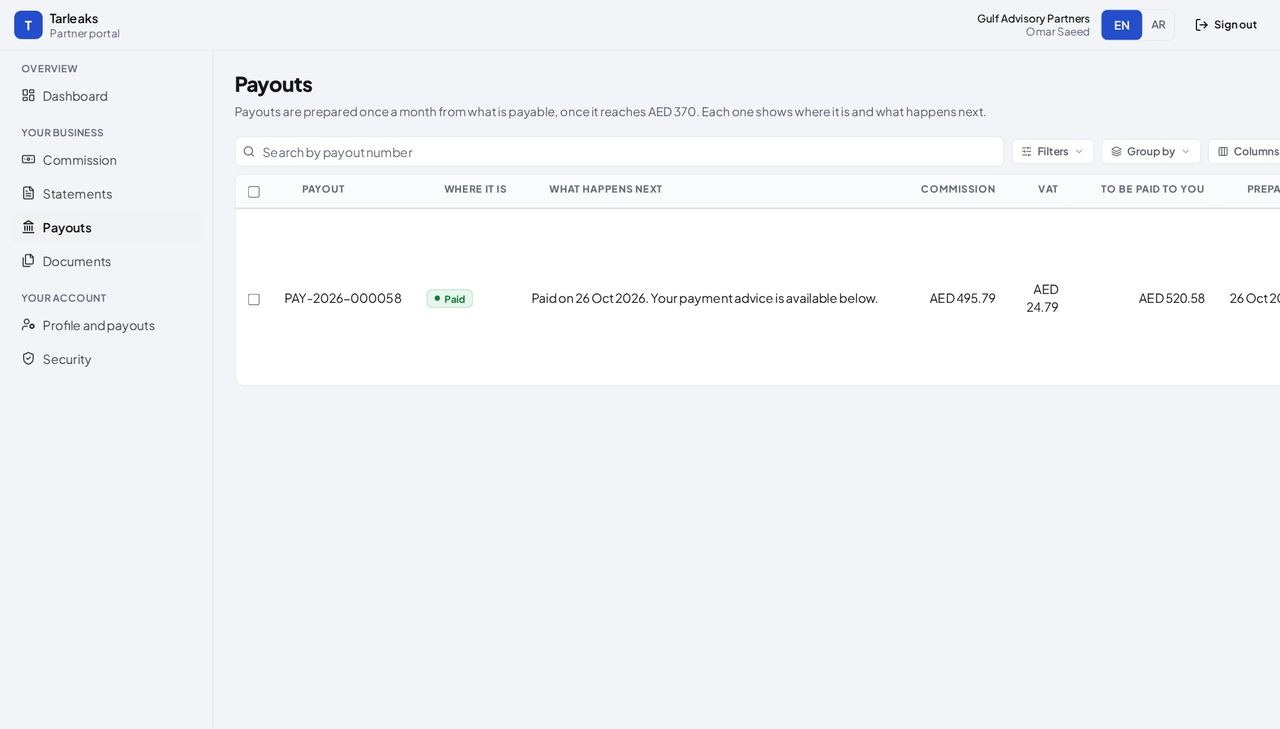
You should see The payout, its commission, its VAT and what is paid to you; a paid one says Paid on its date.
Watch out With self-billing on, the tax invoice is written for you. If self-billing were off, the payout would wait for your own invoice (Send your invoice).
Statements #
Where Partner portal » Statements
- Open Statements.
- Press PDF on a row, or choose a Month and press Get this statement.
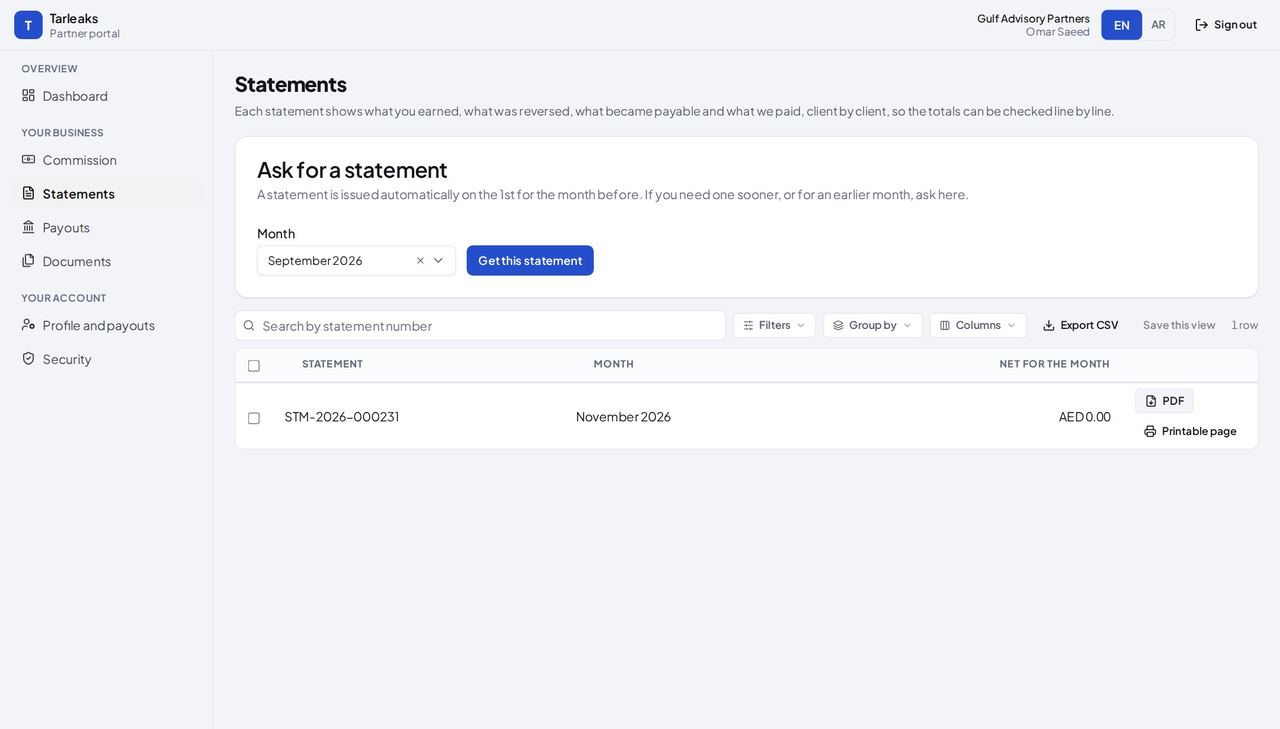
You should see Each month's statement as a PDF or a printable page. The current month is not final, so it is not offered.
Watch out A month with no commission activity has nothing to put on a statement, and the page says so.
Documents #
Where Partner portal » Documents
- Open Documents.
- Press PDF on a row.
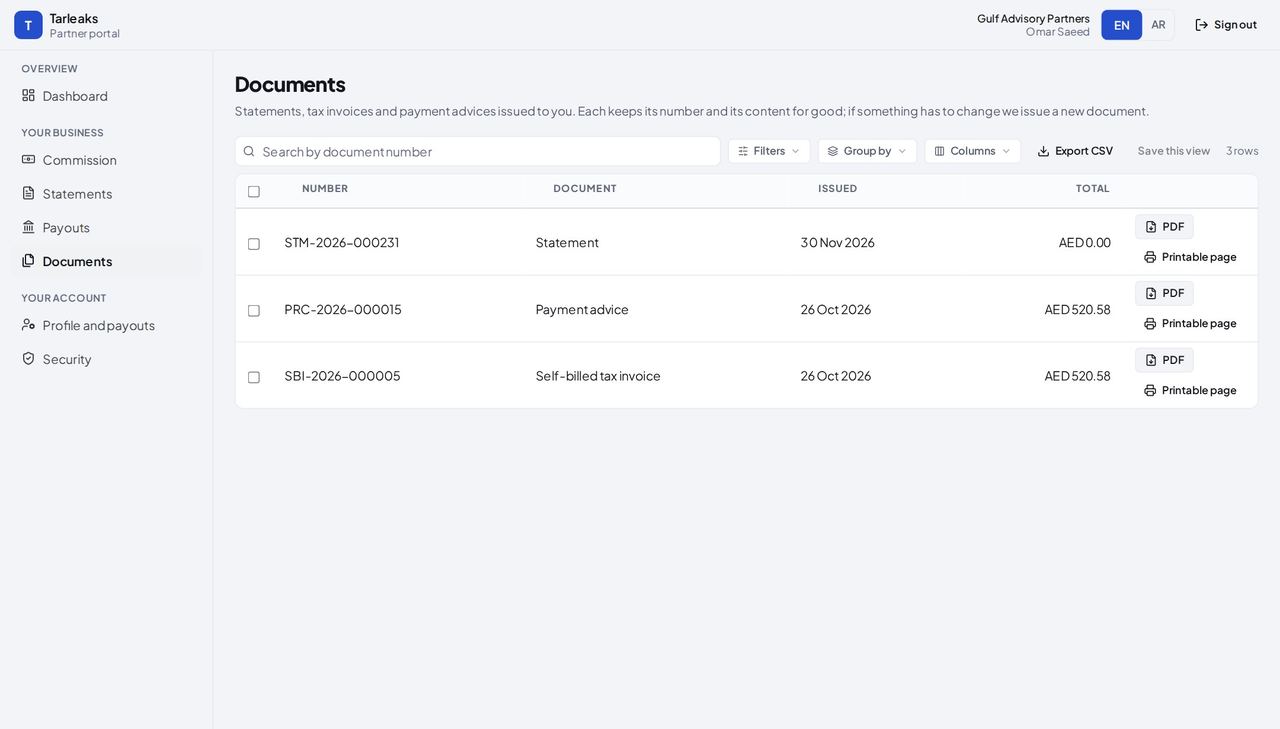
You should see Every document issued to your company, each with its number, date, total and a PDF.
Watch out Keep the self-billed tax invoices for your VAT return.
The bank account #
Where Partner portal » Profile and payouts » Payout details
- Open Profile and payouts.
- Scroll to Payout details.
- Press Change bank details.
- Fill in the new account and the check at the end.
- Press Save bank details.
| Field | What to put in it |
|---|---|
| Account holder | The name on the account, as the bank has it. |
| Bank | The bank's name. |
| IBAN | A UAE IBAN has 23 characters and starts with AE. |
| SWIFT / BIC | The bank's code. |
| Bank country | Where the bank is. |
| Your password (or Code from your authenticator app) | Asked once more before changing where money goes. |
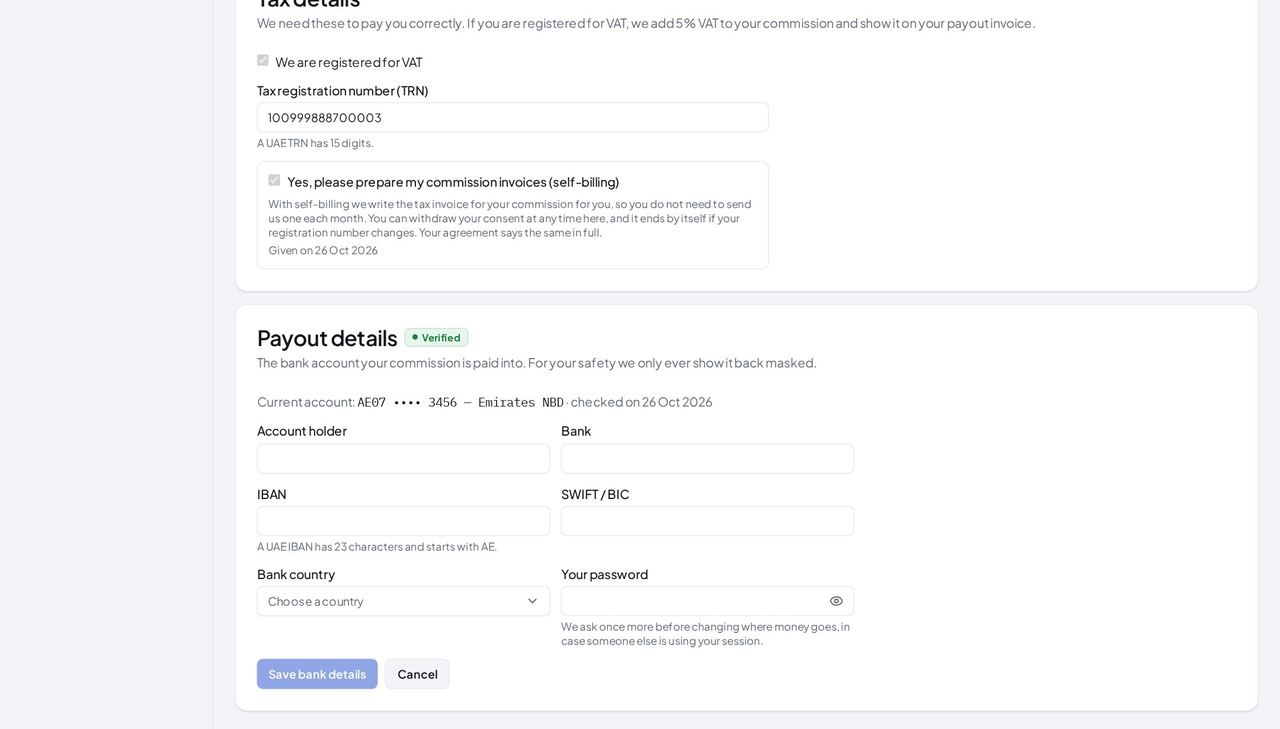
You should see The current account is only ever shown masked. Changing it asks once more who you are, and the partner team checks the new account before the next payout.
Watch out New bank details show Waiting to be checked until the partner team verifies them.
Use cases — the work, step by step
Each one is a sequence somebody actually performs, with the screen behind every step. Every screen here was opened in the product as this role before it was published.
around the 15thCheck a payout before it reaches the bank #
The payout adds up the lines whose hold has ended. Reading the lines first means a question is asked before the money moves, not after.
Read each line's reason on Commission.
Partner portal » Commission — verified: the page says “Why this amount”; the page says “Pending”; the control is offered; 6 row(s) listed; the action is not offered to this role; the action is not offered to this role; the action is not offered to this role Open the payout on Payouts and compare its total and VAT.
Partner portal » Payouts — verified: the page says “To be paid to you”; the page says “Paid on”; the page says “Payment advice”; 1 row(s) listed; the action is not offered to this role; the action is not offered to this role; the action is not offered to this role Keep the self-billed invoice and the payment advice from Documents for your books.
Partner portal » Documents — verified: the page says “Self-billed tax invoice”; the page says “Payment advice”; 3 row(s) listed; the action is not offered to this role; the action is not offered to this role; the action is not offered to this role
when the account changesKeep the bank account right #
A payout goes only to an account the platform has checked; a change is held until it is checked again, so a wrong number never receives money.
Open Profile and payouts and read the masked account.
Partner portal » Profile and payouts » Payout details — verified: the control is offered; the control is offered; the page says “We ask once more before changing where money goes”; the page says “A UAE IBAN has 23 characters”; the action is not offered to this role; the action is not offered to this role; the action is not offered to this role
Clients, deals and the team belong to the owner and the sales colleague: they are not in your menu, and the server refuses them for your sign-in too.
Partner sales
Bring in new clients: share the link, register deals, and see who is live.
Brings new clients: shares the partner's link, registers deals before the client signs up, and follows which clients are live. Sees no amounts.
What you will be able to do
- Copy the company's referral link and share it
- See which clients are live, on trial or waiting for payment
- See every deal you and your colleagues registered, and what became of it
- Register a deal before the company signs up
What this role can and cannot do
| Can | Cannot |
|---|---|
|
|
6 steps, each one carried out in the product on .
What sales sees #
Where Partner portal » Dashboard
- Open partner.tarleaks.com and sign in with your e-mail address and password.
- The Dashboard opens.
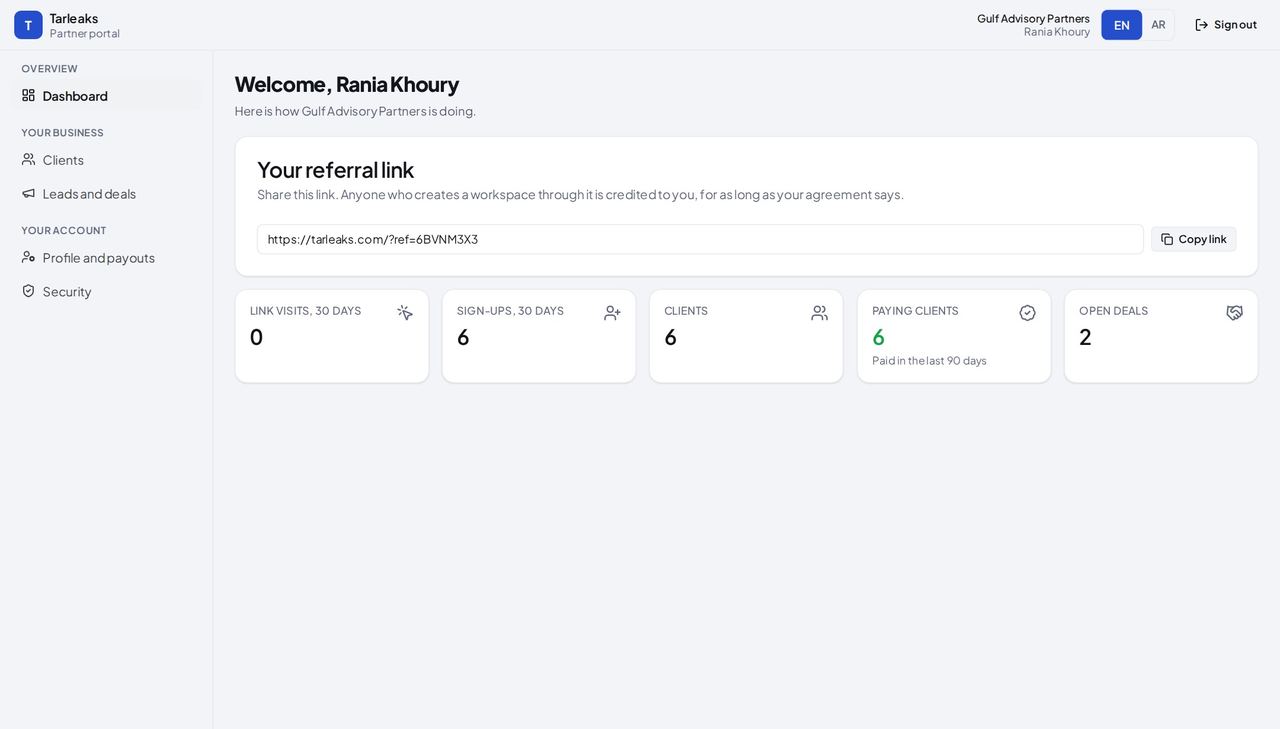
You should see The referral link, link visits, sign-ups, clients, paying clients and open deals. No amount, no payout and no bank detail.
Watch out The menu has no Commission, Statements, Payouts, Documents or Team; that is your role, not a fault.
Share the link #
Where Partner portal » Dashboard » Your referral link
- On the Dashboard, press Copy link.
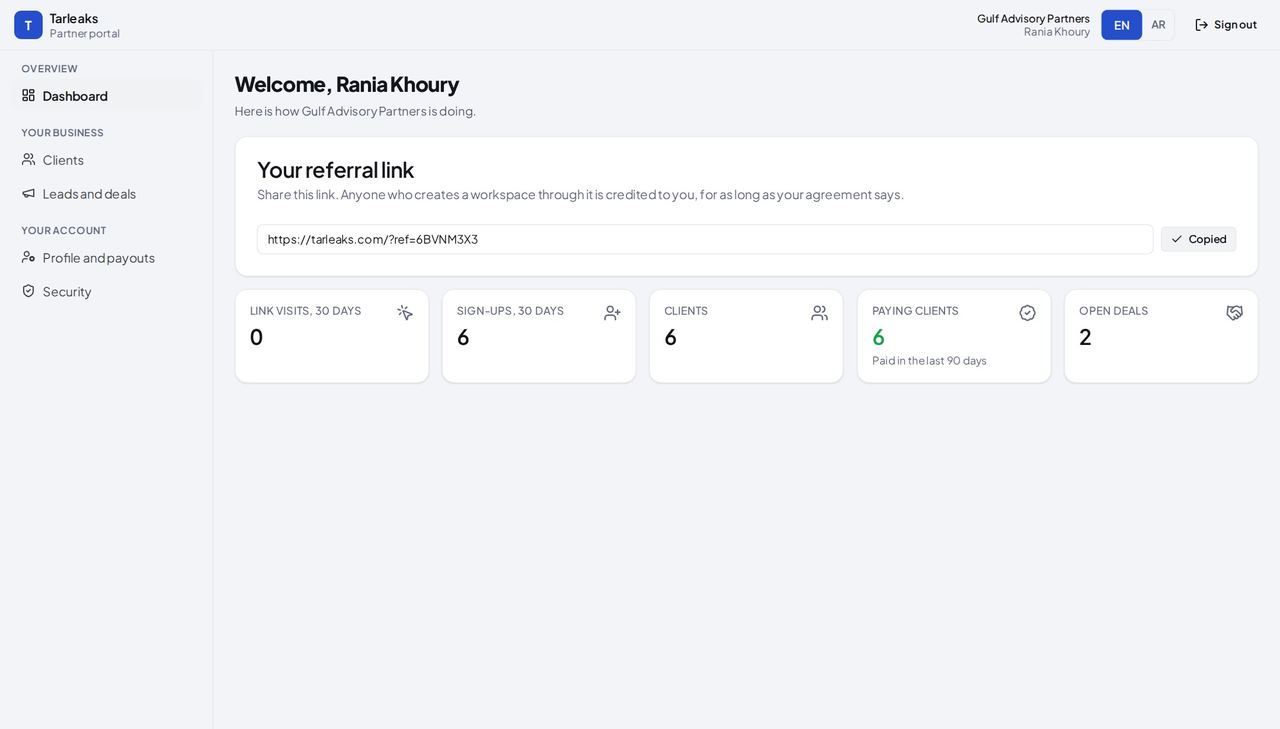
You should see The button says Copied. It is the same link as the owner's: a sign-up through it is credited to your company.
Watch out Send the link before the company signs up; or register a deal first.
Clients, without amounts #
Where Partner portal » Clients
- Open Clients.
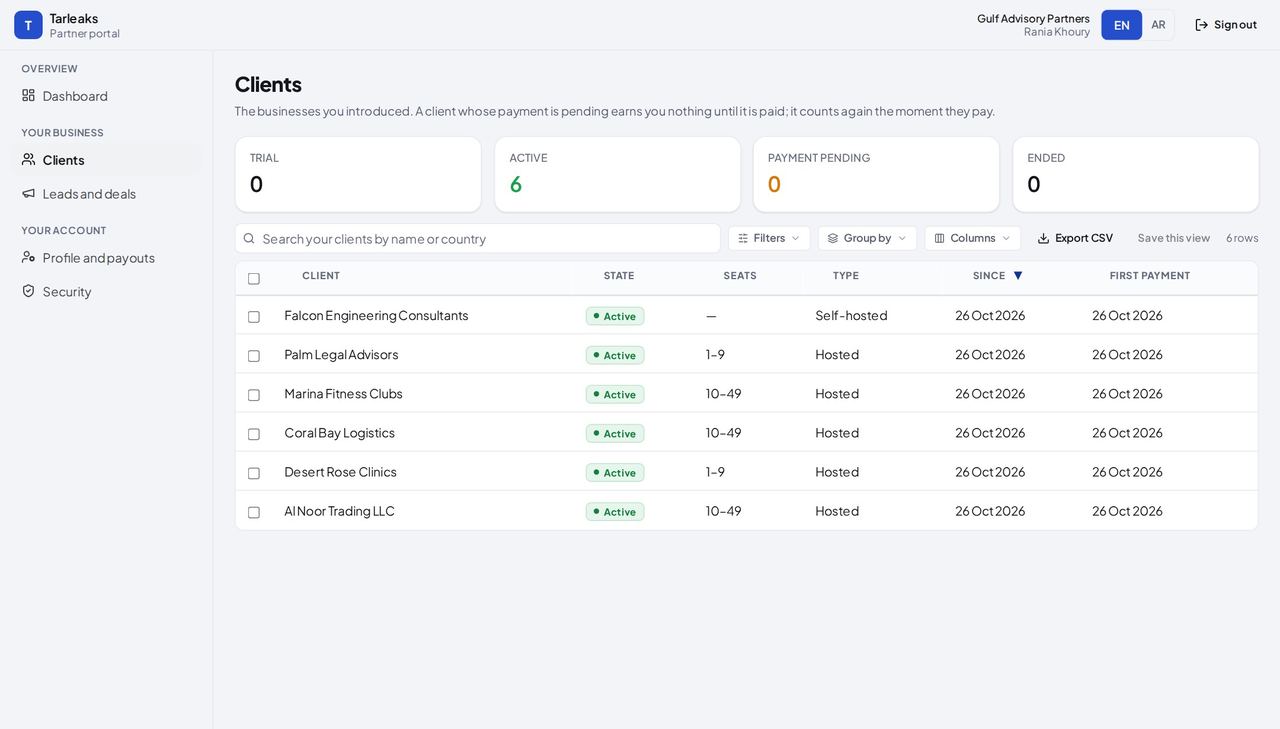
You should see Which companies are live, on trial or waiting for payment, their size and since when. There is no Commission earned column for you.
Watch out Payment pending means the client has not paid yet; follow up with them, not with the partner team.
Leads and deals #
Where Partner portal » Leads and deals
- Open Leads and deals.
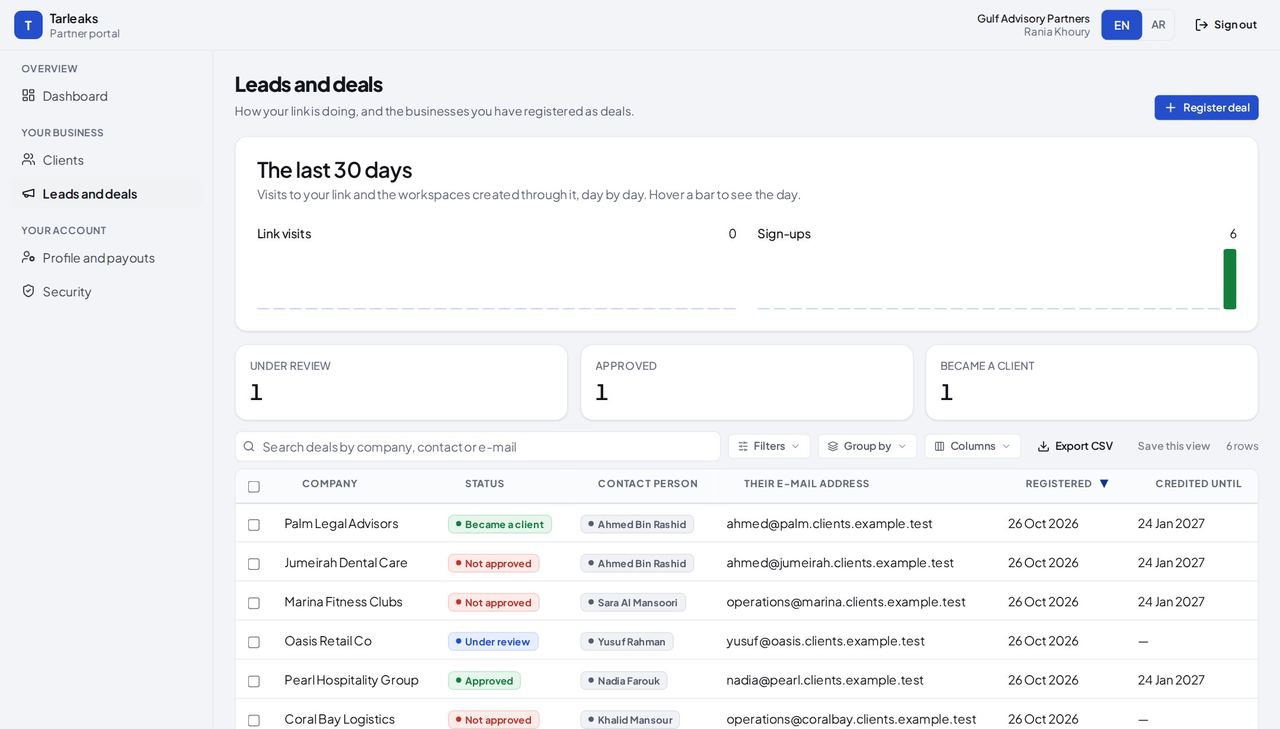
You should see The link's last 30 days, then every deal you and your colleagues registered, with its status and until when it is credited to your company.
Watch out A deal that passes Credited until without a sign-up expires; register it again if you are still talking.
Register a deal #
Where Partner portal » Leads and deals » Register deal
- Open Leads and deals.
- Press Register deal.
- Fill in the form.
- Press Register deal at the bottom of the window.
| Field | What to put in it |
|---|---|
| Company | The business you are talking to. Required. |
| Contact person | The person you deal with there. |
| Their e-mail address | Their work address at the company's own domain. Required: it is how their sign-up is matched to your deal. |
| Country | Where the company is. |
| Expected number of users | About how many people will use it. |
| Anything we should know | A sentence for the partner team, for example where you met. |
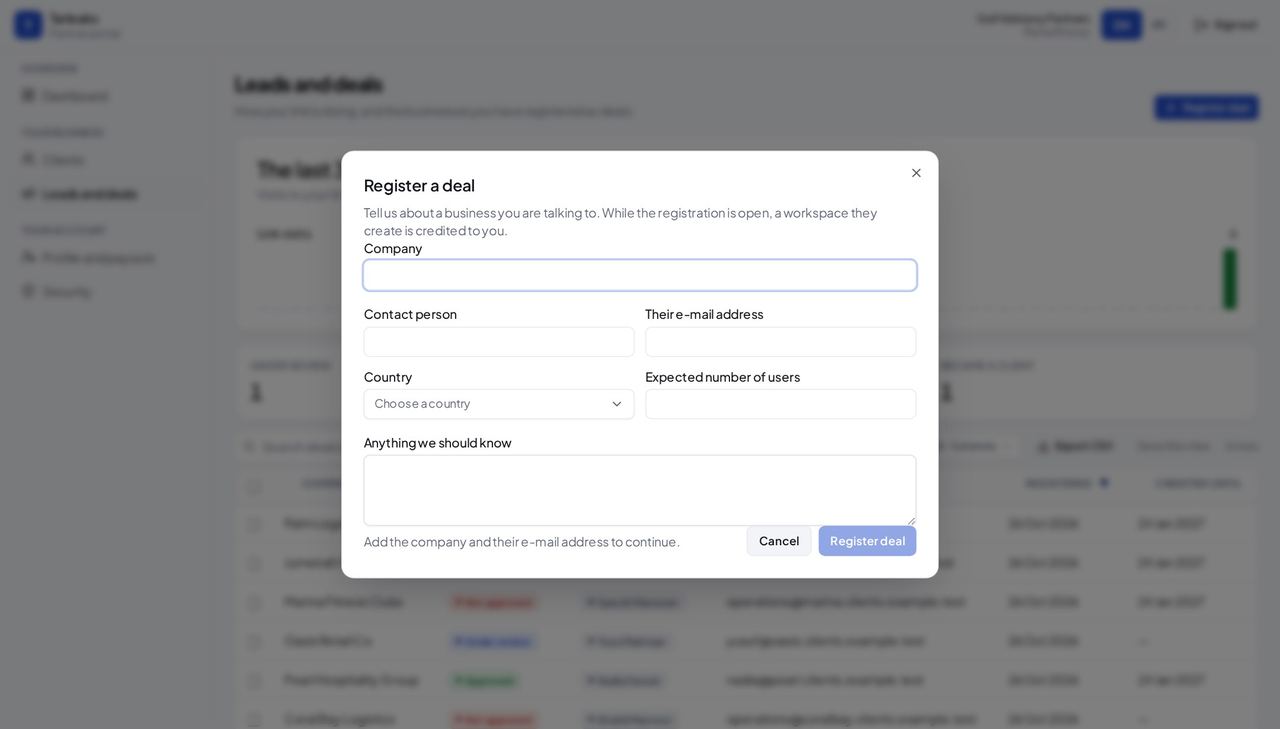
You should see The deal is listed as Under review. Once the partner team approves it, a workspace that company creates is credited to your company.
Watch out Register before the company creates its workspace.
Worth knowing Use the e-mail address at the company's own domain: that is how its sign-up is matched to your deal.
No money for sales #
Where Partner portal » Commission (not in your menu)
- Look at the menu.
- If you type the Commission page's address, the page says This is not available right now.
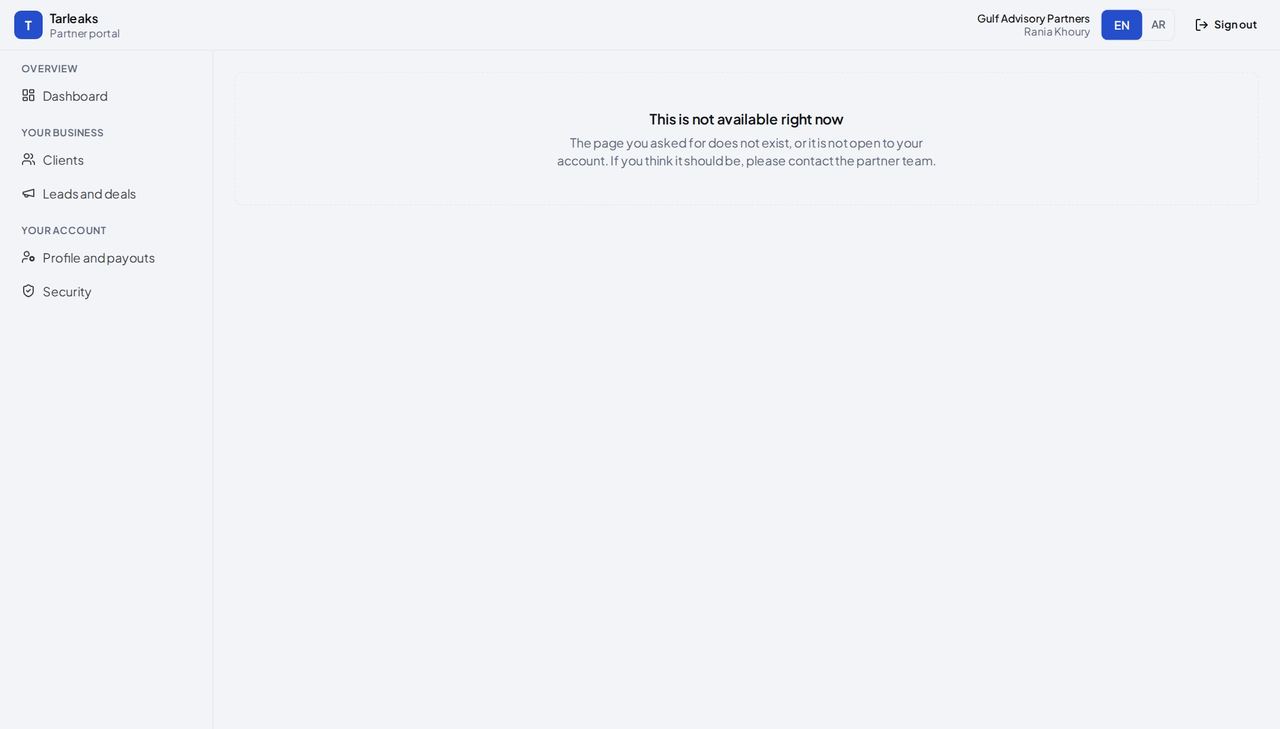
You should see Amounts, payouts and documents belong to the owner and finance; the server refuses them for your sign-in too.
Watch out If you need to know what a client earned, ask the owner or finance.
Use cases — the work, step by step
Each one is a sequence somebody actually performs, with the screen behind every step. Every screen here was opened in the product as this role before it was published.
every new prospectRegister a deal before the demo #
The first partner to register a company's deal holds it for 90 days. A conflict between two partners is decided by the platform's partner team.
Press Register deal and fill in the company and the contact.
Partner portal » Leads and deals » Register deal — verified: the control is offered; the page says “Register a deal” Follow it on Leads and deals.
Partner portal » Leads and deals — verified: the page says “Pearl Hospitality Group”; the page says “Oasis Retail Co”; the page says “The last 30 days”; 6 row(s) listed When the company signs up, it is on Clients — without amounts.
Partner portal » Clients — verified: the page says “Al Noor Trading LLC”; the page says “Coral Bay Logistics”; the action is not offered to this role; no “Commission earned” anywhere on the page; no “AED” anywhere on the page; 6 row(s) listed; the action is not offered to this role; the action is not offered to this role; the action is not offered to this role; the action is not offered to this role
You never see an amount, a payout or a bank detail. Commission, statements, payouts and documents are not in your menu, and the server refuses them for your sign-in.
Platform partner team
Run the partner program from one console: who joins, what they earn, and what they are paid.
Runs the partner program for Tarleaks: approves partners and their terms, settles deal conflicts, watches every commission line, runs and pays the monthly payouts, invoices self-hosted licences and keeps the legal documents current.
What you will be able to do
- Review an application and approve it with the right commission terms
- Open a partner and read its terms, its people and every change made
- See every deal, every credited client and every commission line
- Run the monthly payouts, approve them and send them
- Find any statement, invoice or payment advice the program issued
- Invoice a self-hosted licence and follow what is still owed
- Keep the program's settings and legal documents current, and prove who accepted what
What this role can and cannot do
| Can | Cannot |
|---|---|
|
|
19 steps, each one carried out in the product on .
The partner program at a glance #
Where Platform » Partners
- Open tarleaks.com (the main address, not a company's) and choose Sign in.
- Type your e-mail and password. Leave Company empty if it is shown: empty means the platform.
- Type the 6-digit code from your authenticator app.
- In the Platform menu, choose Partners.
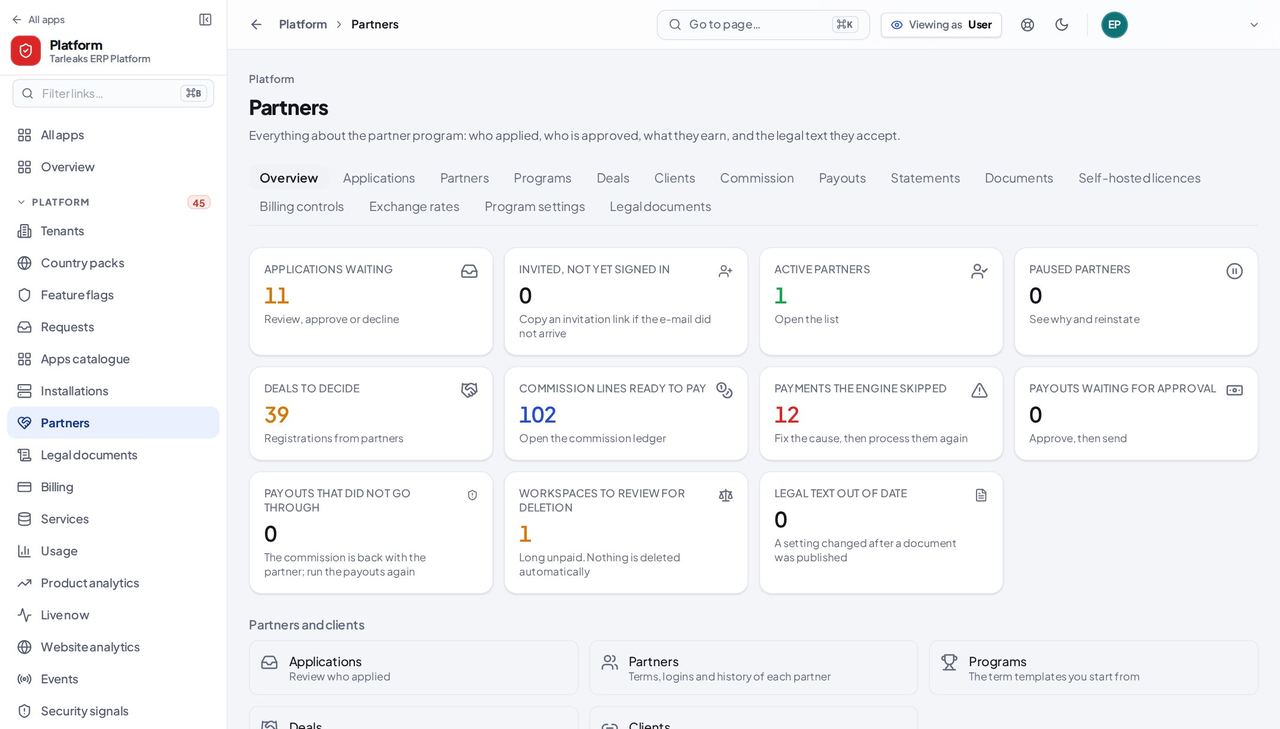
You should see Tiles for what is waiting (applications, deals to decide, payouts waiting for approval, payouts that did not go through, legal text out of date) and below them a link to every page of the program, grouped by Partners and clients, Commission and payouts, Invoicing and collection, and Rules and wording.
Watch out If the page says the partner numbers could not be loaded, check that two-factor sign-in is switched on for your account.
Worth knowing Only a super-administrator who signs in with an authenticator reaches these pages.
Applications #
Where Platform » Partners » Applications
- In the Platform menu, choose Partners.
- Choose Applications.
- Type the organisation, the contact or the e-mail in the search box.
- Click the organisation's name. The application opens on the right.
- Press Approve, Decline or Mark as duplicate.
| Field | What to put in it |
|---|---|
| Name shown to clients | Filled from the application. What clients and the partner's people read. |
| Legal name | The registered name, for documents. |
| Owner's name | The person who runs the partnership for them. |
| Owner's e-mail | The invitation goes here. It is the owner's sign-in name. |
| Track | Referral, Reseller, Implementation or Technology. |
| Start from the program | A program is a template. You can change any term below for this partner only. |
| Level | Registered or Certified. |
| Founding partner badge | Shown beside the partner's name. |
| Require two-factor sign-in | On by default: the partner's people sign in with an authenticator. |
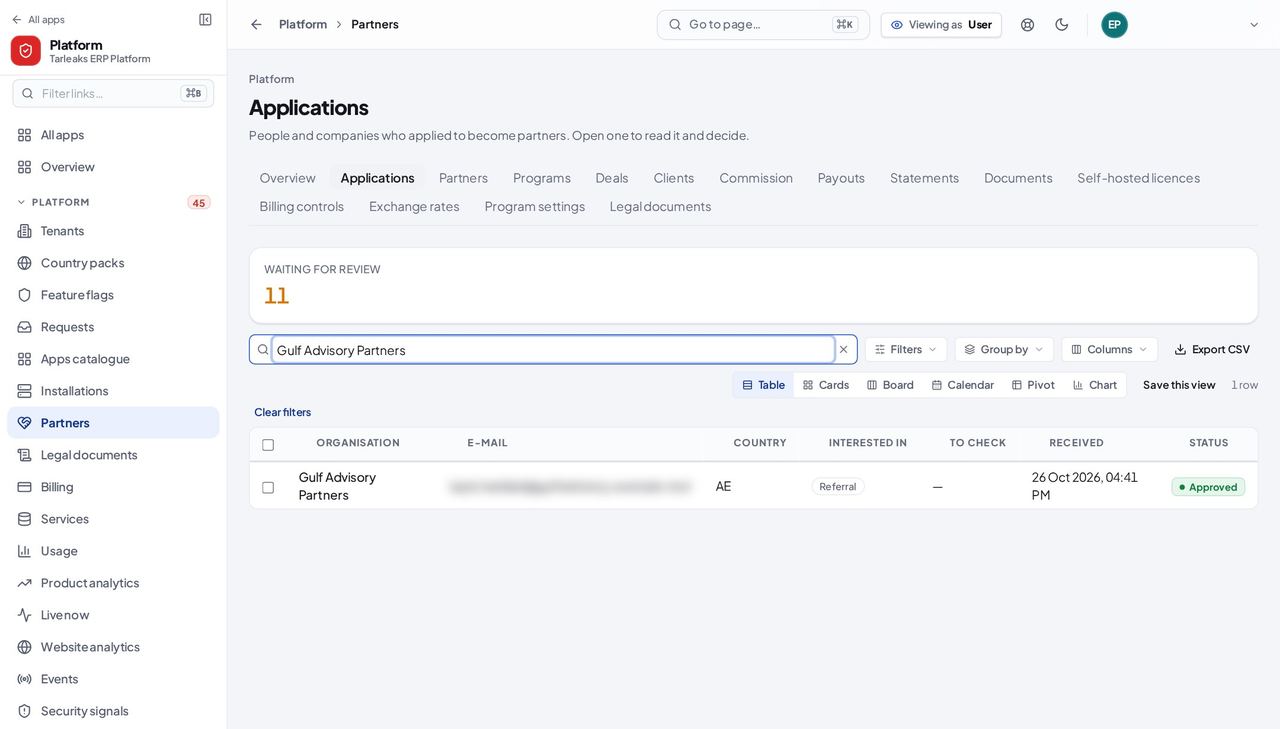
You should see One row per application: the organisation and its contact, the country, what they are interested in, anything To check, when it was received and its status. Applications still waiting for review come first.
Watch out Approve and send invitation creates the partner and e-mails the owner straight away. The terms in the form become the partner's first Schedule A, which the owner accepts at the first sign-in, so read them before you press it.
Partners #
Where Platform » Partners » Partners
- In the Platform menu, choose Partners.
- Choose Partners in the strip of sections.
- Type part of the name, the e-mail, the partner number or the referral code.
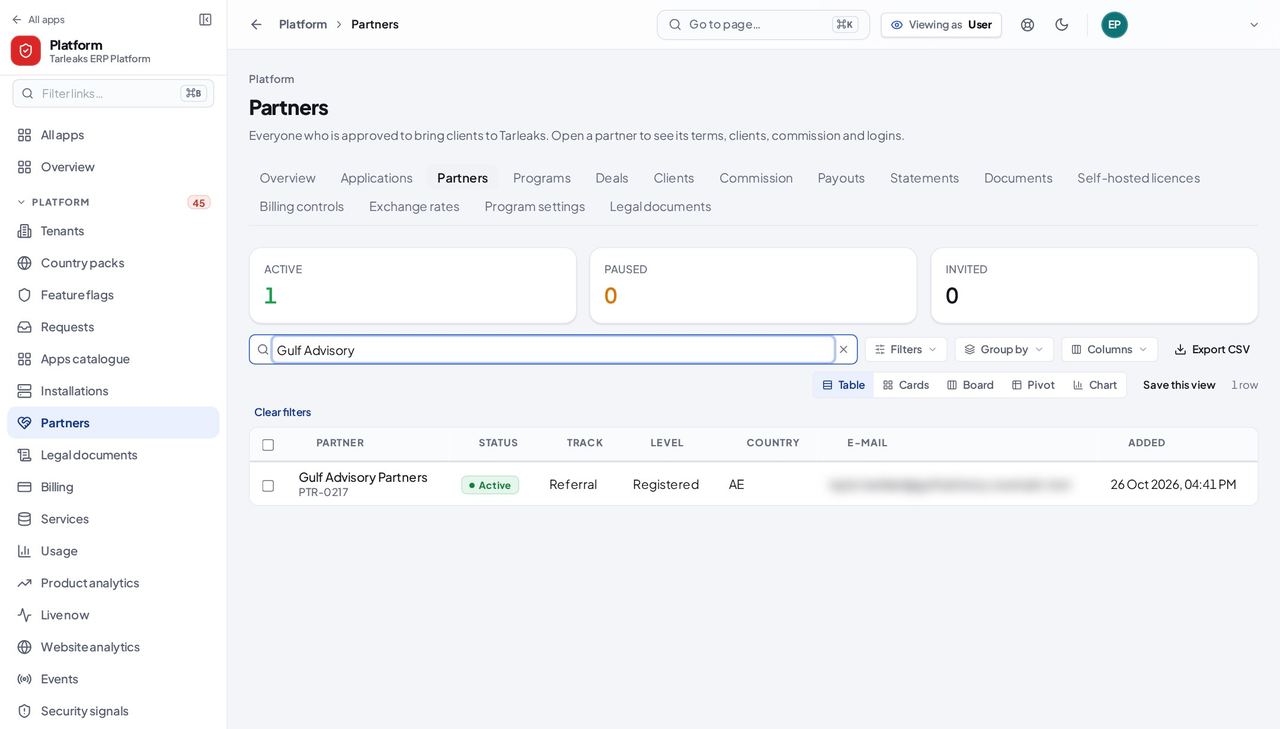
You should see Each partner with its number, status, track, level and country. A partner whose payouts are held shows Payouts on hold beside its status.
Watch out Invited means approved but nobody has signed in yet. If the invitation never arrived, open the partner and copy a fresh invitation link from Logins.
Worth knowing A partner is never created on this page: it appears when you approve an application.
One partner #
Where Platform » Partners » Partners » a partner
- In the Platform menu, choose Partners.
- In the strip of sections under the title, choose Partners.
- Type part of the partner's name in the search box and click the partner's name.
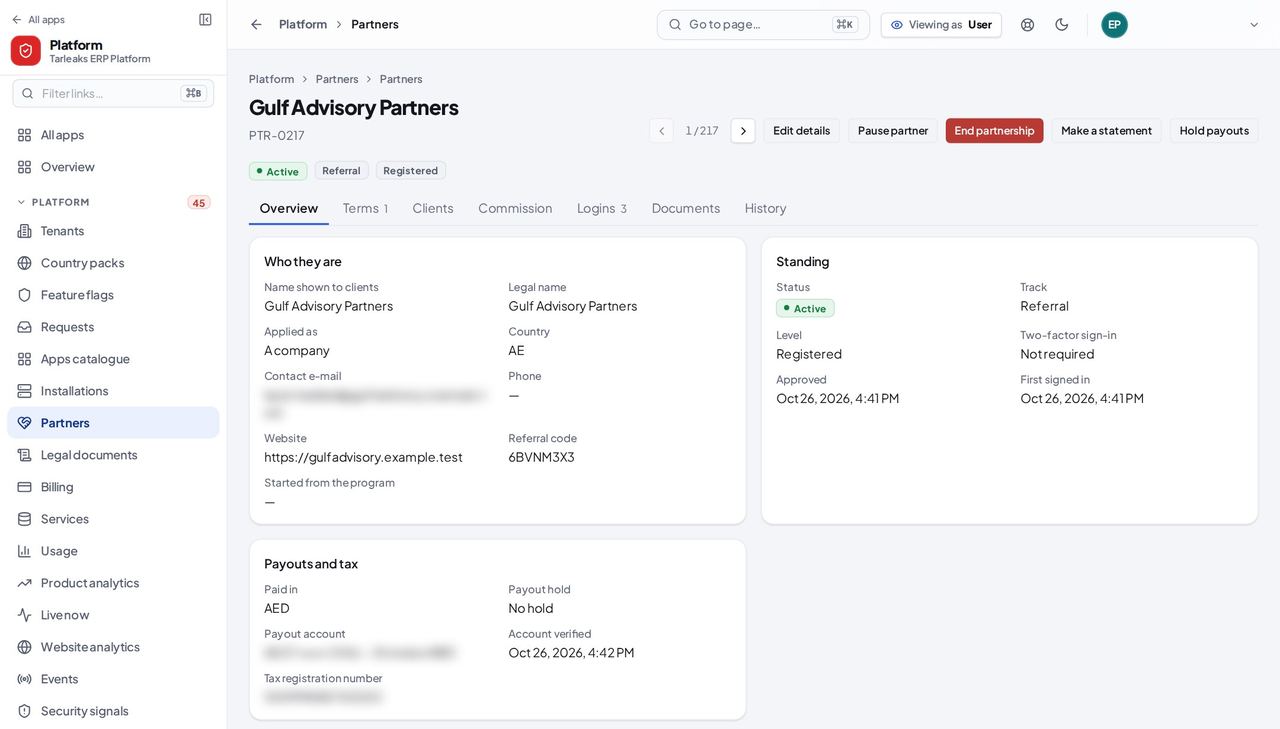
You should see The header shows the status, track and level. Across the top are the actions you may take: Edit details, Pause partner, End partnership, Make a statement and Hold payouts. The Overview ends with the terms that apply now.
Watch out Hold payouts stops payouts for this partner only; its commission keeps adding up until you release the hold. Pause partner also stops its people signing in. Both ask for a reason, and the partner's owners are told.
Commission terms #
Where Platform » Partners » Partners » a partner » Terms
- In the Platform menu, choose Partners.
- In the strip of sections under the title, choose Partners.
- Type part of the partner's name in the search box and click the partner's name.
- Click the Terms tab.
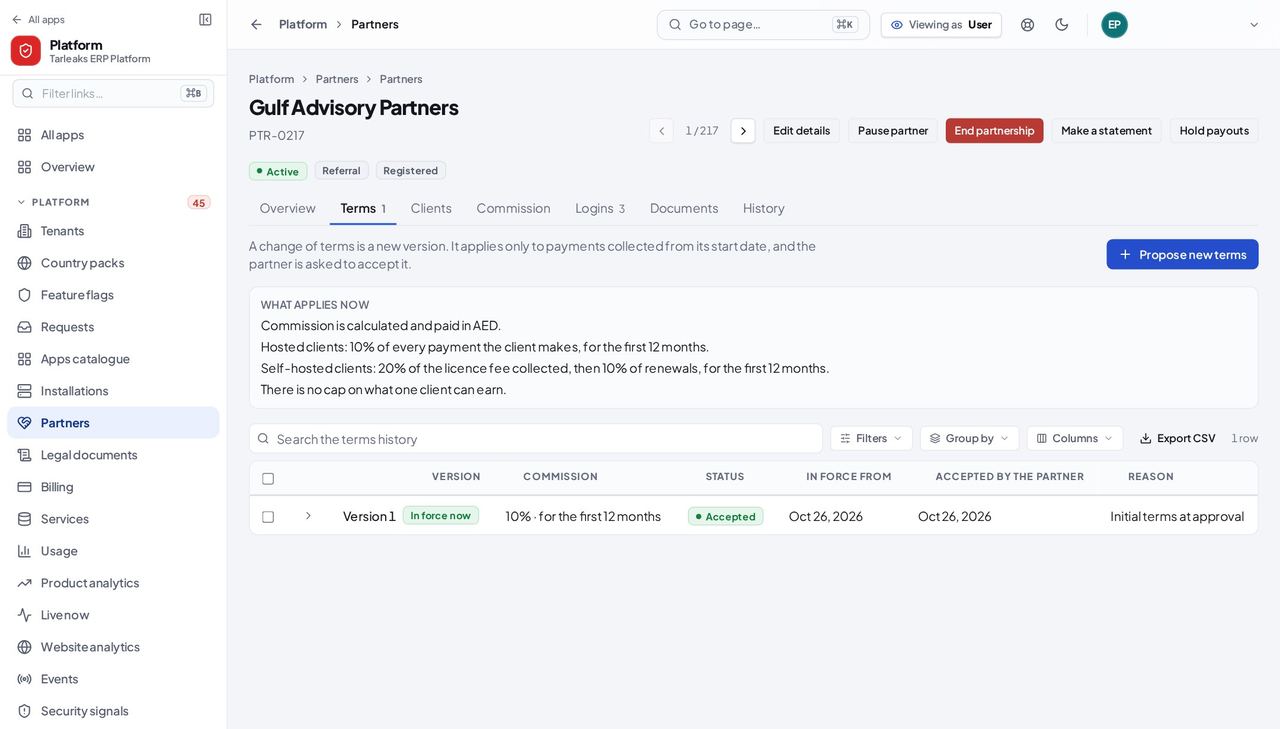
You should see The partner's Schedule A in plain words: the currency, what it earns on hosted clients, what it earns on self-hosted clients, and any cap. Each version shows its status, the day it is in force from and when the partner accepted it.
Watch out A change is never made in place: Propose new terms makes a new version that starts after the notice period (Notice for changed terms in Program settings), unless the partner agreed in writing to start earlier. Only one proposal can wait for the partner at a time.
Worth knowing To change the terms, press Propose new terms. The partner is asked to accept the new version, and it applies only to payments collected from its start date.
People and sign-ins #
Where Platform » Partners » Partners » a partner » Logins
- In the Platform menu, choose Partners.
- In the strip of sections under the title, choose Partners.
- Type part of the partner's name in the search box and click the partner's name.
- Click the Logins tab.
- Click ⋯ at the end of a person's row for the actions.
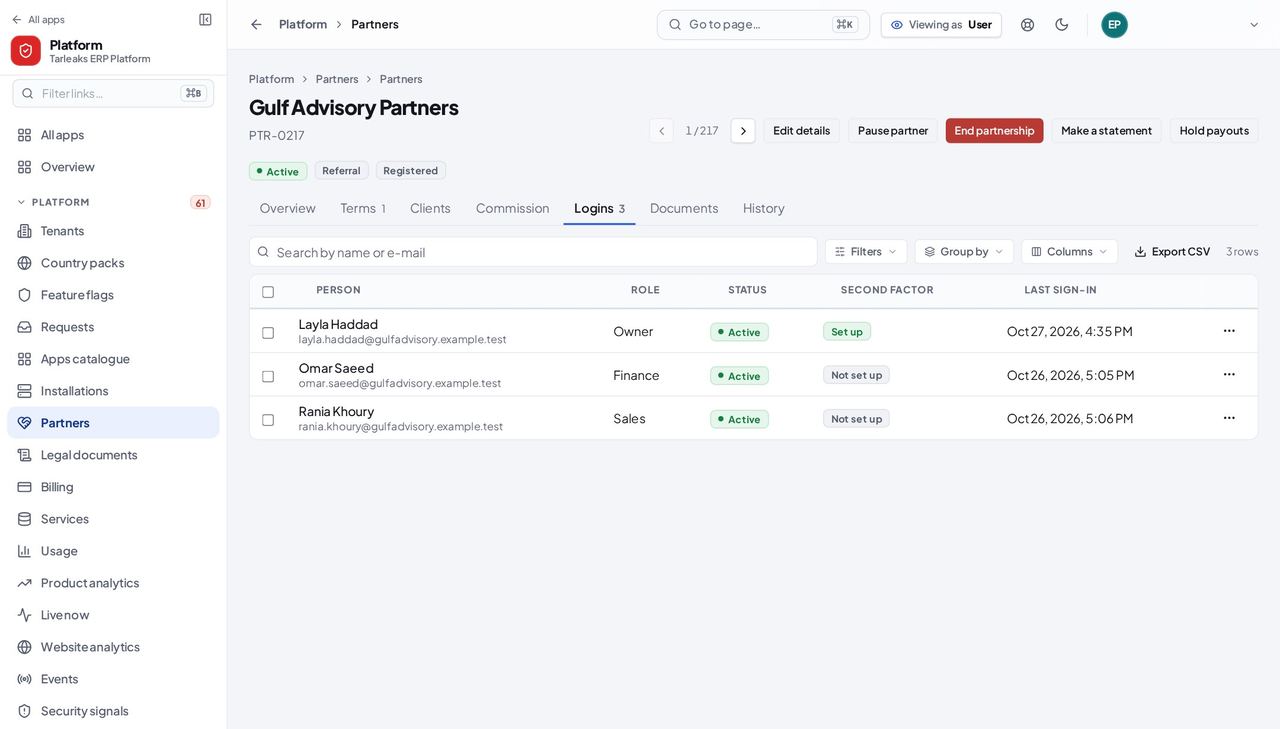
You should see Everyone who signs in for the partner, with their role (Owner, Finance or Sales), whether their login is active, whether a second factor is set up, and their last sign-in. The ⋯ menu offers Copy invitation link, Disable this login, Reset the second factor and Sign out everywhere.
Watch out Copy invitation link makes a new one-time link and the earlier link stops working: send it to the person yourself. Reset the second factor only after you have checked who is asking.
History #
Where Platform » Partners » Partners » a partner » History
- In the Platform menu, choose Partners.
- In the strip of sections under the title, choose Partners.
- Type part of the partner's name in the search box and click the partner's name.
- Click the History tab.
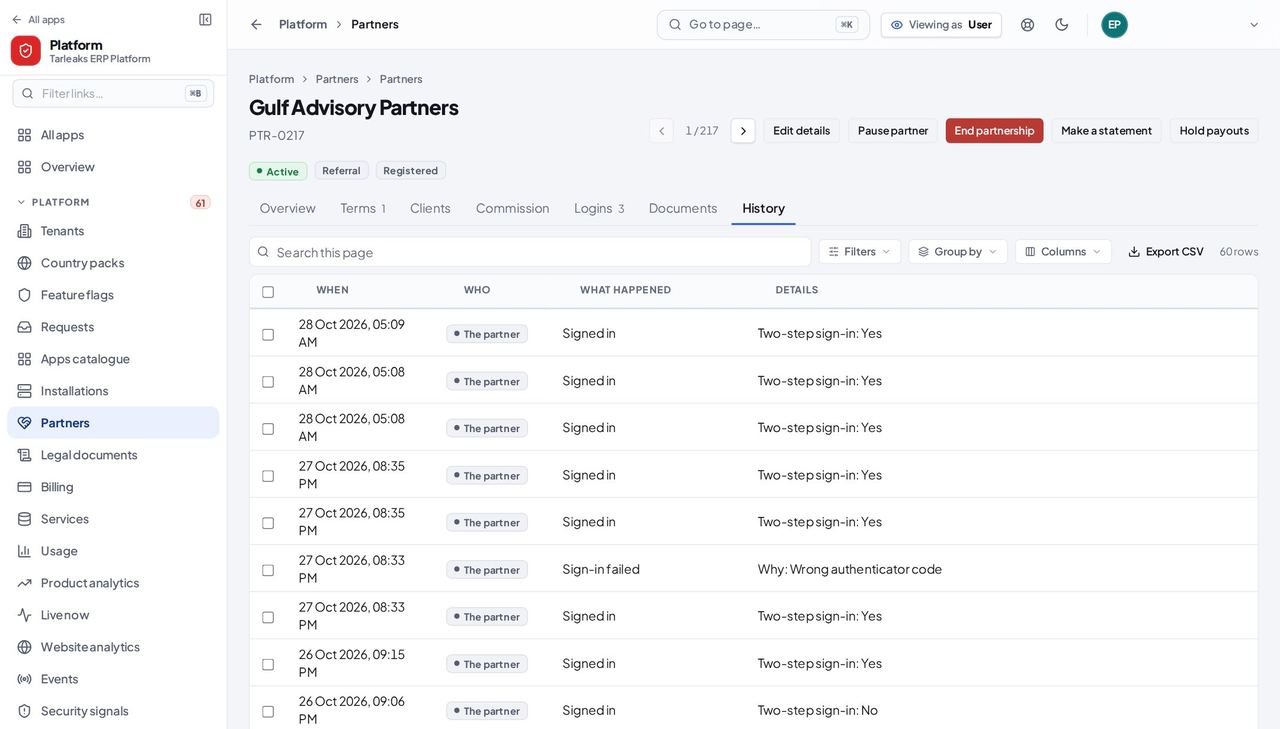
You should see Every change to the partner, newest first: when, who (the Tarleaks team, the partner or the system), what happened in words, and the details, the reason first.
Watch out The history cannot be edited or deleted. It names the kind of actor, not the person: to see which of your colleagues made a change, use the platform's audit log.
Programs #
Where Platform » Partners » Programs
- In the Platform menu, choose Partners.
- Choose Programs in the strip of sections.
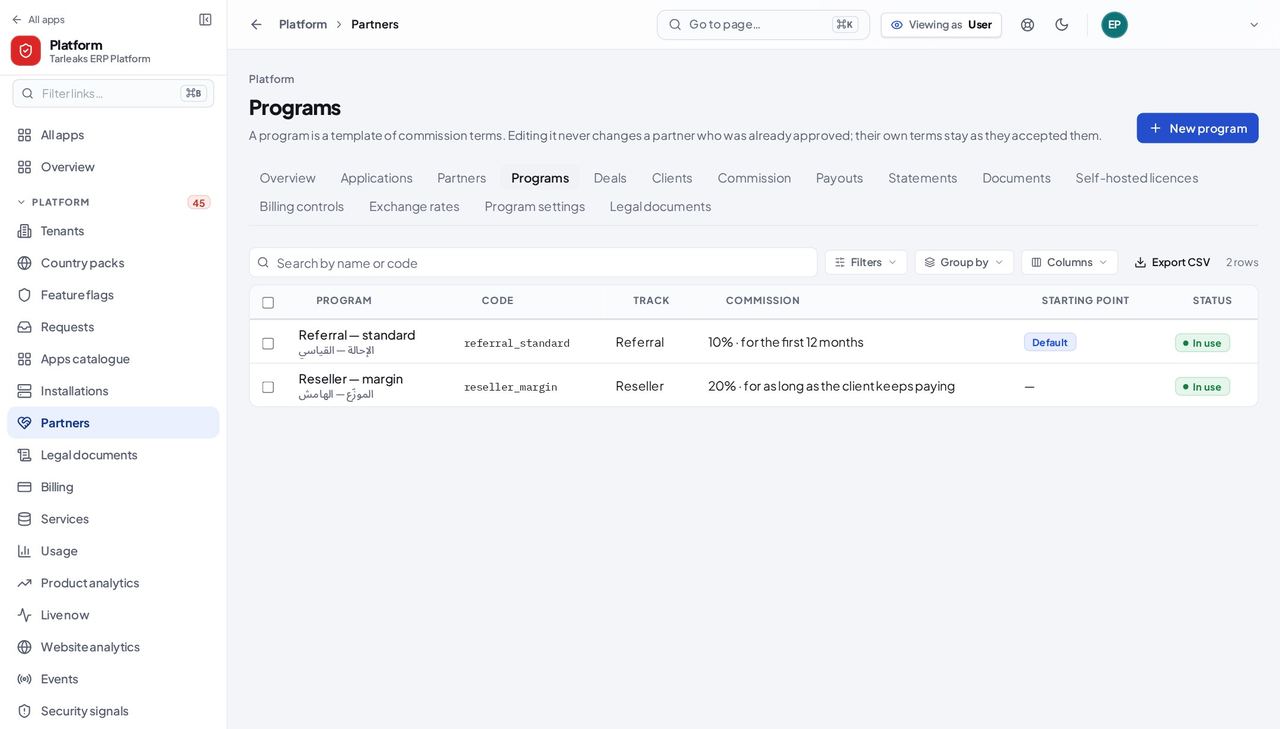
You should see The templates of commission terms you start from when you approve a partner: each program's name in English and Arabic, its code, track, commission, and whether it is the starting point for its track.
Watch out Changing a program only changes partners approved from it afterwards. To change an existing partner's commission, propose new terms on that partner's Terms tab.
Worth knowing Editing a program never changes a partner already approved: their own terms stay as they accepted them.
Deals #
Where Platform » Partners » Deals
- In the Platform menu, choose Partners.
- Choose Deals in the strip of sections.
- Type the prospect's or the partner's name in the search box.
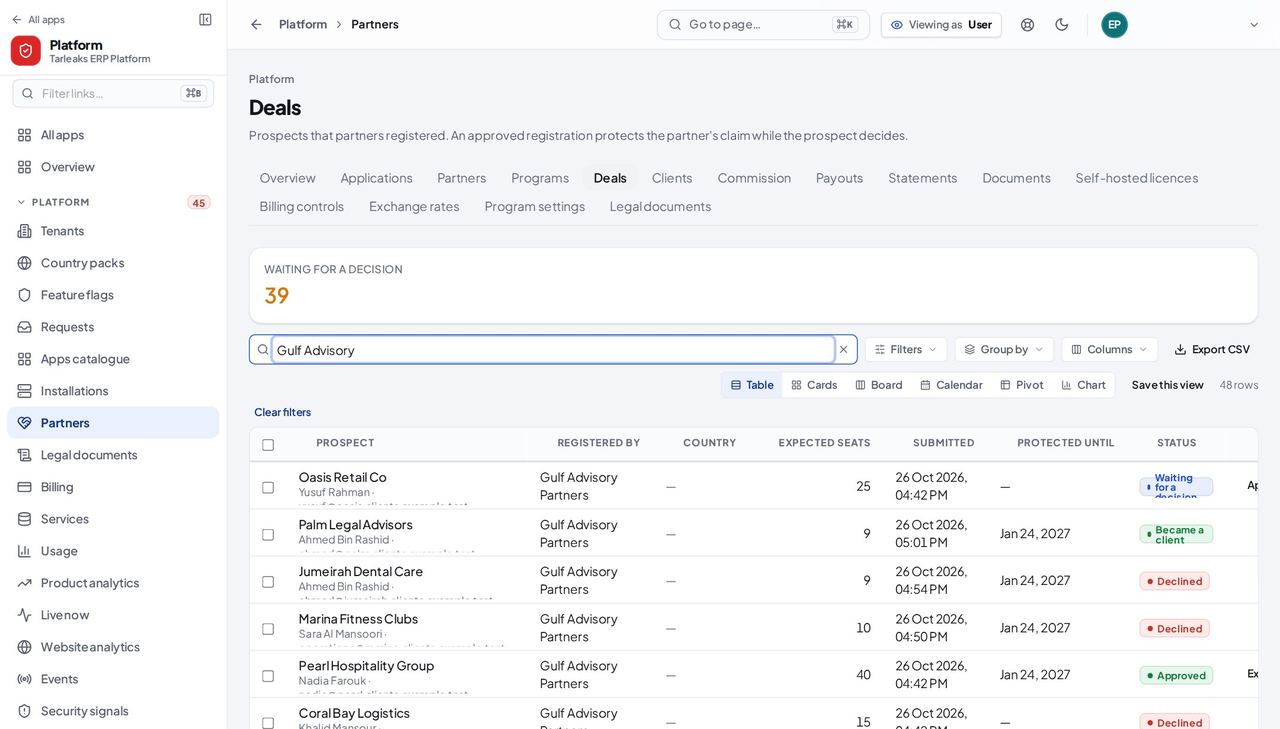
You should see Each prospect a partner registered: who registered it, the country, the expected seats, when it was submitted, how long the partner is protected and its status. Registrations waiting for a decision come first.
Watch out The search looks only at the page of deals already loaded. An approved registration protects the partner's claim for the Deal registration validity in Program settings, and the partner reads your reason when you decline.
Clients and who they are credited to #
Where Platform » Partners » Clients
- In the Platform menu, choose Partners.
- Choose Clients in the strip of sections.
- Type the client's or the partner's name in the search box.
- To credit a client, press Credit a client to a partner; to move one, press Change partner on its row.
| Field | What to put in it |
|---|---|
| Partner | The partner to credit. Left empty when changing, it ends the credit without naming another partner. |
| Kind of client | A hosted workspace or a self-hosted installation. |
| Client | Choose it by name. |
| Effective from | Commission on payments from this day on goes to the new partner. |
| Reason | For example: the client's written nomination of this partner. It stays on the record. |
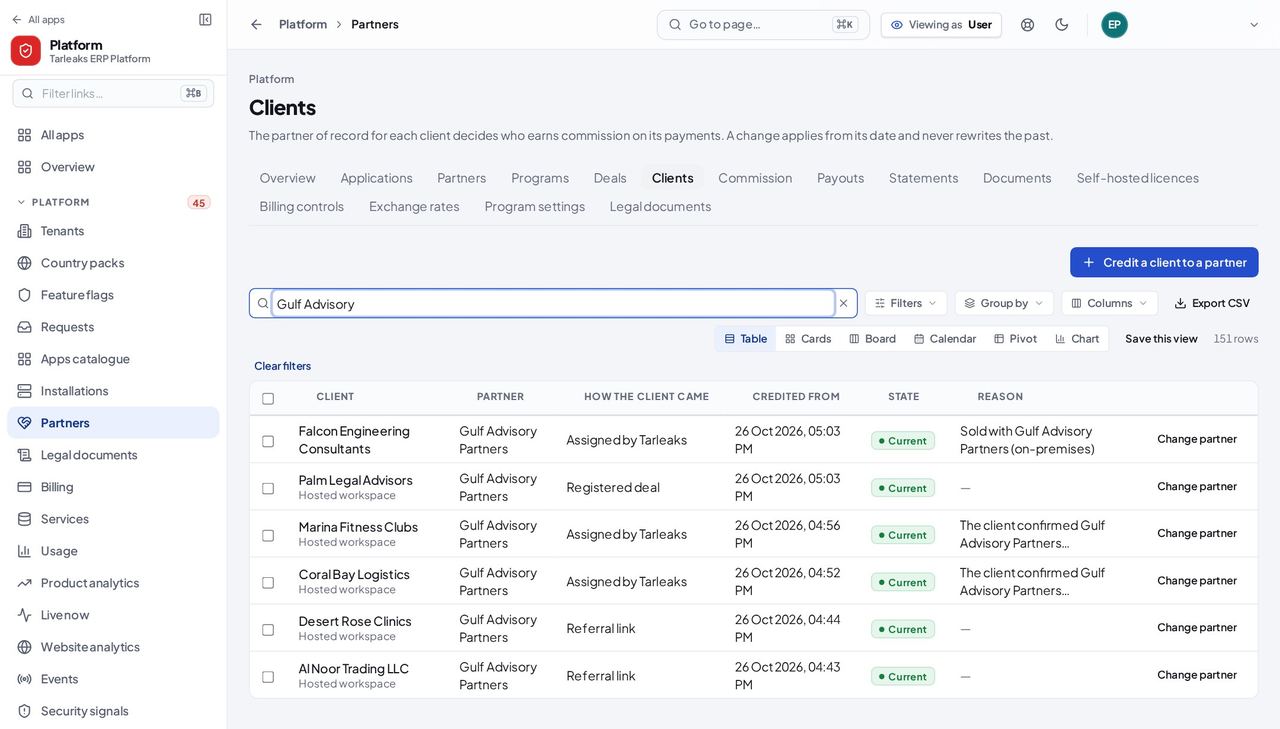
You should see Each client, whether it is a hosted workspace or a self-hosted installation, the partner it is credited to, how the client came (Referral link, Registered deal or Assigned by Tarleaks), the day the credit starts and whether it is current.
Watch out A change applies from its date and never rewrites the past: commission already earned stays with the partner who earned it.
The commission ledger #
Where Platform » Partners » Commission
- In the Platform menu, choose Partners.
- Choose Commission in the strip of sections.
- Type the partner's or the client's name in the search box.
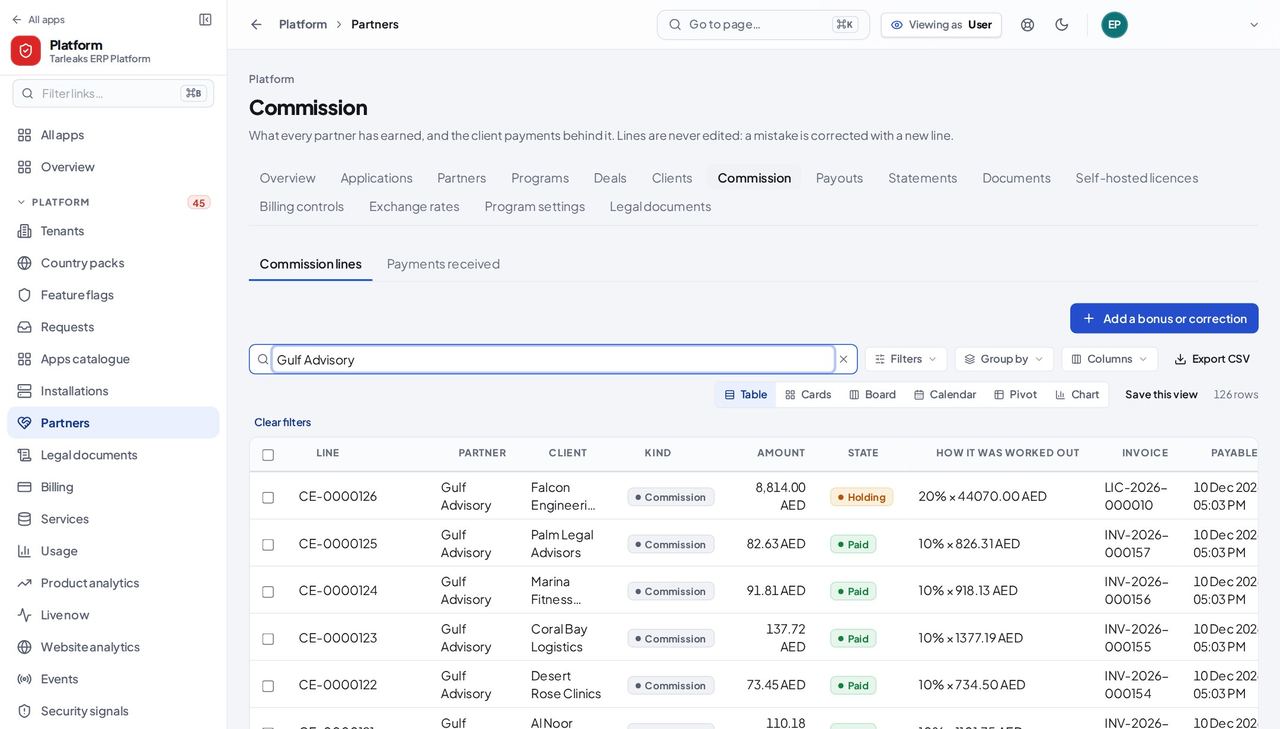
You should see Every commission line: the partner, the line number, the client, the kind, the amount, its state (Holding, Ready to pay, In a payout, Paid) and how it was worked out.
Watch out Lines are never edited. A new line is Holding until the holding period after the client's payment ends, then Ready to pay. A mistake is corrected with a new line: press Add a bonus or correction and give the reason.
Worth knowing The Payments received tab lists the client payments behind the lines, including any the engine skipped.
The payout desk #
Where Platform » Partners » Payouts
- In the Platform menu, choose Partners.
- Choose Payouts in the strip of sections.
- Type the partner's name in the search box, or choose the partner in Any partner.
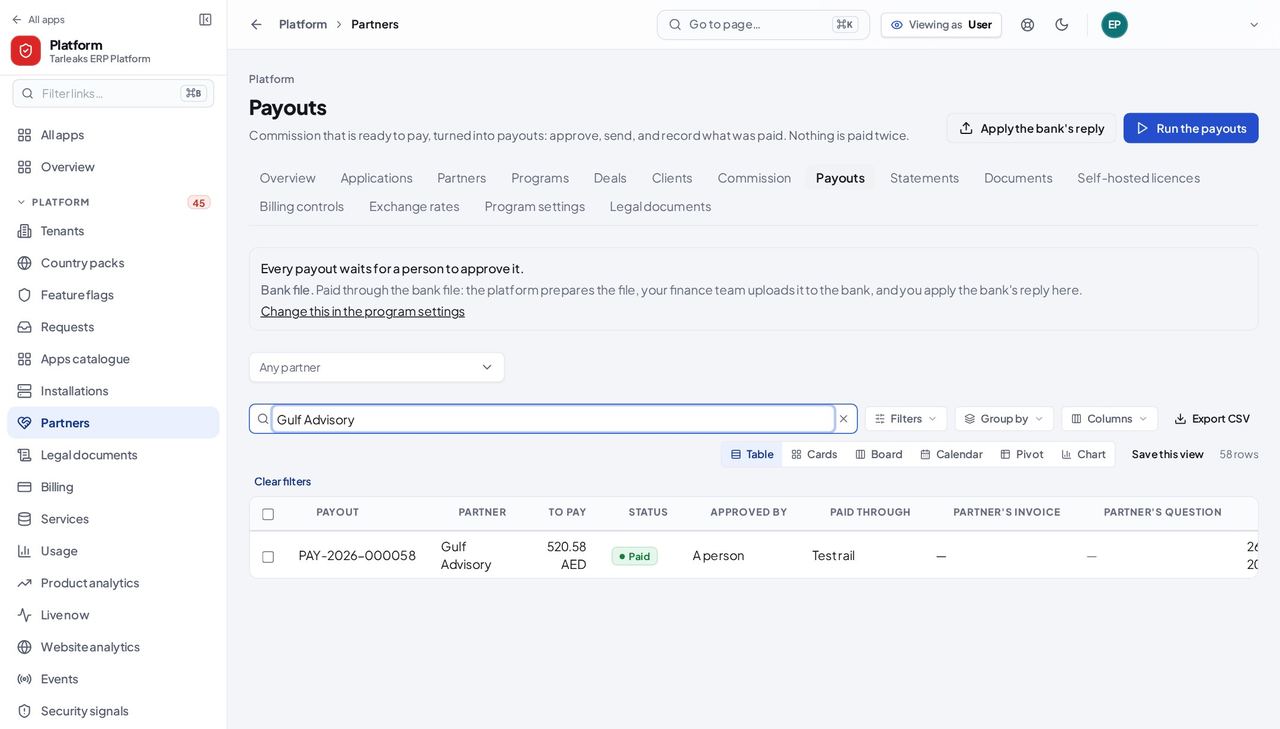
You should see Each payout with the partner, the amount to pay, its status, who approved it and what it was paid through. A payout that is waiting shows its next step on its row: Approve, then Send.
Watch out The Test rail (sandbox) moves no money: it is for testing only. A payout waits for the partner's own invoice when the partner has no self-billing consent; with consent, the platform issues the self-billed invoice and the payout waits for approval. Nothing is paid twice.
Statements #
Where Platform » Partners » Statements
- In the Platform menu, choose Partners.
- Choose Statements in the strip of sections.
- Type the partner's name or the statement's number in the search box.
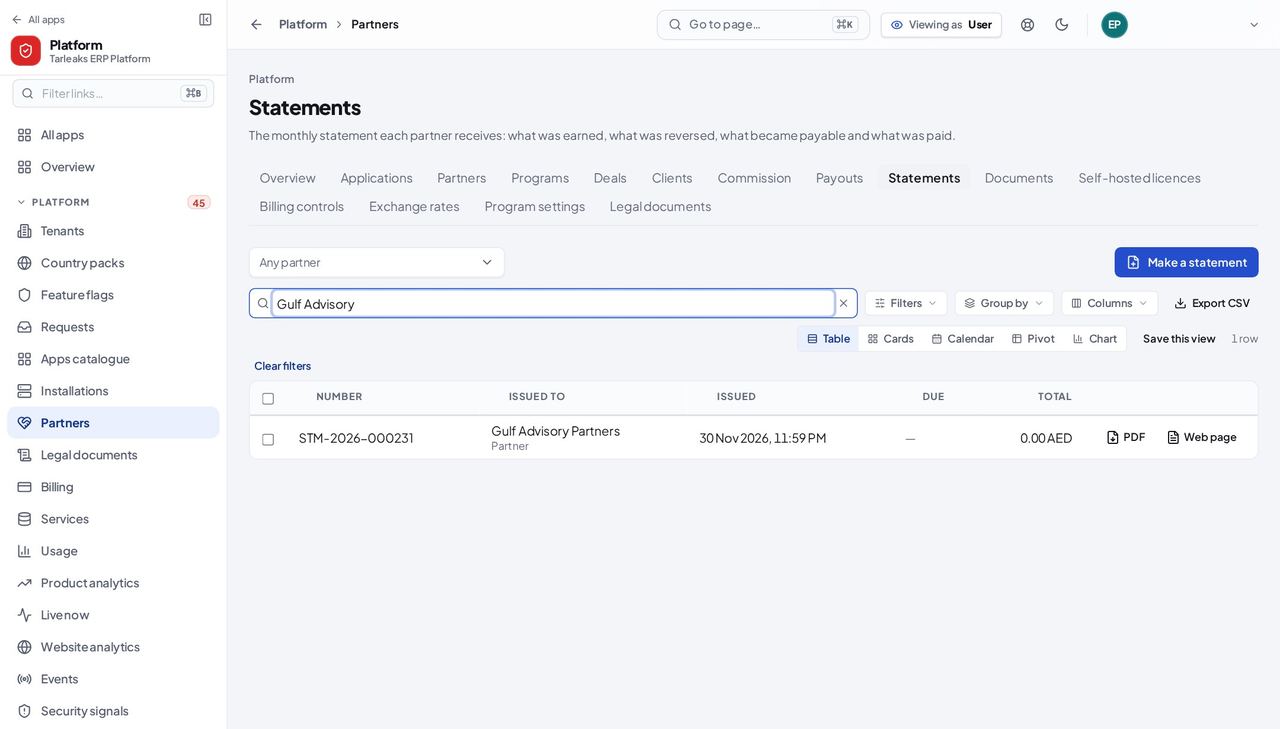
You should see Each partner's monthly statements, with their numbers, the partner they were issued to and the day they were issued.
Watch out A statement is never changed once made. The partner has the Time to question a statement in Program settings to raise a question about it.
Worth knowing Statements are made automatically on the 1st of each month for the month before. Make a statement makes one now; asking twice for the same month gives the same statement.
Documents #
Where Platform » Partners » Documents
- In the Platform menu, choose Partners.
- Choose Documents in the strip of sections.
- Type a number or a name in the search box, or choose a partner in Any partner.
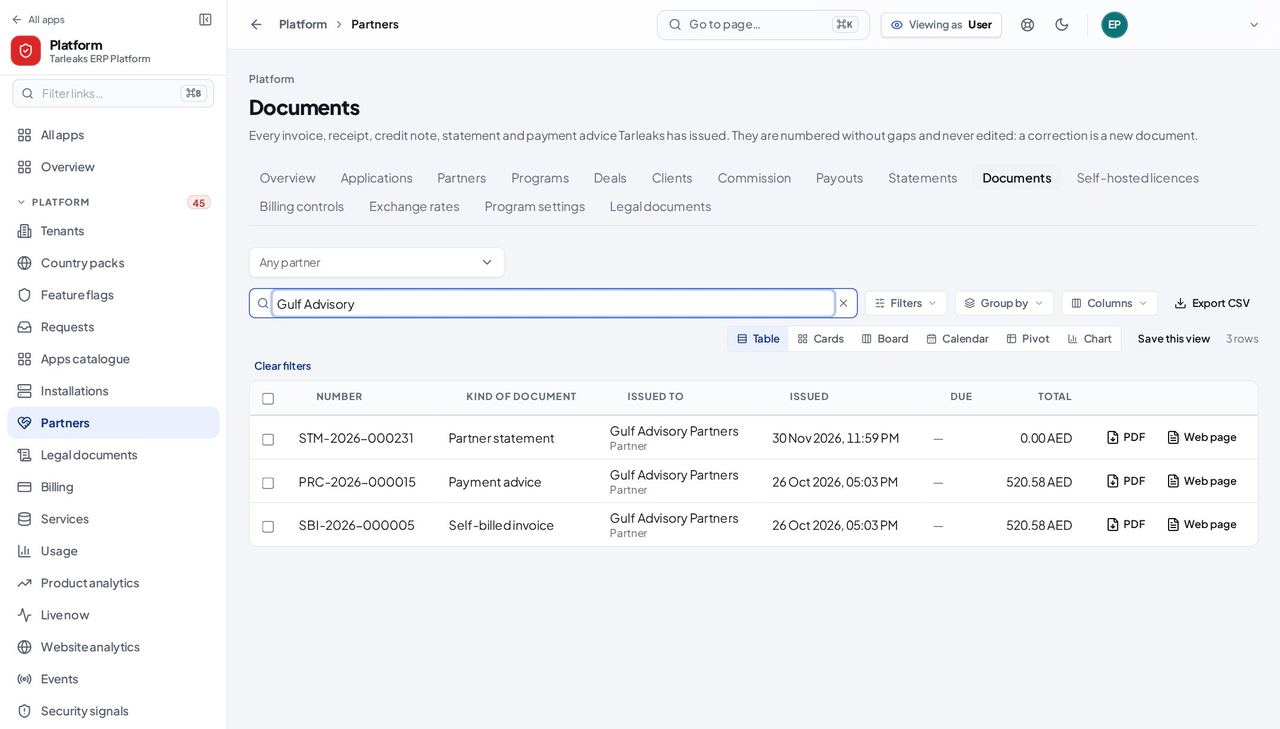
You should see Every invoice, receipt, credit note, statement, self-billed invoice and payment advice the program issued: its number, the kind of document, who it was issued to, the dates and the amounts before and after VAT.
Watch out Documents are numbered without gaps and never edited: a correction is a new document, such as a credit note.
Self-hosted licences #
Where Platform » Partners » Self-hosted licences
- In the Platform menu, choose Partners.
- Choose Self-hosted licences in the strip of sections.
- Type the customer's name in the search box.
- Press Issue a licence invoice for a new invoice.
| Field | What to put in it |
|---|---|
| Customer | The self-hosted customer, chosen by name. |
| What is it for? | New licence, Renewal, Maintenance, Extra seats or Upgrade. |
| Description | Optional. It is printed on the invoice. |
| Covers from / Covers until | The licence period. The end must be on or after the start. |
| Amount before VAT | Above zero, at most two decimals. |
| Currency | Optional, for example USD. Left empty, the platform's usual currency is used. |
| VAT rate (%) | Optional. 5 means five percent; empty follows the customer's country. |
| Payment due on | Optional. The platform's usual payment term applies if empty. |
| Customer's tax number / Customer's address | Optional. Printed on the invoice. |
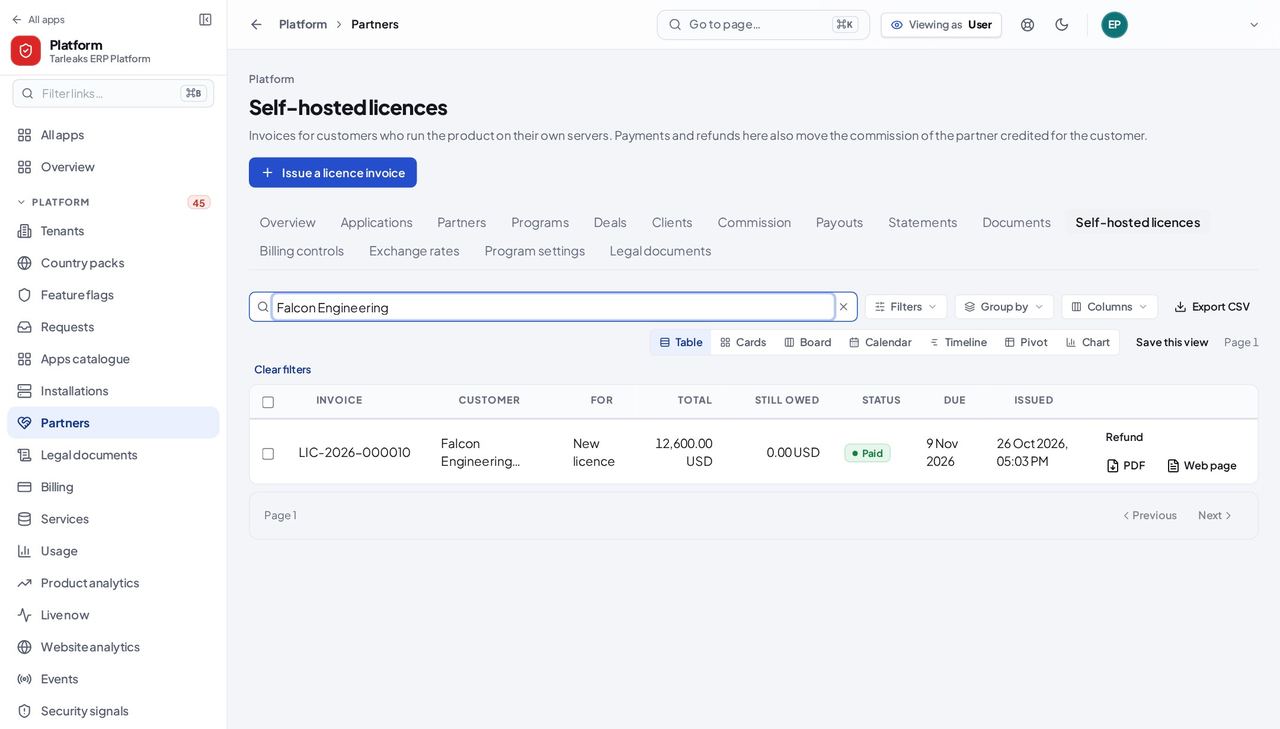
You should see Licence invoices for customers who run the product on their own servers: the invoice, the customer, what it is for, the total, what is still owed, its status and the receipts for its payments.
Watch out The invoice is numbered and its document made the moment you press Issue the invoice. If a partner is credited for the customer, it earns commission once the invoice is paid, and a refund reverses it.
Worth knowing A payment recorded here also moves the commission of the partner credited for the customer.
Exchange rates #
Where Platform » Partners » Exchange rates
- In the Platform menu, choose Partners.
- Choose Exchange rates in the strip of sections.
| Field | What to put in it |
|---|---|
| From currency / To currency | Three letters each, for example USD and AED. |
| How many units of the second currency for one of the first | The rate. |
| In force from | The first day the rate applies. |
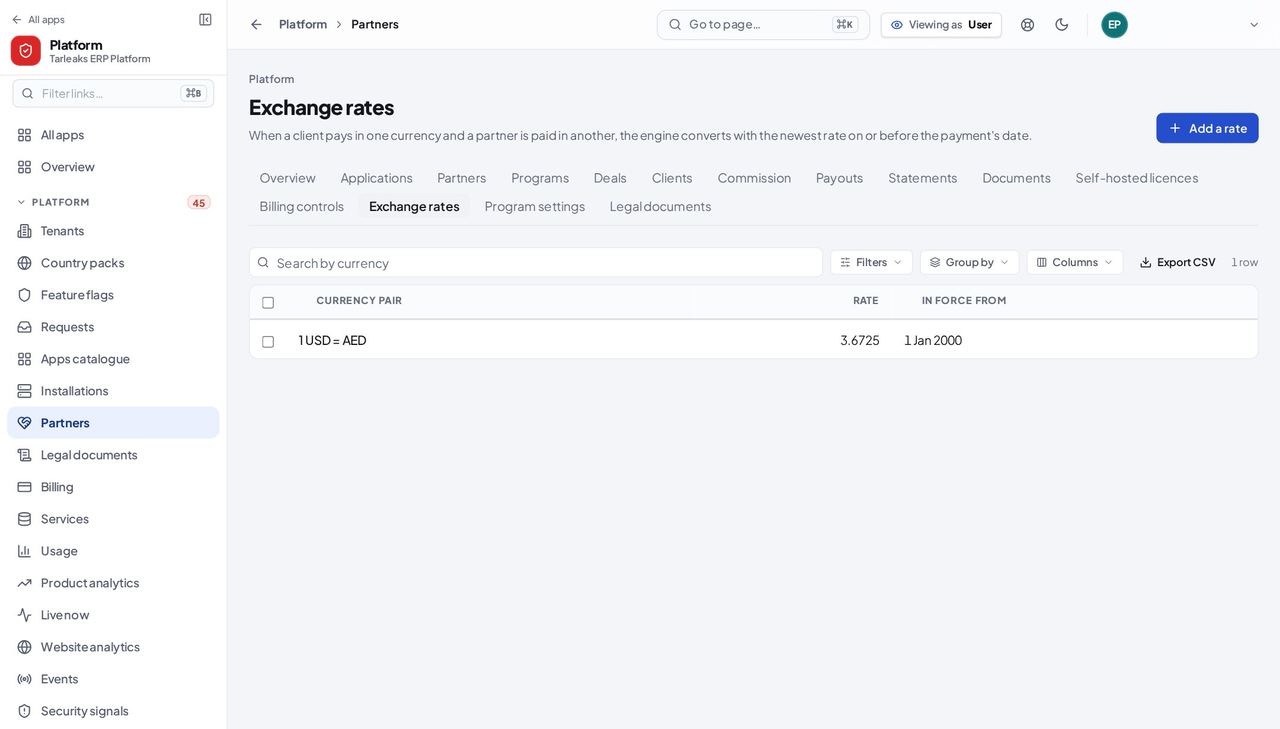
You should see Each currency pair, its rate and the day it is in force from. When a client pays in one currency and the partner is paid in another, the newest rate on or before the payment's date is used.
Watch out A rate is used for payments on or after its day. A commission that needs a missing rate is skipped and appears under Payments received on the Commission page until the rate is added.
Program settings #
Where Platform » Partners » Program settings
- In the Platform menu, choose Partners.
- Choose Program settings in the strip of sections.
- Type part of a setting's name in Find a setting.
| Field | What to put in it |
|---|---|
| Holding period (days) | Commission becomes payable this many days after the client's payment. 45 by default. |
| Clawback window (days) | A refund inside this window reverses the related commission. 120 by default. |
| Minimum payout | Smaller balances roll over to the next payout, in the payout currency. |
| Payout mode | approval: a person approves each payout. auto: payouts under the cap are approved by the platform. |
| Payout provider | bank_batch: a bank file. manual: paid elsewhere and recorded here. sandbox: tests only, no money. |
| Auto-approval cap (per payout) | In auto mode, larger payouts wait for a person. |
| Allow self-billing | Tarleaks may issue the partner's tax invoice when the partner consents and is VAT-registered. |
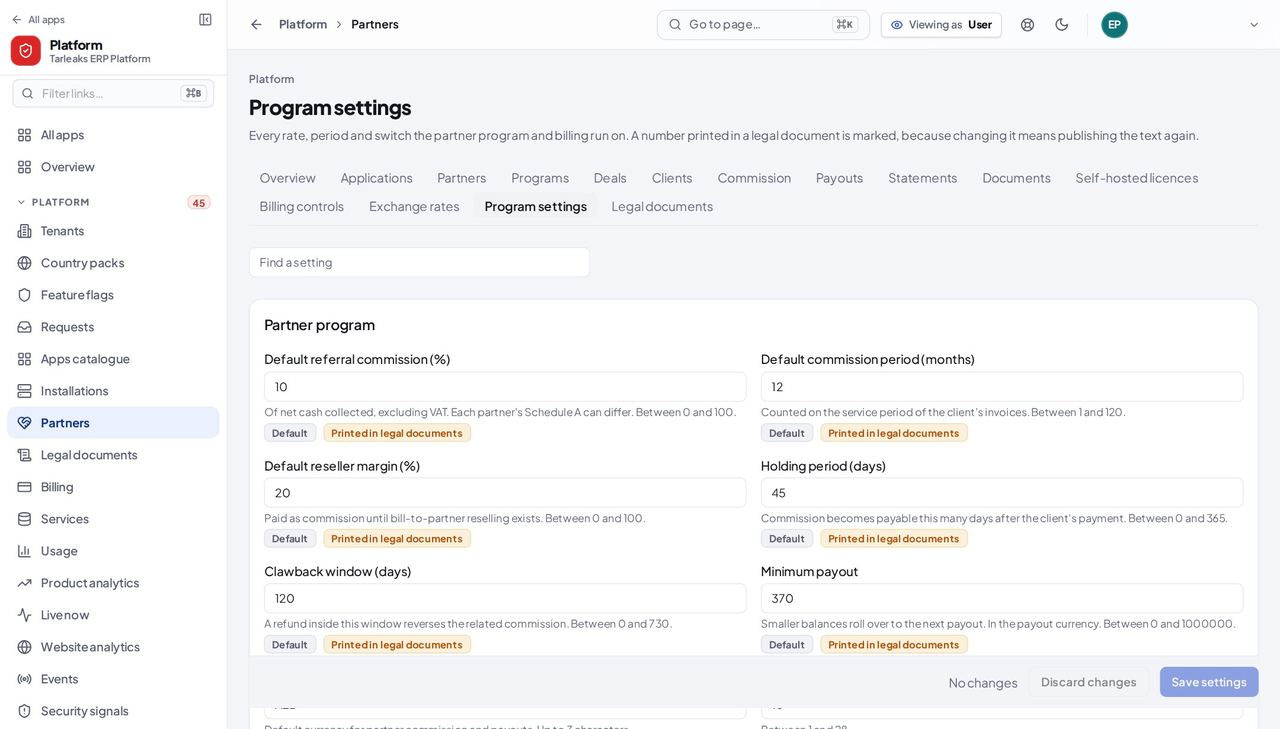
You should see Every rate, period and switch the program runs on, in groups: Partner program, Payouts, Billing and the grace period, Legal documents and sign-up, and Company details on documents. Each setting says what it does and its allowed range, and shows Default or Changed from the default.
Watch out Changes wait at the bottom until you press Save settings. A setting marked Printed in legal documents is quoted in a published text; after changing it, publish that text again.
Worth knowing A setting marked Printed in legal documents appears in a published text: changing it means publishing that text again.
Legal documents #
Where Platform » Legal documents
- In the Platform menu, choose Legal documents.
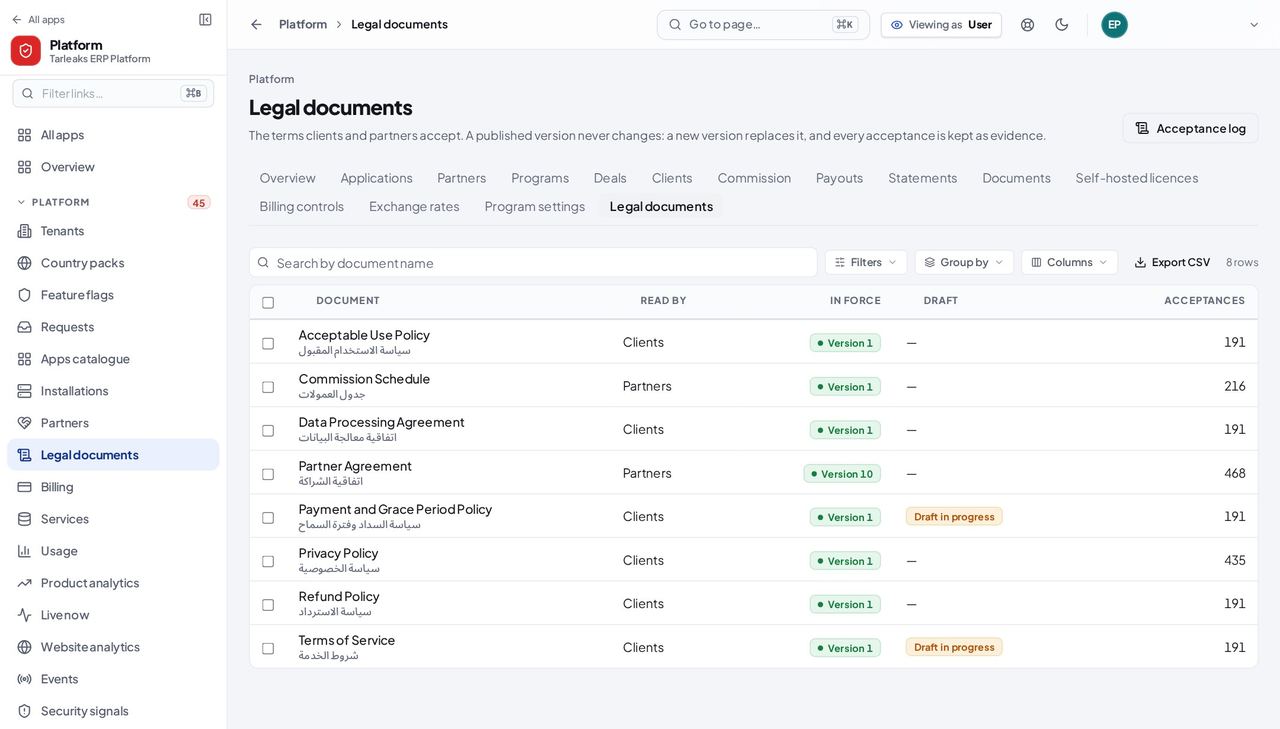
You should see The agreement and the policies clients and partners accept: who reads each one, the version in force, whether a draft is in progress, and how many acceptances it has.
Watch out A published version is never edited: start a new draft, then publish it as the next version. Whether people must accept it again is decided when you publish.
Worth knowing A published version never changes. A new version replaces it, and every acceptance of the old one is kept.
Who accepted what #
Where Platform » Legal documents » Acceptance log
- In the Platform menu, choose Legal documents.
- Press Acceptance log at the top right.
- Narrow the log with Any document, E-mail contains…, Any partner or Any workspace.
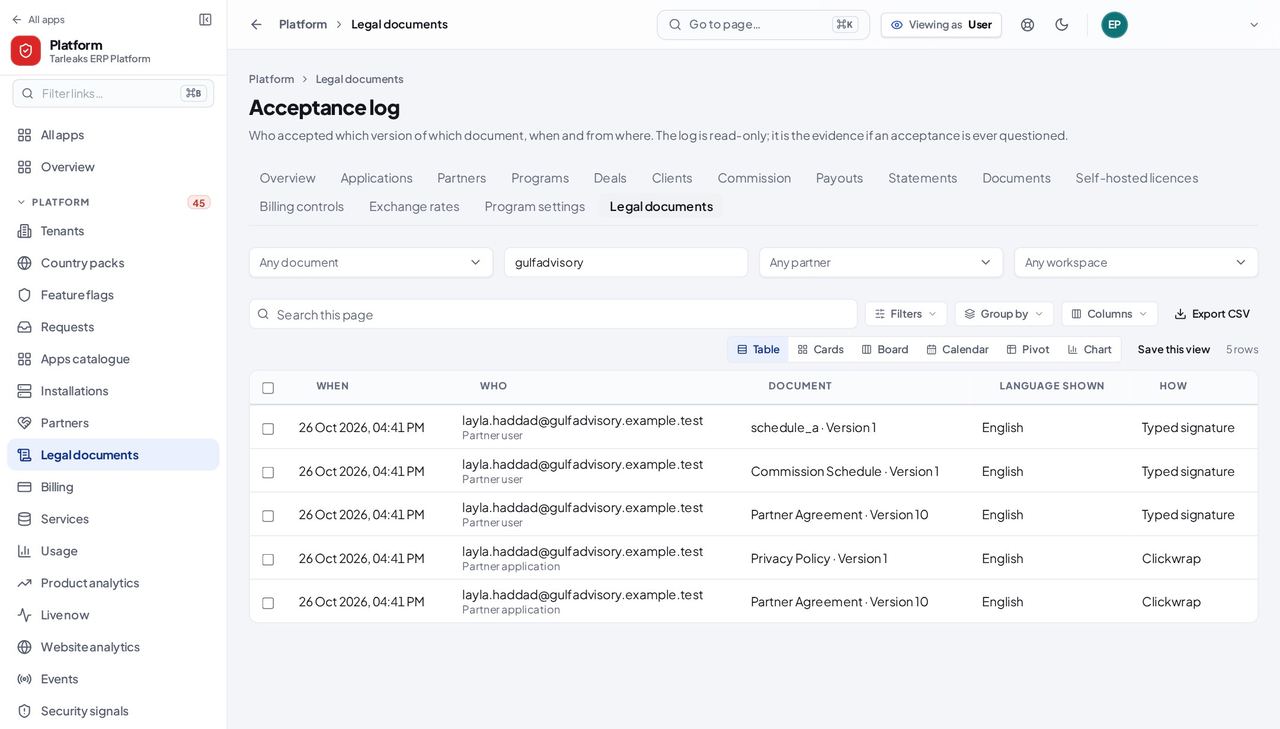
You should see Every acceptance: when, who, which document and version, the language it was shown in and how it was accepted. The log is read-only; it is the evidence if an acceptance is ever questioned.
Watch out The log is read-only. The text fingerprint proves which exact text was accepted, even after a newer version is published.
Use cases — the work, step by step
Each one is a sequence somebody actually performs, with the screen behind every step. Every screen here was opened in the product as this role before it was published.
on the 15thPay the month's commission #
The payout run collects every partner's payable lines. In approval mode nothing is sent until you approve it; a partner without self-billing consent first sends its own invoice.
Open the payout desk: read the rail, the mode and the month's payouts.
Platform » Partners » Payouts — verified: the control is offered; the control is offered; the page says “Gulf Advisory Partners”; the page says “Paid through”; the page says “Test rail”; the control is offered; the action is not offered to this role Check a partner's lines on the ledger before approving.
Platform » Partners » Commission — verified: the control is offered; the control is offered; the page says “Gulf Advisory Partners”; the page says “Al Noor Trading LLC”; the page says “How it was worked out”; the action is not offered to this role After sending, the documents are issued for each payout.
Platform » Partners » Documents — verified: the control is offered; the page says “Gulf Advisory Partners”; the page says “Kind of document”; the page says “Self-billed invoice”; the action is not offered to this role
for each applicationApprove a new partner #
The terms you choose at approval become the partner's Schedule A; the partner accepts them with the agreement before it can earn.
Read the application.
Platform » Partners » Applications — verified: the control is offered; the page says “Gulf Advisory Partners”; the page says “Interested in”; the page says “To check”; the action is not offered to this role After approval, the partner's terms are on its record.
Platform » Partners » Partners » a partner » Terms — verified: the control is offered; the control is offered; the page says “What applies now”; the page says “Hosted clients:”; the page says “Self-hosted clients:”; the control is offered; the page says “Accepted by the partner” Its people and their sign-ins are on the Logins tab.
Platform » Partners » Partners » a partner » Logins — verified: the control is offered; the page says “Owner”; the page says “Finance”; the page says “Sales”; 3 row(s) listed; the page says “Second factor”; the page says “Last sign-in”; the action is not offered to this role
Nothing here is edited in place. A change of terms is a new version, a mistake in commission is corrected with a new line, a published legal text is replaced by a new version, and every change is kept with a reason.